
Chapter 11, “Introduction to Three Dimensional Geometry,” extends the coordinate geometry students learned in Class 10 by adding a third axis (the z-axis), allowing us to locate any point in space using an ordered triplet (x, y, z). This chapter covers coordinate axes and planes in 3D, the eight octants, the distance formula, and the section formula − all of which form the foundation for the more advanced 3D geometry (direction cosines, lines and planes) studied in Class 12.
Last Updated: September 23, 2026
Exercise 11.1
Q1. A point is on the x-axis. What are its y-coordinate and z-coordinates? — Any point lying on the x-axis has zero perpendicular distance from both the y-axis and…
Any point lying on the x-axis has zero perpendicular distance from both the y-axis and the z-axis, since the x-axis is the only axis it touches. Therefore, both coordinates must be zero. A general point on the x-axis is written as (x, 0, 0). Hence, the y-coordinate is 0 and the z-coordinate is 0.
Q2. A point is in the XZ-plane. What can you say about its y-coordinate? — The XZ-plane is the plane containing the x-axis and the z-axis, and every point on this…
The XZ-plane is the plane containing the x-axis and the z-axis, and every point on this plane has no displacement along the y-axis. A general point in the XZ-plane is of the form (x, 0, z). Therefore, the y-coordinate of any point in the XZ-plane is 0.
Q3. Name the octant in which each of the following points lie: (1, 2, 3), (4, −2, 3), (4, −2, −5), (4, 2, −5), (−4, 2, −5), (−4, 2, 3), (−4, −2, −5), (−4, −2, 3) — The eight octants are identified by the signs of the (x, y, z) coordinates as follows:…
The eight octants are identified by the signs of the (x, y, z) coordinates as follows: Octant I (+,+,+), Octant II (−,+,+), Octant III (−,−,+), Octant IV (+,−,+), Octant V (+,+,−), Octant VI (−,+,−), Octant VII (−,−,−), Octant VIII (+,−,−). Matching each point to its sign pattern:
(1, 2, 3) → (+,+,+) → Octant I
(4, −2, 3) → (+,−,+) → Octant IV
(4, −2, −5) → (+,−,−) → Octant VIII
(4, 2, −5) → (+,+,−) → Octant V
(−4, 2, −5) → (−,+,−) → Octant VI
(−4, 2, 3) → (−,+,+) → Octant II
(−4, −2, −5) → (−,−,−) → Octant VII
(−4, −2, 3) → (−,−,+) → Octant III
The points lie in Octants I, IV, VIII, V, VI, II, VII and III respectively.
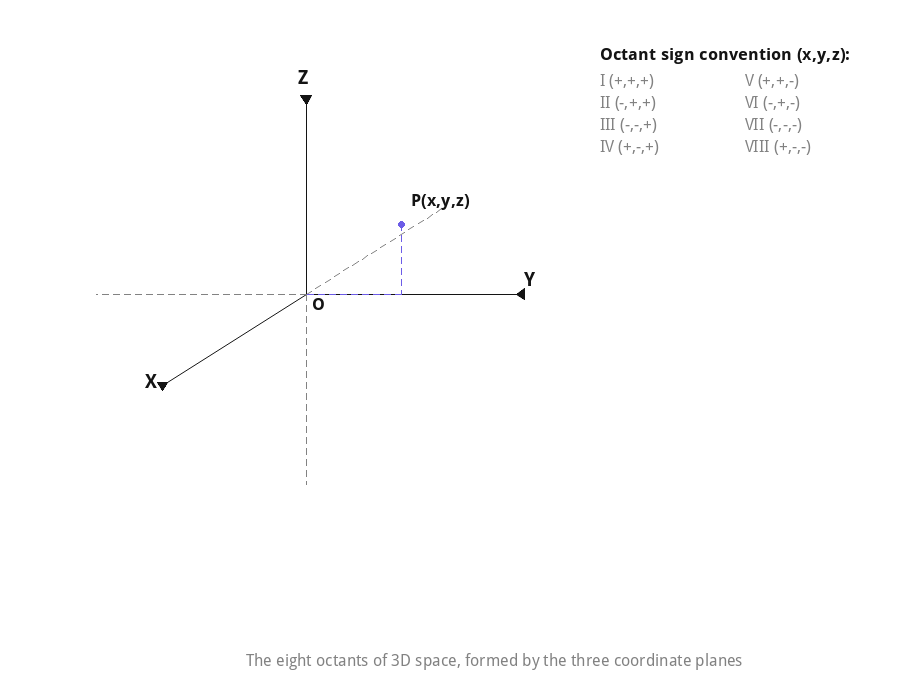
Q4. Fill in the blanks: (i) The x-axis and y-axis taken together determine a plane known as ______. (ii) The coordinates of points in the XY-plane are of the form ______. (iii) Coordinate planes divide the space into ______ octants — (i) The x-axis and y-axis together lie in and determine the XY-plane. (ii) Every point…
(i) The x-axis and y-axis together lie in and determine the XY-plane.
(ii) Every point on the XY-plane has zero displacement along the z-axis, so its coordinates are of the form (x, y, 0).
(iii) The three mutually perpendicular coordinate planes (XY, YZ and ZX) divide the whole of space into eight (8) octants.
Exercise 11.2
Q1. Find the distance between the following pairs of points: (i) (2, 3, 5) and (4, 3, 1) (ii) (−3, 7, 2) and (2, 4, −1) (iii) (−1, 3, −4) and (1, −3, 4) (iv) (2, −1, 3) and (−2, 1, 3) — The distance between two points (x1, y1, z1) and (x2, y2, z2) in three dimensions,…
The distance between two points (x1, y1, z1) and (x2, y2, z2) in three dimensions, obtained by applying the Pythagoras theorem twice, is d = √[(x2−x1)2 + (y2−y1)2 + (z2−z1)2].
(i) d = √[(4−2)2 + (3−3)2 + (1−5)2] = √[4 + 0 + 16] = √20 = 2√5 units.
(ii) d = √[(2−(−3))2 + (4−7)2 + (−1−2)2] = √[25 + 9 + 9] = √43 units.
(iii) d = √[(1−(−1))2 + (−3−3)2 + (4−(−4))2] = √[4 + 36 + 64] = √104 = 2√26 units.
(iv) d = √[(−2−2)2 + (1−(−1))2 + (3−3)2] = √[16 + 4 + 0] = √20 = 2√5 units.
Q2. Show that the points (−2, 3, 5), (1, 2, 3) and (7, 0, −1) are collinear — Let A(−2, 3, 5), B(1, 2, 3) and C(7, 0, −1). Using the distance formula:
Let A(−2, 3, 5), B(1, 2, 3) and C(7, 0, −1). Using the distance formula:
AB = √[(1−(−2))2 + (2−3)2 + (3−5)2] = √[9 + 1 + 4] = √14
BC = √[(7−1)2 + (0−2)2 + (−1−3)2] = √[36 + 4 + 16] = √56 = 2√14
AC = √[(7−(−2))2 + (0−3)2 + (−1−5)2] = √[81 + 9 + 36] = √126 = 3√14
Since AB + BC = √14 + 2√14 = 3√14 = AC, point B lies on line segment AC. Therefore, A, B and C are collinear.
Q3. Verify the following: (i) (0, 7, −10), (1, 6, −6) and (4, 9, −6) are the vertices of an isosceles triangle. (ii) (0, 7, 10), (−1, 6, 6) and (−4, 9, 6) are the vertices of a right-angled triangle. (iii) (−1, 2, 1), (1, −2, 5), (4, −7, 8) and (2, −3, 4) are the vertices of a parallelogram — (i) Let A(0, 7, −10), B(1, 6, −6), C(4, 9, −6). AB = √[12 + (−1)2 + 42] =…
(i) Let A(0, 7, −10), B(1, 6, −6), C(4, 9, −6).
AB = √[12 + (−1)2 + 42] = √[1+1+16] = √18
BC = √[32 + 32 + 02] = √[9+9+0] = √18
CA = √[(−4)2 + (−2)2 + (−4)2] = √[16+4+16] = √36 = 6
Since AB = BC = √18, the triangle is isosceles, verified.
(ii) Let A(0, 7, 10), B(−1, 6, 6), C(−4, 9, 6).
AB = √[(−1)2 + (−1)2 + (−4)2] = √[1+1+16] = √18
BC = √[(−3)2 + 32 + 02] = √[9+9+0] = √18
CA = √[42 + (−2)2 + 42] = √[16+4+16] = √36 = 6
Since AB2 + BC2 = 18 + 18 = 36 = CA2, by the converse of Pythagoras theorem the triangle is right-angled at B (and also isosceles, since AB = BC), verified.
(iii) Let A(−1, 2, 1), B(1, −2, 5), C(4, −7, 8), D(2, −3, 4).
AB = √[22 + (−4)2 + 42] = √[4+16+16] = √36 = 6
BC = √[32 + (−5)2 + 32] = √[9+25+9] = √43
CD = √[(−2)2 + 42 + (−4)2] = √[4+16+16] = √36 = 6
DA = √[(−3)2 + 52 + (−3)2] = √[9+25+9] = √43
Since AB = CD = 6 and BC = DA = √43, opposite sides are equal, so ABCD is a parallelogram, verified.
Q4. Find the equation of the set of points P such that PA2 + PB2 = 2k2, where A and B are the points (3, 4, 5) and (−1, 3, −7), respectively.
Let P(x, y, z) be any point on the required set.
PA2 = (x−3)2 + (y−4)2 + (z−5)2, and PB2 = (x+1)2 + (y−3)2 + (z+7)2
PA2 + PB2 = [(x−3)2 + (x+1)2] + [(y−4)2 + (y−3)2] + [(z−5)2 + (z+7)2]
= (2x2 − 4x + 10) + (2y2 − 14y + 25) + (2z2 + 4z + 74)
= 2x2 + 2y2 + 2z2 − 4x − 14y + 4z + 109
Setting this equal to 2k2: 2x2 + 2y2 + 2z2 − 4x − 14y + 4z + 109 − 2k2 = 0 is the required equation.
Q5. Find the equation of the set of points P, the sum of whose distances from A (4, 0, 0) and B (−4, 0, 0) is equal to 10 — Let P(x, y, z). We are given PA + PB = 10, i.e., PA = 10 − PB.
Let P(x, y, z). We are given PA + PB = 10, i.e., PA = 10 − PB.
PA2 = (x−4)2 + y2 + z2, PB2 = (x+4)2 + y2 + z2
Squaring PA = 10 − PB: PA2 = 100 − 20PB + PB2, so PA2 − PB2 = 100 − 20PB.
PA2 − PB2 = (x−4)2 − (x+4)2 = −16x
So −16x = 100 − 20PB ⇒ 20PB = 100 + 16x ⇒ PB = (25 + 4x)/5
Squaring again: (x+4)2 + y2 + z2 = (25 + 4x)2/25
25(x2 + 8x + 16 + y2 + z2) = 625 + 200x + 16x2
25x2 + 200x + 400 + 25y2 + 25z2 = 625 + 200x + 16x2
9x2 + 25y2 + 25z2 = 225
Dividing throughout by 225: x2/25 + y2/9 + z2/9 = 1 (equivalently, 9x2 + 25y2 + 25z2 = 225).
Miscellaneous Exercise
Q1. Three vertices of a parallelogram ABCD are A(3, −1, 2), B(1, 2, −4), C(−1, 1, 2). Find the coordinates of the fourth vertex — In a parallelogram, the diagonals bisect each other, so the midpoint of AC equals the…
In a parallelogram, the diagonals bisect each other, so the midpoint of AC equals the midpoint of BD.
Midpoint of AC = ((3+(−1))/2, (−1+1)/2, (2+2)/2) = (1, 0, 2)
Let D = (x, y, z). Midpoint of BD = ((1+x)/2, (2+y)/2, (−4+z)/2). Equating with (1, 0, 2):
(1+x)/2 = 1 ⇒ x = 1; (2+y)/2 = 0 ⇒ y = −2; (−4+z)/2 = 2 ⇒ z = 8
The fourth vertex D = (1, −2, 8).
Q2. Find the lengths of the medians of the triangle with vertices A(0, 0, 6), B(0, 4, 0) and C(6, 0, 0) — The median from a vertex goes to the midpoint of the opposite side.
The median from a vertex goes to the midpoint of the opposite side.
Midpoint of BC = (3, 2, 0). Median from A = √[(3−0)2 + (2−0)2 + (0−6)2] = √[9+4+36] = √49 = 7
Midpoint of AC = (3, 0, 3). Median from B = √[(3−0)2 + (0−4)2 + (3−0)2] = √[9+16+9] = √34
Midpoint of AB = (0, 2, 3). Median from C = √[(0−6)2 + (2−0)2 + (3−0)2] = √[36+4+9] = √49 = 7
The lengths of the three medians are 7, √34 and 7 units.
Q3. If the origin is the centroid of the triangle PQR with vertices P(2a, 2, 6), Q(−4, 3b, −10) and R(8, 14, 2c), find the values of a, b and c — The centroid of a triangle with vertices (x1,y1,z1), (x2,y2,z2), (x3,y3,z3) is…
The centroid of a triangle with vertices (x1,y1,z1), (x2,y2,z2), (x3,y3,z3) is ((x1+x2+x3)/3, (y1+y2+y3)/3, (z1+z2+z3)/3). Setting this equal to (0, 0, 0):
(2a − 4 + 8)/3 = 0 ⇒ 2a + 4 = 0 ⇒ a = −2
(2 + 3b + 14)/3 = 0 ⇒ 3b + 16 = 0 ⇒ b = −16/3
(6 − 10 + 2c)/3 = 0 ⇒ 2c − 4 = 0 ⇒ c = 2
Q4. Find the coordinates of a point on the y-axis which is at a distance of 5√2 from the point P(3, −2, 5) — Any point on the y-axis is of the form (0, y, 0). The distance from this point to P(3,…
Any point on the y-axis is of the form (0, y, 0). The distance from this point to P(3, −2, 5) is given as 5√2, so its square is 50.
(0−3)2 + (y−(−2))2 + (0−5)2 = 50
9 + (y+2)2 + 25 = 50 ⇒ (y+2)2 = 16 ⇒ y + 2 = ±4 ⇒ y = 2 or y = −6
The required points are (0, 2, 0) and (0, −6, 0).
Q5. A point R with x-coordinate 4 lies on the line segment joining the points P(2, −3, 4) and Q(8, 0, 10). Find the coordinates of point R — Let R divide PQ internally in the ratio k : 1. By the section formula, the x-coordinate…
Let R divide PQ internally in the ratio k : 1. By the section formula, the x-coordinate of R is (8k + 2)/(k + 1).
Setting this equal to 4: (8k + 2)/(k + 1) = 4 ⇒ 8k + 2 = 4k + 4 ⇒ 4k = 2 ⇒ k = 1/2, i.e., the ratio is 1 : 2.
Using the section formula for the y and z coordinates with ratio 1:2:
y = (1×0 + 2×(−3))/(1+2) = −6/3 = −2
z = (1×10 + 2×4)/(1+2) = 18/3 = 6
The coordinates of R are (4, −2, 6).
Q6. If A and B are the points (3, 4, 5) and (−1, 3, −7), respectively, find the equation of the set of points P such that PA2 + PB2 = k2.
This uses the same points as Exercise 11.2, Q4, but with PA2 + PB2 equal to k2 instead of 2k2. From the earlier working:
PA2 + PB2 = 2x2 + 2y2 + 2z2 − 4x − 14y + 4z + 109
Setting this equal to k2: 2x2 + 2y2 + 2z2 − 4x − 14y + 4z + 109 − k2 = 0 is the required equation.
Class 11 Maths Chapter 11 – Notes and Extra Questions
Chapter 11, “Introduction to Three Dimensional Geometry,” was Chapter 12 in NCERT textbooks before the 2023 rationalisation; it moved down by one number after “Principle of Mathematical Induction” was dropped from the syllabus as a standalone chapter, while the chapter’s own exercises and question count remain exactly the same as in earlier editions − nothing has been trimmed. The chapter has three exercises: Exercise 11.1 (4 questions on axes, coordinate planes and octants), Exercise 11.2 (5 questions on the distance formula, collinearity and locus problems), and the Miscellaneous Exercise (6 questions combining the section formula, centroid formula, medians and locus questions), making 15 questions in total. While this chapter itself is short, it lays the groundwork for direction cosines, the equation of a line in space, and the equation of a plane studied in Class 12, so students should be completely comfortable with the distance formula, the section formula, and identifying octants before moving ahead. A common mistake is forgetting the third coordinate when writing points on an axis or a coordinate plane (Q1 and Q2 of Exercise 11.1) − always check how many coordinates must be zero based on how many axes/planes the point lies on.
- Chapter 1: Sets (2026-27)
- Chapter 2: Relations and Functions – Free PDF Download
- Chapter 3: Trigonometric Functions – Free PDF Download
- Chapter 4: Complex Numbers and Quadratic Equations – Free PDF Download
- Chapter 5: Linear Inequalities – Free PDF Download
- Chapter 6: Permutations and Combinations – Free PDF Download
- Chapter 7: Binomial Theorem – Free PDF Download
- Chapter 8: Sequences and Series – Free PDF Download
- Chapter 9: Straight Lines – Free PDF Download
- Chapter 10: Conic Sections – Free PDF Download
- Chapter 12: Limits and Derivatives – Free PDF Download
- Chapter 13: Statistics – Free PDF Download
- Chapter 14: Probability – Free PDF Download
Frequently Asked Questions
How is the distance formula in three dimensions related to the distance formula in two dimensions?
The 2D distance formula, d = √[(x2−x1)2 + (y2−y1)2], comes from applying the Pythagoras theorem once to a right triangle formed by the horizontal and vertical differences between two points. In three dimensions, we apply the Pythagoras theorem twice − once to find the distance in the XY-plane, and again to bring in the vertical (z) difference − which gives the extended formula d = √[(x2−x1)2 + (y2−y1)2 + (z2−z1)2]. Essentially, 3D distance is just the 2D formula with one extra squared term for the z-coordinate.
How do you decide which of the eight octants a given point lies in?
Each octant corresponds to a unique combination of positive and negative signs for the x, y and z coordinates of a point (there are 2×2×2 = 8 such combinations). To find the octant, simply note the sign of each coordinate and match it against the standard table: Octant I is (+,+,+), Octant II is (−,+,+), Octant III is (−,−,+), Octant IV is (+,−,+), Octant V is (+,+,−), Octant VI is (−,+,−), Octant VII is (−,−,−), and Octant VIII is (+,−,−). This table should be memorised, since several exam questions ask students to directly name the octant of a given point.
How can we check whether three given points in space are collinear without drawing a graph?
Three points A, B and C are collinear if they all lie on the same straight line. Algebraically, this is verified using the distance formula: calculate AB, BC and AC, and check whether the sum of the two shorter distances equals the longest distance (for example, AB + BC = AC). If this condition holds, point B lies exactly between A and C on the same line, proving collinearity. This method avoids the need for any graph or diagram and is the standard technique used in Exercise 11.2, Q2.
Why does the locus of a point satisfying PA + PB = constant (as in Miscellaneous Q5 type problems) give an ellipsoid-like equation?
When the sum of the distances of a moving point P from two fixed points A and B is kept constant, the point traces out a surface where every cross-section through the line AB is an ellipse − this is the classic definition of an ellipse extended into three dimensions, giving an ellipsoid of revolution. This is why, after simplifying PA + PB = 10 for A(4,0,0) and B(−4,0,0), the resulting equation x2/25 + y2/9 + z2/9 = 1 has the same structure as the standard ellipse equation x2/a2 + y2/b2 = 1, just extended with a z2 term because we are working in three-dimensional space.
Recommended: Buy the Printed NCERT Class 11 Maths Book
Contains Amazon affiliate links.
If you’d like a printed copy alongside the PDF, here’s a verified option:
4.2 out of 5 stars (953 ratings) · Rs. 170
Price and availability may change on Amazon. As an Amazon Associate, ncertbooks.org earns from qualifying purchases.


