
Original extra practice questions for Class 7 Science Chapter 3 (Electricity: Circuits and their Components), going beyond the textbook exercise. Full explanations included. These Class 7 Science Chapter 3 important questions are handy for last-minute exam practice.
Last Updated: September 23, 2026
Q1. Two lamps are connected in a circuit such that each lamp has its own separate switch and its own separate path back to the battery (a parallel-style arrangement). If one lamp’s filament breaks, will the other lamp still glow? How is this different from a series arrangement?
Solution: Yes, the other lamp will still glow, because each lamp has its own independent path (branch) back to the battery — a break in one branch doesn’t affect current flowing through the other branch. This is different from a series arrangement (like in the textbook’s Q3), where all components share a single path, so a break anywhere stops current everywhere in the circuit.
Q2 (Applied reasoning). A student wants to design a circuit where a warning lamp only glows if both of two separate switches are turned on (e.g. a safety interlock). How should the switches be connected?
Solution: The two switches should be connected in series with each other (and with the lamp), so that current can only flow when both switches are closed — if either switch is open, the single shared path is broken and the lamp won’t glow.
Q3 (Assertion–Reason). Assertion (A): All metals are good conductors of electricity. Reason (R): Materials that allow electric current to pass through them easily are called conductors.
Solution: R is true (this is the definition of a conductor). A is generally true and consistent with this chapter’s activity data (copper, aluminium, and other metals tested all conducted). Both true, with R explaining the concept behind A.
Q4 (Spot the error). A student says: “Since a switch can turn a lamp on, a switch must be a source of electrical energy, just like a cell.” Correct this.
Solution: Incorrect. A switch doesn’t generate or supply electrical energy at all — it only opens or closes the circuit’s path, controlling whether the energy already supplied by the cell/battery can flow. The cell (or battery) is the actual source of electrical energy in the circuit.
Q5 (Applied, LED polarity). You have a fresh cell and an LED, but you’re not sure which of the LED’s two leads is positive. Describe a safe way to figure it out.
Solution: Connect the LED to the cell via short connecting wires, trying one orientation first. If the LED glows, that orientation is correct (the lead touching the cell’s positive terminal is the LED’s positive lead). If it doesn’t glow, reverse the connections and try again — since an LED only glows in its correct polarity, this trial-and-error method safely reveals which lead is which (unlike a regular bulb, an LED won’t damage from this brief reversed test at typical single-cell voltages).
Q6 (Classification). Classify each material as a conductor or insulator, and explain your reasoning for one: (i) silver spoon (ii) rubber glove (iii) graphite pencil lead (iv) dry wooden ruler.
Solution: (i) Silver spoon — conductor (metal). (ii) Rubber glove — insulator. (iii) Graphite pencil lead — conductor (graphite, a form of carbon, is a notable exception to the “only metals conduct” idea — it conducts electricity despite not being a metal). (iv) Dry wooden ruler — insulator.
Q7 (Real-world application). Electricians wear rubber gloves and stand on rubber mats when working with live wires. Explain why, using what you’ve learned about conductors and insulators.
Solution: Rubber is an insulator, meaning it does not allow electric current to pass through it easily. By wearing rubber gloves and standing on a rubber mat, the electrician creates an insulating barrier between themselves and any live (current-carrying) wire or the ground, greatly reducing the risk of current flowing through their body and causing an electric shock.
Q8 (Circuit troubleshooting, HOTS). A circuit has a cell, a switch, and a lamp, all connected with wires, but the lamp doesn’t glow even with a brand-new cell and a bulb that’s confirmed to work elsewhere. What’s the most likely remaining problem, and how would you find it?
Solution: Since the cell and bulb are both confirmed good, the most likely remaining problems are a loose or broken wire connection, or a faulty switch that isn’t actually closing the circuit even when moved to “ON.” To investigate: check each wire connection is firmly attached, and try bypassing the switch (connecting its two wires directly together) — if the lamp then glows, the switch was the fault; if it still doesn’t glow, check each wire junction one at a time for a loose or broken connection.
Q9 (Cells in series, numeric reasoning). If one cell provides 1.5 volts, and three such cells are connected in series (positive-to-negative) inside a torch, what is the total voltage supplied?
Solution: When cells are connected in series, their voltages add up: 1.5 + 1.5 + 1.5 = 4.5 volts total.
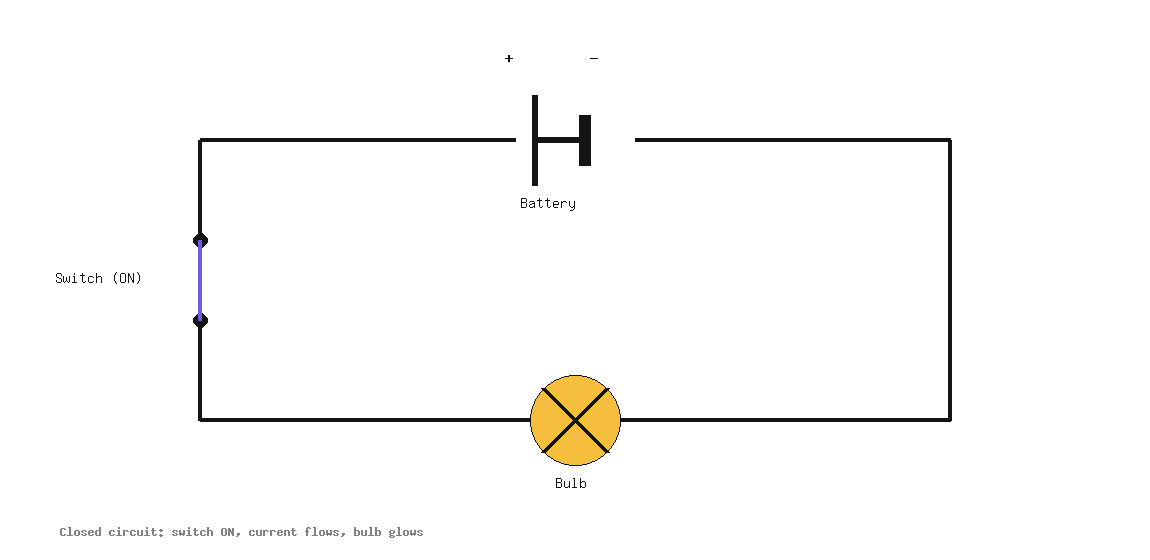
A closed circuit: the switch is ON, so current flows and the bulb glows.
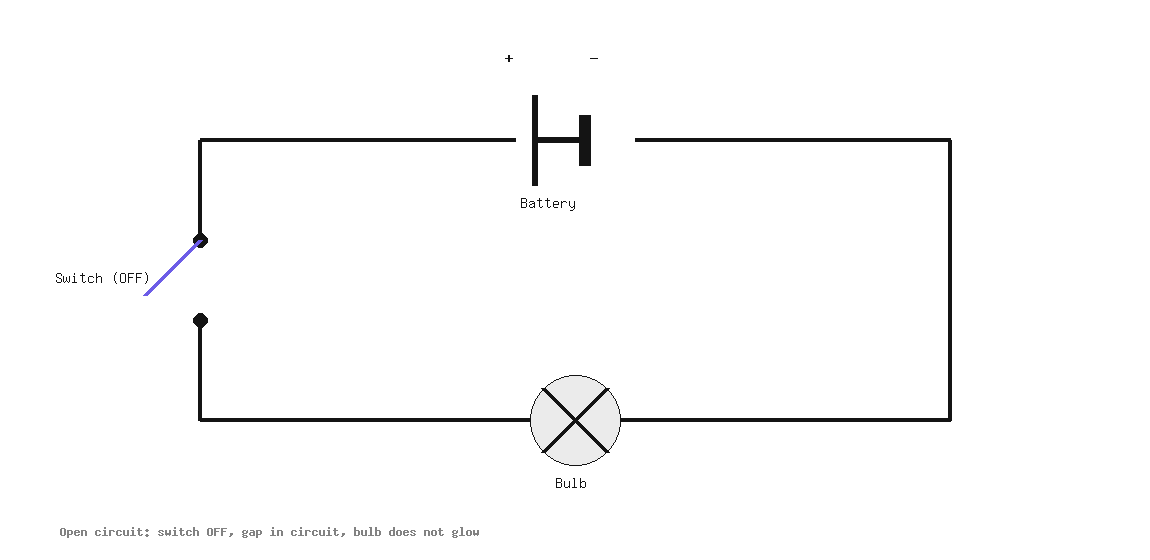
An open circuit: the switch is OFF, creating a gap, so no current flows and the bulb stays off.
Q10 (Symbol recognition). In a circuit diagram, how would you represent (a) a cell (b) a switch in the open (OFF) position (c) a bulb?
Solution: (a) A cell is shown as two parallel lines, one longer (positive terminal) and one shorter (negative terminal). (b) A switch in the open/OFF position is shown as a small gap in the wire with a lever/line not touching the other contact point, indicating no current can flow. (c) A bulb is shown as a circle with an “X” inside it, representing the filament.
See also: NCERT Solutions: Class 7 Science Chapter 3, Class 7 Science NCERT Book and the Class 7 Science Formulas Handbook.
Revision Notes: Class 7 Science Chapter 3 Revision Notes
- Chapter 1: The Ever-Evolving World of Science
- Chapter 2: Exploring Substances - Acidic, Basic and Neutral
- Chapter 4: The World of Metals and Non-metals
- Chapter 5: Changes Around Us - Physical and Chemical
- Chapter 6: Adolescence - A Stage of Growth and Change
- Chapter 7: Heat Transfer in Nature
- Chapter 8: Measurement of Time and Motion
- Chapter 9: Life Processes in Animals
- Chapter 10: Life Processes in Plants
- Chapter 11: Light: Shadows and Reflections
- Chapter 12: Earth, Moon and the Sun
Frequently Asked Questions
If one bulb in a series circuit of three bulbs stops working, what happens to the other two bulbs?
In a series circuit, all components share a single path for current, so if one bulb fails and breaks that path, the circuit becomes incomplete, and the other bulbs also stop working.
Why would you use a switch in an electric circuit rather than always leaving it directly connected?
A switch allows the circuit to be safely opened or closed as needed, letting current be stopped or allowed to flow without physically disconnecting and reconnecting the wires each time.
Chapter Quiz — Test Your Understanding
Class 7 Science Chapter 3 – Solutions and Notes
For complete step-by-step answers and a quick summary, check the Class 7 Science Chapter 3 Solutions and Class 7 Science Chapter 3 Revision Notes.
Recommended: Buy the Printed NCERT Class 7 Science Book
Contains Amazon affiliate links.
If you’d like a printed copy alongside the PDF, here’s a verified option:
Rs. 130
Price and availability may change on Amazon. As an Amazon Associate, ncertbooks.org earns from qualifying purchases.


