
Fresh, higher-order practice questions for Class 7 Science Chapter 12 “Earth, Moon and the Sun”, designed to test deeper understanding of Earth’s rotation, revolution, seasons and eclipses through original scenarios not drawn from any textbook example. These Class 7 Science Chapter 12 important questions are handy for last-minute exam practice.
Last Updated: September 23, 2026
Q1. A weather-tracking website shows that a city near the Arctic Circle had a sunset at 11:45 pm in June but did not have a sunset at all in the last week of June. Explain how both of these can be true for the same city, using Earth's tilt.
Answer: Cities near the Arctic Circle lie close to the boundary where, around the June solstice, the Northern Hemisphere’s tilt towards the Sun becomes so extreme that the Sun never fully dips below the horizon. Earlier in June, the city may still be just outside this “midnight Sun” zone, giving an extremely late but real sunset (11:45 pm) followed by only a very brief twilight before sunrise. By the last week of June, near the solstice itself, the same city’s latitude falls fully inside the region that stays continuously sunlit, so the Sun simply skims along the horizon without setting at all that day.
Q2. Assertion-Reason — Assertion (A): A person standing exactly on the equator experiences almost equal length…
Assertion (A): A person standing exactly on the equator experiences almost equal length of day and night throughout the year.
Reason (R): The equator is always exactly midway between the sunlit and dark halves of the Earth, regardless of how the Earth’s axis is tilted at any point in its orbit.
Answer: Both A and R are true, and R correctly explains A. Because the equator lies at the “middle” of the Earth relative to its rotational axis, the day-night boundary (the terminator) always splits the equator into roughly equal lit and dark arcs no matter which way the axis is tilted towards the Sun — unlike locations near the poles, where the split becomes very unequal depending on the season.
Q3. Two friends, one in Norway and one in Indonesia (near the equator), compare how much the length of daytime changes for them between June and December. Predict who notices a bigger difference, and explain why.
Answer: The friend in Norway will notice a far bigger difference. Norway lies at a high latitude, far from the equator, so the effect of Earth’s axial tilt on day length is strongly exaggerated there — producing very long summer days and very short (or even day-less) winter days. Indonesia, being close to the equator, is close to the “middle” of the Earth relative to the tilt, so its day length stays close to 12 hours all year with only a small seasonal change.
Q4. A student says, "During a lunar eclipse, since the Moon passes through the Earth's shadow, the Moon should completely disappear from view." Is this always correct? Explain what is actually observed.
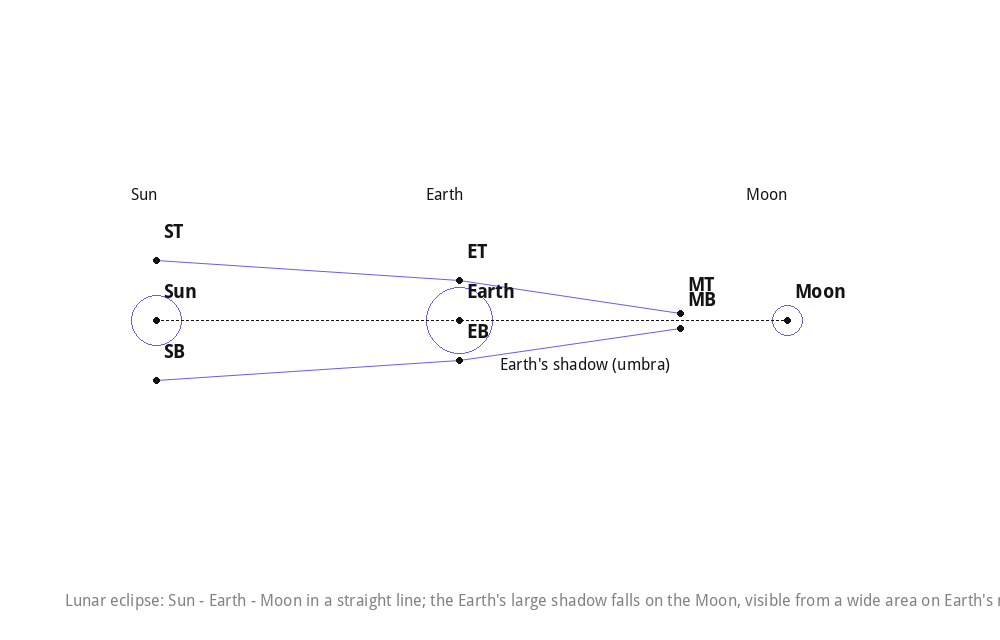
Answer: This is not entirely correct. Even during a total lunar eclipse, the Moon usually does not vanish completely — it typically takes on a dim reddish or coppery colour instead of disappearing. This happens because a small amount of sunlight is bent (refracted) by the Earth’s atmosphere around the edge of the Earth and reaches the Moon; the atmosphere scatters away the blue part of this light more than the red part (the same reason sunsets look red), so only the reddish light reaches the Moon’s surface, giving rise to what is sometimes called a “blood moon.”
Q5. Spot the Error — A student wrote: "A solar eclipse can only happen on a full Moon night, since that is…
A student wrote: “A solar eclipse can only happen on a full Moon night, since that is when the Moon is fully visible and closest to the Sun’s path.” Identify and correct the error.
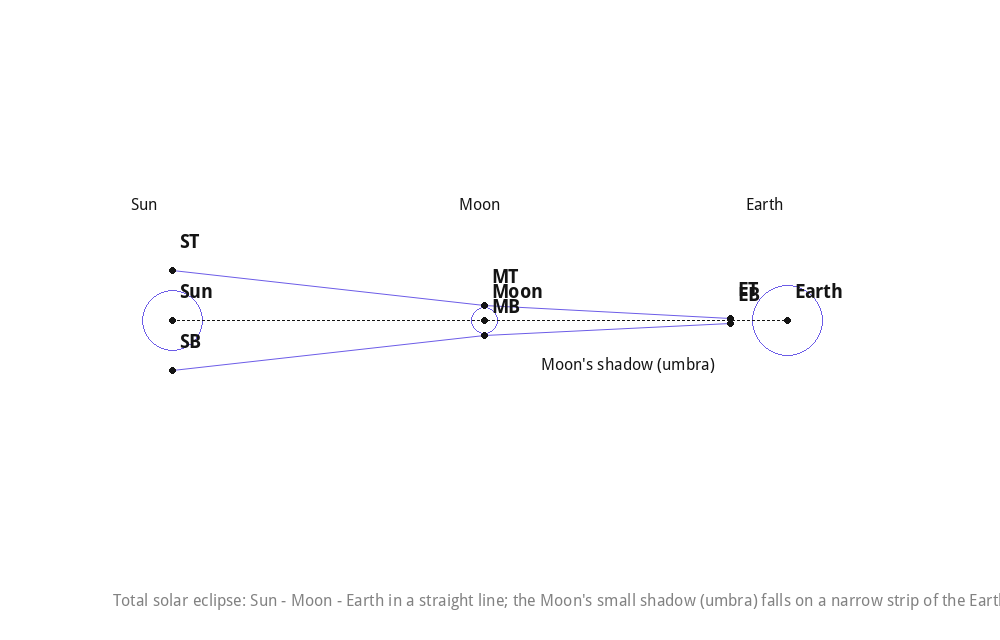
Answer: This is incorrect on two counts. A solar eclipse requires the Moon to come directly between the Sun and the Earth, which can only happen on a new Moon day (when the Moon lies roughly between the Sun and Earth), not a full Moon night (when the Moon lies on the opposite side of the Earth from the Sun). It is a lunar eclipse, not a solar eclipse, that can only occur on a full Moon night, since that is when the Earth can come between the Sun and the Moon.
Q6. A satellite image taken from directly above the North Pole shows the Earth's day-night boundary as a straight line passing exactly through both poles. Around which two dates of the year is this image most likely to have been taken? Explain.
Answer: This is most likely to be around the two equinoxes — approximately 21 March and 22/23 September. On these two dates, neither hemisphere is tilted towards or away from the Sun (the tilt lies exactly sideways to the Sun’s rays), so the boundary between day and night runs straight through both the North and South Poles, and every place on Earth experiences close to 12 hours of day and 12 hours of night.
Q7. Two space photographers, one stationed on the Moon and one stationed on the Earth, both want to photograph a lunar eclipse and a solar eclipse (as seen from their own location) in the same month. Explain what each of them would actually be able to record.
Answer: A lunar eclipse and a solar eclipse are really the same event of the three bodies lining up, but viewed from opposite ends — an observer on Earth during a lunar eclipse would photograph the Moon darkening as it passes through the Earth’s shadow, while an observer standing on the Moon at that very same moment would instead see the Earth pass directly in front of the Sun — to them, it would look exactly like a solar eclipse, with the Earth blocking out the Sun’s light.
Q8. A student plots the length of daytime in her city on a graph across an entire year and notices it forms a smooth wave-like curve rather than a sudden jump between "long" and "short" days. Explain why the change in day length happens gradually rather than all at once.
Answer: The Earth’s tilt relative to the Sun changes only gradually as the Earth steadily revolves along its (nearly circular) orbit — there is no sudden jump in how the axis is oriented from one day to the next. Since the length of daytime at any location depends smoothly on this slowly-changing tilt angle, the day length also changes little by little, day after day, producing a smooth, wave-like curve over the year rather than any abrupt jump.
Q9. A city lies close to the border between two countries. Local news reports that its clock time is one hour ahead of a city almost directly to its west, even though both cities are at a similar latitude. Explain, using Earth's rotation, why cities to the east generally have their local Sun-time ahead…
Answer: Because the Earth rotates from west to east, an eastern location is carried into the sunlit half of the Earth (and reaches local noon) slightly earlier than a location further west at a similar latitude. Clock time systems are generally set up to roughly track this real difference in when the Sun is overhead at each place, which is why places to the east of a given location typically have clock times that run ahead of places to its west.
Q10. An imaginary planet has no axial tilt but takes 500 Earth days to revolve once around its star. Would the inhabitants of this planet experience seasons? Would they experience day and night? Explain both answers separately.
Answer: The inhabitants would not experience seasons, since seasons are caused by axial tilt, and this planet has none — every location would receive sunlight at a constant angle and for a constant number of hours all through its orbit. However, they would still experience day and night, as long as the planet also spins on its own axis (rotation), since it is rotation — not tilt or revolution — that creates the repeating cycle of a sunlit side and a shadowed side; the 500-day revolution period only affects how long a full “year” is, not whether day and night occur.
See also: NCERT Solutions for Class 7 Science Chapter 12
Revision Notes: Revision Notes for Class 7 Science Chapter 12
For the full chapter list, see the Class 7 Science book page and the Class 7 Science Formulas Handbook.
Quick visual: a worked diagram from the full Solutions page, for reference.
- Chapter 1: The Ever-Evolving World of Science
- Chapter 2: Exploring Substances - Acidic, Basic and Neutral
- Chapter 3: Electricity - Circuits and their Components
- Chapter 4: The World of Metals and Non-metals
- Chapter 5: Changes Around Us - Physical and Chemical
- Chapter 6: Adolescence - A Stage of Growth and Change
- Chapter 7: Heat Transfer in Nature
- Chapter 8: Measurement of Time and Motion
- Chapter 9: Life Processes in Animals
- Chapter 10: Life Processes in Plants
- Chapter 11: Light: Shadows and Reflections
Frequently Asked Questions
Why do we always see approximately the same side of the moon from Earth?
The moon takes almost exactly the same time to rotate once on its axis as it takes to orbit the Earth, a phenomenon called synchronous rotation, resulting in the same side always facing Earth.
Why does a lunar eclipse not happen every month, even though the moon orbits the Earth once a month?
A lunar eclipse requires the sun, Earth, and moon to be nearly perfectly aligned, but because the moon orbit is slightly tilted relative to the Earth orbit around the sun, this alignment only happens occasionally.
Chapter Quiz — Test Your Understanding
Class 7 Science Chapter 12 – Solutions and Notes
For complete step-by-step answers and a quick summary, check the Class 7 Science Chapter 12 Solutions and Class 7 Science Chapter 12 Revision Notes.
Recommended: Buy the Printed NCERT Class 7 Science Book
Contains Amazon affiliate links.
If you’d like a printed copy alongside the PDF, here’s a verified option:
Rs. 130
Price and availability may change on Amazon. As an Amazon Associate, ncertbooks.org earns from qualifying purchases.


