
Quick revision notes summarizing all key concepts from Class 7 Science Chapter 11 “Light: Shadows and Reflections”. These Class 7 Science Chapter 11 notes are ideal for quick revision just before exams.
Last Updated: September 23, 2026
- Luminous objects produce their own light (e.g. the Sun, stars, a burning candle); non-luminous objects do not produce light and are seen only because they reflect or scatter light falling on them (e.g. the Moon, planets, this page).
- Light travels in a straight line (rectilinear propagation) — it cannot bend around obstacles or turn corners inside a bent pipe.
- Transparent materials (glass, water) let almost all light pass through, giving a clear view; translucent materials (butter paper, frosted glass) let only some light pass through, giving a blurred view; opaque materials (wood, metal, cardboard) block light completely and form shadows.
- A shadow forms on a screen when an opaque object blocks light from a source; it needs a light source, an opaque object, and a screen.
- Shadow size and sharpness depend on the object’s position: closer to the light source (and farther from the screen) -> larger, blurrier shadow; closer to the screen -> smaller, sharper shadow, closer to the object’s true shape.
- A shadow’s length changes through the day with the Sun’s altitude: shortest around noon (Sun nearly overhead), longest in early morning/late evening (Sun near the horizon).
- Two light sources shining on the same object from different directions produce two separate shadows.
- Reflection is the bouncing back of light when it strikes a surface. Smooth, polished surfaces give regular reflection (a clear, single-direction reflected beam/image); rough surfaces give diffuse reflection/scattering (light spreads in many directions, no clear image).
- The image formed by a plane mirror is: virtual (cannot be caught on a screen), erect (right-side up), the same size as the object, and formed as far behind the mirror as the object is in front of it.
- Lateral inversion: a plane mirror reverses left and right (but not up and down) — e.g. written text appears reversed, and “AMBULANCE” is written in mirror-reversed form on some vehicles so it reads correctly when seen in the rear-view mirror of a vehicle ahead. Letters with vertical-line symmetry (A, H, I, M, O, T, U, V, W, X, Y) look unchanged after lateral inversion.
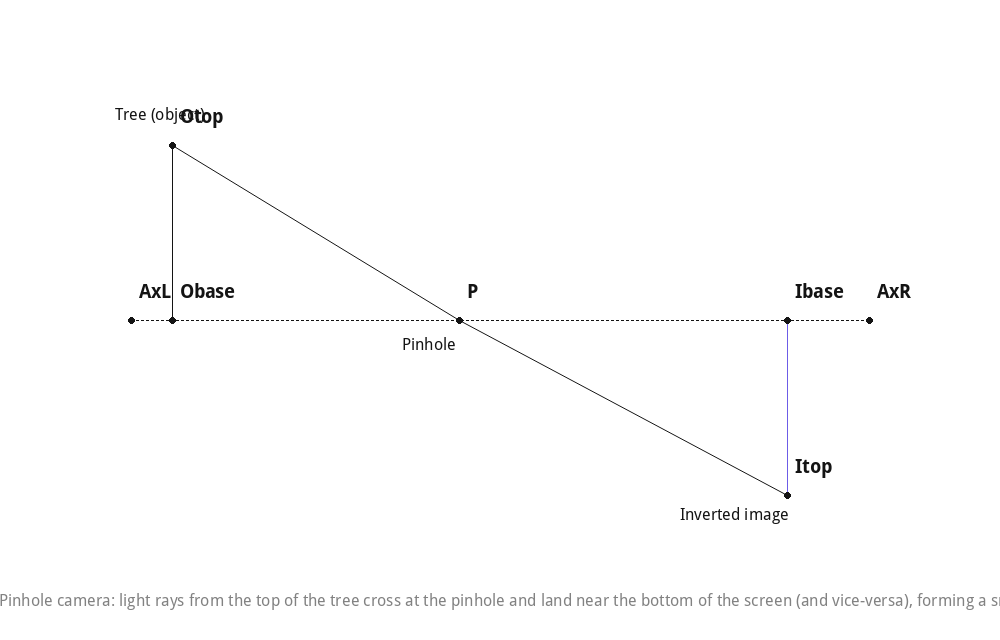
- A pinhole camera uses a small hole to form a small, real, inverted image of an object on a screen, because light rays from the top and bottom of the object cross over exactly at the pinhole.
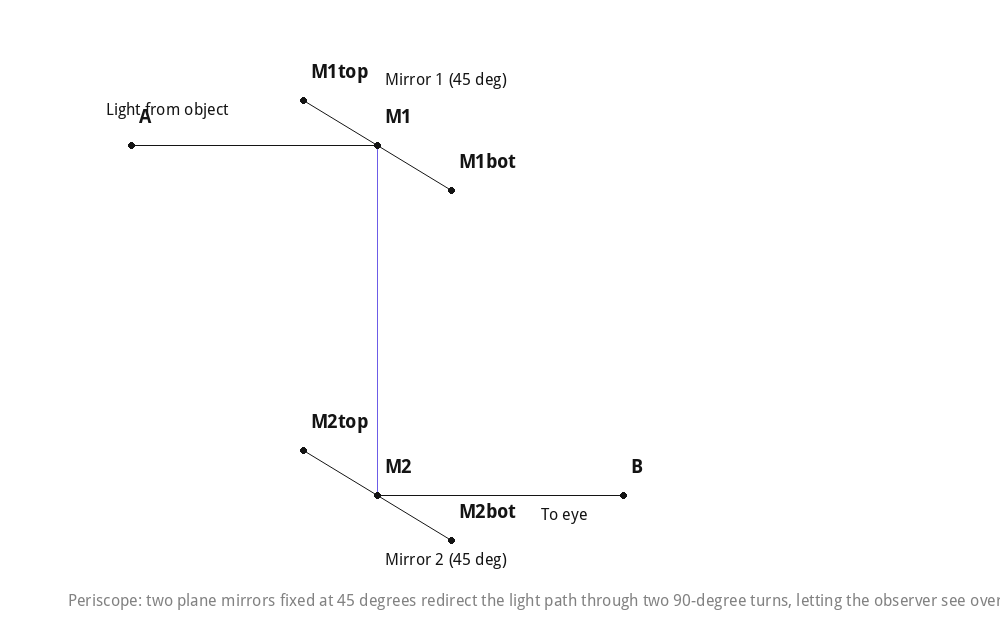
- A periscope uses two plane mirrors, each fixed at 45° to the tube and facing each other, to redirect light through two 90° turns — used to see over or around obstacles (e.g. in submarines, trenches).
See also: NCERT Solutions for Class 7 Science Chapter 11
Practice more: Extra Questions for Class 7 Science Chapter 11
For the full chapter list, see the Class 7 Science book page and the Class 7 Science Formulas Handbook.
Quick visual: a worked diagram from the full Solutions page, for reference.
- Chapter 1: The Ever-Evolving World of Science
- Chapter 2: Exploring Substances - Acidic, Basic and Neutral
- Chapter 3: Electricity - Circuits and their Components
- Chapter 4: The World of Metals and Non-metals
- Chapter 5: Changes Around Us - Physical and Chemical
- Chapter 6: Adolescence - A Stage of Growth and Change
- Chapter 7: Heat Transfer in Nature
- Chapter 8: Measurement of Time and Motion
- Chapter 9: Life Processes in Animals
- Chapter 10: Life Processes in Plants
- Chapter 12: Earth, Moon and the Sun
Frequently Asked Questions
Why is a shadow formed only when light travels in a straight line and meets an opaque object?
A shadow forms because light travels in straight lines and cannot bend around an opaque object, so the region behind the object where light is blocked from reaching remains dark, creating a shadow.
What is the law of reflection, and how does it apply to a plane mirror?
The law of reflection states that the angle at which light strikes a surface equals the angle at which it reflects off, and in a plane mirror this produces an image the same size as the object but reversed left to right.
Chapter Quiz — Test Your Understanding
Class 7 Science Chapter 11 – Solutions and Important Questions
Need full answers or more practice? See the Class 7 Science Chapter 11 Solutions and Class 7 Science Chapter 11 Extra Questions.
Recommended: Buy the Printed NCERT Class 7 Science Book
Contains Amazon affiliate links.
If you’d like a printed copy alongside the PDF, here’s a verified option:
Rs. 130
Price and availability may change on Amazon. As an Amazon Associate, ncertbooks.org earns from qualifying purchases.


