
Fresh, higher-order practice questions for Class 7 Science Chapter 11 “Light: Shadows and Reflections”, designed to test deeper understanding of shadow formation, reflection, and image formation through original scenarios not drawn from any textbook example. These Class 7 Science Chapter 11 important questions are handy for last-minute exam practice.
Last Updated: September 23, 2026
Q1. A lamp, an opaque circular disc, and a screen are set up in a straight line. If the disc is slowly moved from its position near the screen towards the lamp while the lamp and screen stay fixed, how will the shadow on the screen change, and why?
Answer: As the disc moves closer to the lamp (and farther from the screen), the shadow on the screen will grow larger and progressively blurrier. This happens because light rays from the lamp diverge outward from a point; moving the disc nearer to the lamp means the rays that just miss the disc’s edge have a longer distance left to spread out before reaching the screen, enlarging and softening the shadow’s outline.
Q2. Assertion-Reason — Assertion (A): A frosted (translucent) glass window lets a room stay bright during the…
Assertion (A): A frosted (translucent) glass window lets a room stay bright during the day but does not allow a clear view of what is on the other side.
Reason (R): A translucent material allows only part of the incoming light to pass through, and scatters it in many directions instead of letting it travel straight through.
Answer: Both A and R are true, and R correctly explains A.
Q3. A periscope works by fixing its two mirrors at 45° to the tube. Explain, using the idea of how light bounces off a surface, why 45° is the correct angle to turn the light path by a full 90° at each mirror, rather than some other angle.
Answer: When light reflects off a mirror, the change in its direction of travel is twice the angle between the incoming ray and the mirror’s surface. Since the periscope needs to turn the horizontal line of sight into a vertical path down the tube (a 90° turn) at each mirror, the mirror surface must be tilted at half of that turn, i.e. 45°, to the incoming light — any other angle would send the light off in the wrong direction and the tube would not line up with the observer’s eye.
Q4. A student wants to create the sharpest, most clearly outlined shadow silhouette of a leaf on a wall using a single torch. Suggest how she should position the torch, the leaf, and the wall, and explain your reasoning.
Answer: She should place the leaf as close as possible to the wall, and keep the torch as far away from the leaf as is practical (or use as narrow/parallel a beam as possible). Keeping the leaf close to the wall means the light rays grazing its edges have very little distance left to spread out before reaching the wall, so the shadow stays close to the leaf’s true size with sharp, well-defined edges rather than a large, blurred one.
Q5. Spot the Error — A student wrote: "The image formed by a plane mirror is inverted upside-down, just like…
A student wrote: “The image formed by a plane mirror is inverted upside-down, just like the image formed by a pinhole camera.” Identify and correct the error.
Answer: This is incorrect. A plane mirror image is not inverted upside-down — it stays erect (right-side up) but is reversed left-to-right (laterally inverted). It is the pinhole camera that forms an image inverted upside-down (and reversed left-right), because its rays cross over at the pinhole — a plane mirror does not make light rays cross over in that way.
Q6. Two identical opaque balls are hung at different distances from a single torch, with a screen placed behind both. Ball P is close to the torch, and Ball Q is close to the screen. Compare the shadows of P and Q on the screen, and explain the difference.
Answer: Ball P’s shadow will be larger and blurred, since it is close to the torch and its light rays have a long distance to diverge before reaching the screen. Ball Q’s shadow will be smaller, close to its true size, and sharply outlined, since it is close to the screen and the rays around it have barely spread out by the time they land on the screen.
Q7. A clock is held up in front of a plane mirror. Will the mirror image of the clock show the correct time? Explain using the idea of lateral inversion.
Answer: No, the mirror image will generally not show the correct time directly — the positions of the numbers and hands are laterally inverted (reversed left-to-right), so, for example, a clock reading 4 o’clock would appear to show roughly 8 o’clock in the mirror. To read the actual time, one has to mentally reverse the left-right positions of the hands, which is why mirror-image clock faces look confusing at a glance.
Q8. A vertical stick is fixed upright on the ground at night, with one street lamp switched on directly to its left and another switched on directly to its right, both at the same height. Describe and sketch the shadow(s) the stick would cast, and explain your reasoning.
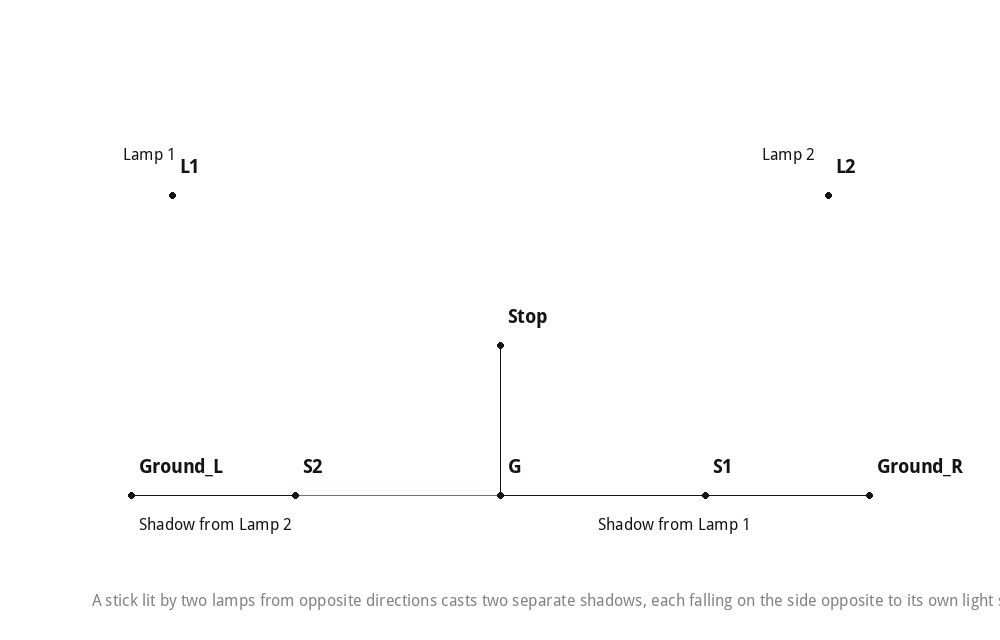
Answer: The stick will cast two separate shadows on the ground — one on the side facing away from each lamp. The shadow caused by the left-hand lamp falls to the right of the stick’s base, and the shadow caused by the right-hand lamp falls to the left of the stick’s base, since each shadow forms on the side directly opposite to its own light source, exactly as light travels in a straight line from each lamp past the stick to the ground.
Q9. Explain, in terms of what happens to light rays at the surface, why you can see a sharp reflection of your face in a still pond but only a hazy, spread-out patch of light in a pond with ripples.
Answer: A still pond has a smooth surface, so incoming light rays are reflected in a single, well-defined direction (regular reflection), forming a clear image. A rippled pond has a constantly changing, uneven surface at many small angles, so the same incoming rays are reflected in many different directions at once (diffuse reflection/scattering), spreading the light out and preventing a sharp image from forming.
Q10. Both a pinhole camera and a periscope use the basic property that light travels in straight lines, yet they are used for very different purposes. Compare how each device makes use of this property.
Answer: A pinhole camera uses the straight-line travel of light combined with a single small opening to make light rays from different parts of an object cross over, producing a small, inverted real image — it is used to capture or view an image of a scene. A periscope uses the straight-line travel of light combined with two mirrors placed at 45° to redirect the path of light around bends, without forming a crossed-over image — it is used to see around obstacles or over them, not to capture an image.
See also: NCERT Solutions for Class 7 Science Chapter 11
Revision Notes: Revision Notes for Class 7 Science Chapter 11
For the full chapter list, see the Class 7 Science book page and the Class 7 Science Formulas Handbook.
- Chapter 1: The Ever-Evolving World of Science
- Chapter 2: Exploring Substances - Acidic, Basic and Neutral
- Chapter 3: Electricity - Circuits and their Components
- Chapter 4: The World of Metals and Non-metals
- Chapter 5: Changes Around Us - Physical and Chemical
- Chapter 6: Adolescence - A Stage of Growth and Change
- Chapter 7: Heat Transfer in Nature
- Chapter 8: Measurement of Time and Motion
- Chapter 9: Life Processes in Animals
- Chapter 10: Life Processes in Plants
- Chapter 12: Earth, Moon and the Sun
Frequently Asked Questions
Why does the size of a shadow change depending on the distance between the object and the light source?
As an object moves closer to a light source, it blocks a larger cone of light rays, casting a bigger shadow, while moving further away blocks a smaller cone, resulting in a smaller shadow.
Why does an image formed in a plane mirror appear reversed left to right but not upside down?
A plane mirror reflects light rays symmetrically front to back relative to the mirror surface, producing a reversal perpendicular to the mirror, appearing as left-right reversal without flipping vertically.
Chapter Quiz — Test Your Understanding
Class 7 Science Chapter 11 – Solutions and Notes
For complete step-by-step answers and a quick summary, check the Class 7 Science Chapter 11 Solutions and Class 7 Science Chapter 11 Revision Notes.
Recommended: Buy the Printed NCERT Class 7 Science Book
Contains Amazon affiliate links.
If you’d like a printed copy alongside the PDF, here’s a verified option:
Rs. 130
Price and availability may change on Amazon. As an Amazon Associate, ncertbooks.org earns from qualifying purchases.


