
Quick revision notes summarizing all key concepts from Class 7 Science Chapter 12 “Earth, Moon and the Sun”. These Class 7 Science Chapter 12 notes are ideal for quick revision just before exams.
Last Updated: September 23, 2026
- Rotation: the Earth spins on its own axis from west to east, completing one turn in about 24 hours; this causes the cycle of day and night and makes the Sun and stars appear to move from east to west across the sky.
- Revolution: the Earth moves around the Sun in a nearly circular orbit, taking about 365 days (one year) to complete one revolution.
- The Pole Star lies almost directly above Earth’s rotational axis and so appears almost fixed in the sky, while other stars appear to circle around it through the night.
- Stars appear to rise about 4 minutes earlier each successive night, because of the Earth’s combined rotation and revolution; over a year this adds up to a full 24-hour (one-day) shift, so the same star pattern returns to the same position after about 365 days.
- Different constellations are visible at different times of year because Earth’s revolution changes which direction in space faces us at night.
- Seasons are caused by the tilt of Earth’s axis (about 23.5° to its orbital plane) combined with its revolution around the Sun — not by the Earth’s changing distance from the Sun.
- When a hemisphere is tilted towards the Sun, it has longer days, more direct sunlight, and summer; when tilted away, it has shorter days, slanting sunlight, and winter — the two hemispheres always have opposite seasons at the same time.
- At the equinoxes (around 21 March and 22/23 September), neither hemisphere is tilted towards the Sun, and day and night are close to equal (about 12 hours each) everywhere on Earth.
- Near the poles, extreme tilt effects can cause continuous daylight (“midnight Sun”) or continuous darkness for weeks at a time around the solstices.
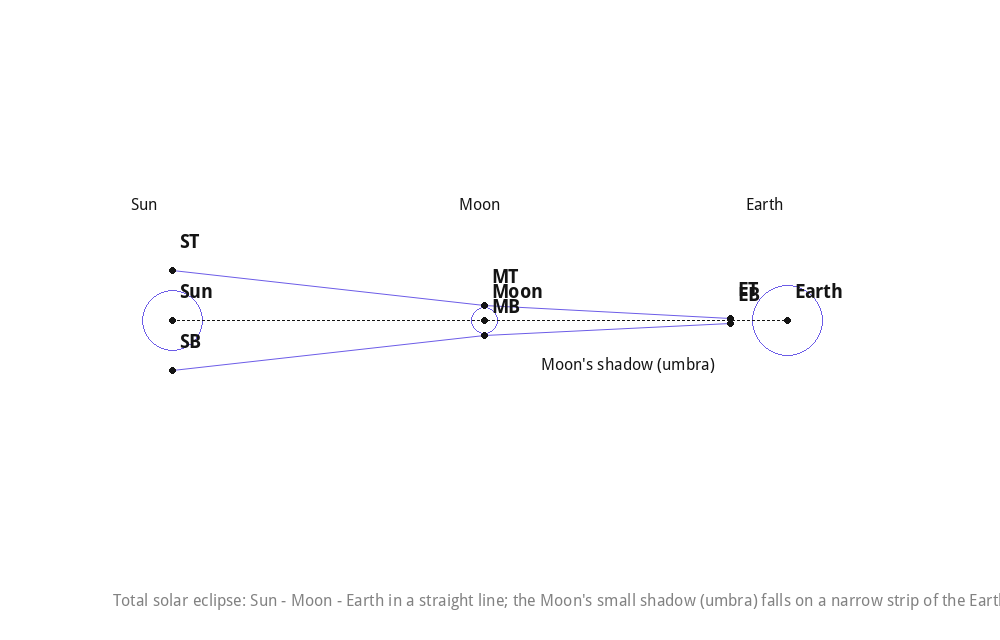
- Solar eclipse: occurs on a new Moon day, when the Moon comes between the Sun and the Earth; the Moon’s small shadow (umbra) falls on a narrow strip of Earth, so totality is visible only briefly and from a small area; never look directly at a solar eclipse without proper eye protection.
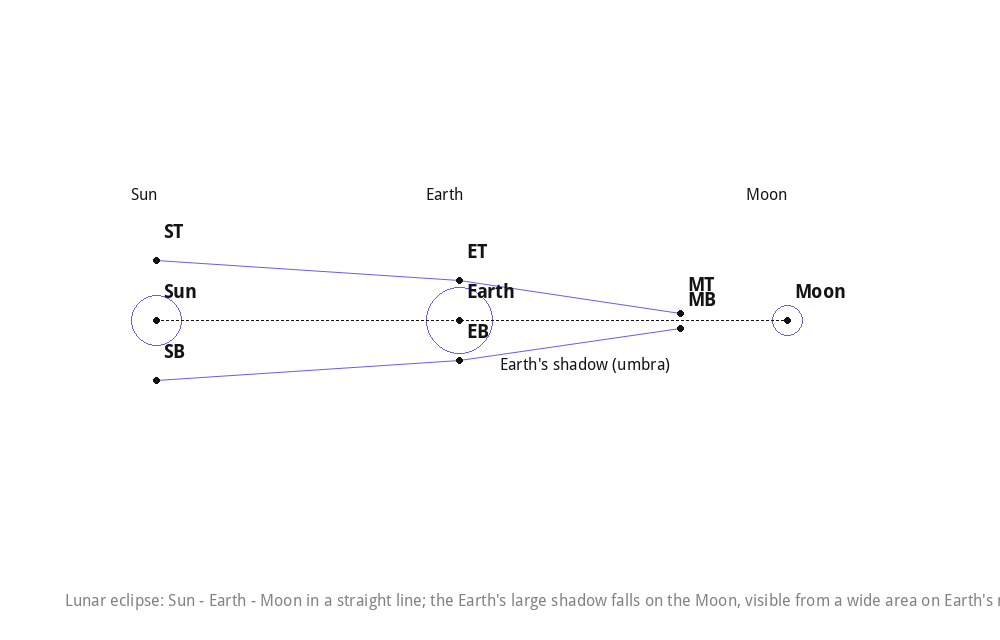
- Lunar eclipse: occurs on a full Moon night, when the Earth comes between the Sun and the Moon; the Earth’s large shadow falls on the Moon, so it is visible from a much wider area of Earth and is safe to view with the naked eye. The Moon often looks reddish (“blood moon”) during totality due to sunlight bending through Earth’s atmosphere.
- The Moon can appear to exactly cover the much larger Sun during a total solar eclipse because apparent size depends on both actual size and distance — the Sun is about 400 times wider than the Moon but also about 400 times farther away, making their apparent sizes in the sky nearly equal.
- Because the Earth rotates west to east, places to the east experience sunrise, noon and sunset earlier than places to the west at a similar latitude.
See also: NCERT Solutions for Class 7 Science Chapter 12
Practice more: Extra Questions for Class 7 Science Chapter 12
For the full chapter list, see the Class 7 Science book page and the Class 7 Science Formulas Handbook.
Quick visual: a worked diagram from the full Solutions page, for reference.
- Chapter 1: The Ever-Evolving World of Science
- Chapter 2: Exploring Substances - Acidic, Basic and Neutral
- Chapter 3: Electricity - Circuits and their Components
- Chapter 4: The World of Metals and Non-metals
- Chapter 5: Changes Around Us - Physical and Chemical
- Chapter 6: Adolescence - A Stage of Growth and Change
- Chapter 7: Heat Transfer in Nature
- Chapter 8: Measurement of Time and Motion
- Chapter 9: Life Processes in Animals
- Chapter 10: Life Processes in Plants
- Chapter 11: Light: Shadows and Reflections
Frequently Asked Questions
Why does the moon appear to shine even though it does not produce its own light?
The moon appears to shine because it reflects sunlight falling on its surface, and the portion of reflected light visible from Earth changes as the moon orbits, producing its different phases.
What causes a solar eclipse and a lunar eclipse?
A solar eclipse occurs when the moon passes between the sun and the Earth, blocking sunlight from part of the Earth surface, while a lunar eclipse occurs when the Earth passes between the sun and the moon.
Chapter Quiz — Test Your Understanding
Class 7 Science Chapter 12 – Solutions and Important Questions
Need full answers or more practice? See the Class 7 Science Chapter 12 Solutions and Class 7 Science Chapter 12 Extra Questions.
Recommended: Buy the Printed NCERT Class 7 Science Book
Contains Amazon affiliate links.
If you’d like a printed copy alongside the PDF, here’s a verified option:
Rs. 130
Price and availability may change on Amazon. As an Amazon Associate, ncertbooks.org earns from qualifying purchases.


