
Chapter 2, Relations and Functions, builds on the Cartesian product of two sets to define relations, and then narrows relations down to the special case of functions, where algebraic operations like addition and multiplication can also be applied.
Last Updated: September 23, 2026
Common Mistakes Students Make in Relations and Functions
n
- n
- Confusing a relation with a function: every function is a relation, but a relation is a function only if every element of the domain maps to exactly ONE element of the codomain. Students often accept a relation as a function even when one input has two outputs.
- Domain vs range mix-up: the domain is the set of all first elements (inputs) of the ordered pairs; the range is the set of all second elements (outputs) actually used, which is a subset of the codomain, not the same as it. Treating range and codomain as identical is a very common error.
- Cartesian product order errors: A × B is NOT the same as B × A unless A = B — students frequently list ordered pairs in the wrong order or miscount |A × B| = |A| × |B|.
- Errors in finding domain/range of real-valued functions: for functions involving square roots or fractions, students often forget to exclude values that make the denominator zero or the expression under a root negative, leading to an incorrect domain.
n
n
n
n
n
Key Concepts
The Cartesian product A×B is the set of all ordered pairs (a, b) where a belongs to A and b belongs to B, with |A×B| = |A|×|B|. A relation is simply any subset of A×B; its domain is the set of first elements used, and its range is the set of second elements. A function is a special kind of relation where every element in the domain maps to exactly one output — no domain element is allowed to have two different outputs. Common function types include the identity function f(x)=x, constant functions f(x)=c, the modulus function f(x)=|x|, the signum function (giving −1, 0 or 1), and the greatest integer function [x].
Quick Recap
- Every function is a relation, but not every relation is a function.
- A relation fails to be a function if any single domain element maps to more than one output.
- Functions can be combined algebraically: (f+g)(x), (f−g)(x), (fg)(x), and (f/g)(x) where g(x) ≠ 0.
- The domain of a combined function like f/g excludes any input where the denominator g(x) equals 0.
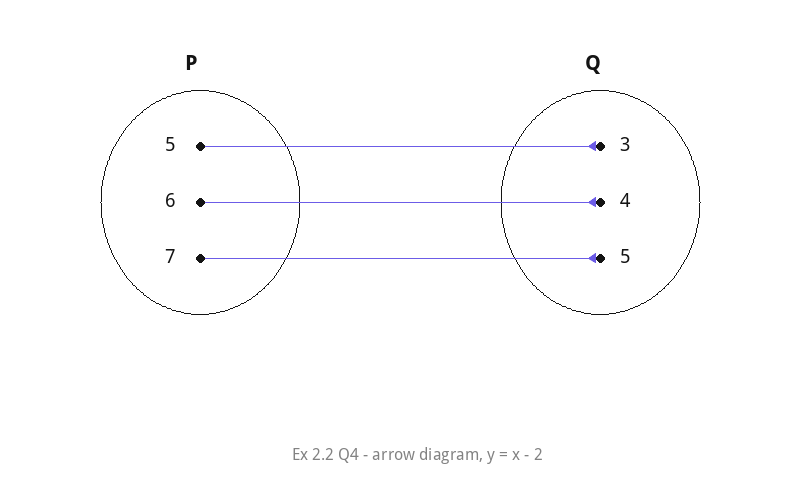
Quick visual: a worked diagram from the full Solutions page, for reference.
Common Mistake to Avoid
Students often assume every relation qualifies as a function. A relation only becomes a function if each input value is paired with exactly one output; if even one input maps to two different outputs, it is a relation but not a function.
- Chapter 1: Sets - Quick Revision Notes
- Chapter 3: Trigonometric Functions – Revision Notes
- Chapter 4: Complex Numbers and Quadratic Equations – Revision Notes
- Chapter 5: Linear Inequalities – Revision Notes
- Chapter 6: Permutations and Combinations – Revision Notes
- Chapter 7: Binomial Theorem – Revision Notes
- Chapter 8: Sequences and Series – Revision Notes
- Chapter 9: Straight Lines – Revision Notes
- Chapter 10: Conic Sections – Revision Notes
- Chapter 11: Introduction to Three Dimensional Geometry – Revision Notes
- Chapter 12: Limits and Derivatives – Revision Notes
- Chapter 13: Statistics – Revision Notes
- Chapter 14: Probability – Revision Notes
Frequently Asked Questions
Q. What is the quickest way to check if a relation is a function?
For every input (x-value) in the relation, check that it appears with only one output (y-value); if any input repeats with a different output, the relation is not a function.
Full walkthrough: Chapter 2 Solutions · Extra Questions.
What to Revise First (and Last) in Relations and Functions
n
Revise the precise definitions of relation, function, domain, co-domain and range first, since almost every question in this chapter tests whether you can correctly identify these from a given set of ordered pairs or a graph. Then revise the standard real functions (identity, constant, polynomial, rational, modulus, signum, greatest integer) along with their domain and range, since these come up repeatedly as direct questions. Save the graph-sketching practice for algebraic operations on functions (sum, difference, product, quotient of two real functions) for your last pass — it is quick to refresh once the underlying definitions are solid.
n
Recommended: Buy the Printed NCERT Class 11 Maths Book
Contains Amazon affiliate links.
If you’d like a printed copy alongside the PDF, here’s a verified option:
4.2 out of 5 stars (953 ratings) · Rs. 170
Price and availability may change on Amazon. As an Amazon Associate, ncertbooks.org earns from qualifying purchases.



Pingback: Class 11 Maths Chapter 14 Probability Extra Questions (2026-27)
Pingback: Class 11 Maths Chapter 5 Linear Inequalities Revision Notes (2026-27)