
Not every relation qualifies as a function, since a function can’t send one input to two different outputs, and these questions explore that distinction alongside the modulus and signum functions.
Last Updated: September 23, 2026
How to Approach the HOTS Questions in Relations and Functions
n
HOTS questions here often describe a relation in words or as a set-builder condition and ask you to determine both whether it is a function AND its domain/range together — practice translating word-based conditions into ordered pairs before applying the function test. Another frequent pattern combines two functions algebraically (like f+g or f/g) and asks for the resulting domain — remember the resulting domain is the intersection of the individual domains, with additional exclusions for division.
n
Very Short Answer Questions (1 mark)
Q1. If A has 3 elements and B has 4 elements, how many elements does A × B have?
Ans: 12.
Q2. Is every relation a function? Why or why not?
Ans: No, because a relation may map one domain element to more than one range element, which is not allowed for a function.
Q3. Find the value of the signum function at x = −5.
Ans: −1.
Q4. What is f(x) = |x| called?
Ans: The modulus (absolute value) function.
Q5. If f(x) = x² and g(x) = x+1, find (f+g)(2).
Ans: f(2)+g(2) = 4+3 = 7.
Short Answer Questions (2–3 marks)
Q6. Let A = {1, 2} and B = {3, 4}. Write A × B and state its number of elements.
Ans: A × B = {(1,3), (1,4), (2,3), (2,4)}; it has 4 elements.
Q7. Explain, with reasoning, why the relation R = {(1,2), (1,3), (2,4)} is not a function.
Ans: R is not a function because the domain element 1 is mapped to two different range values (2 and 3), violating the rule that each domain element must map to exactly one output for a relation to be a function.
Q8. If f(x) = 2x + 3 and g(x) = x², find (fg)(x) and (f/g)(2).
Ans: (fg)(x) = f(x)×g(x) = (2x+3)(x²) = 2x³+3x². (f/g)(2) = f(2)/g(2) = (2(2)+3)/(2²) = 7/4.
Higher-Order Thinking / Application Questions
Q9. A function f: R → R is defined as f(x) = [x] (the greatest integer function). Find f(2.9), f(−2.1), and explain why the second answer might seem counterintuitive.
Ans: f(2.9) = 2 (greatest integer ≤ 2.9). f(−2.1) = −3, not −2, because −3 is the greatest integer that is still less than or equal to −2.1 (since −2 is greater than −2.1, it doesn’t qualify) — this can seem counterintuitive since we might expect “rounding toward zero,” but the greatest integer function always rounds down toward negative infinity.
Q10. A taxi company charges a fare function f(x) = 50 + 12x for x kilometres, but only for whole-number distances (domain restricted to non-negative integers). Explain why this restricted f is still a valid function, and find the range if the maximum distance offered is 20 km.
Ans: This is still a valid function because for every valid input x (0 to 20, integers), there is exactly one output fare, satisfying the function definition, even though the domain is restricted rather than being all real numbers. The range: minimum fare f(0) = 50, maximum fare f(20) = 50+240 = 290, so the range is {50, 62, 74, …, 290} (all values of 50+12x for integer x from 0 to 20).
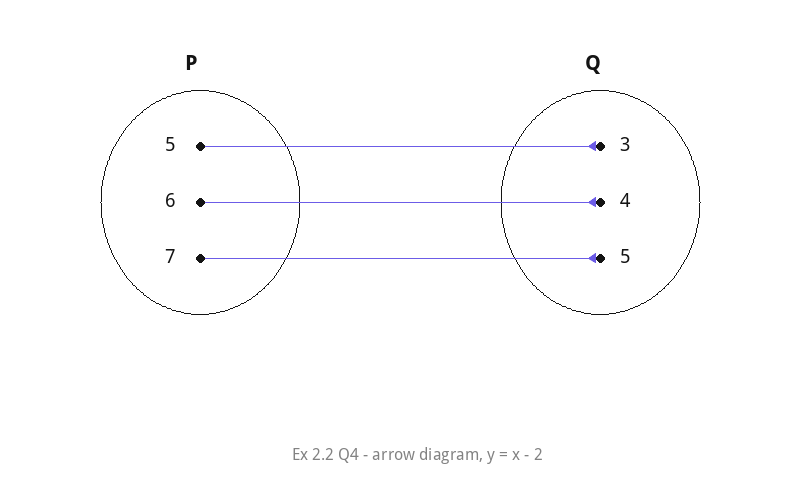
Quick visual: a worked diagram from the full Solutions page, for reference.
- Chapter 1: Sets - Important HOTS & Extra Questions with Solutions
- Chapter 3: Trigonometric Functions – Extra Questions with Answers
- Chapter 4: Complex Numbers and Quadratic Equations – Extra Questions with Answers
- Chapter 5: Linear Inequalities – Extra Questions with Answers
- Chapter 6: Permutations and Combinations – Extra Questions with Answers
- Chapter 7: Binomial Theorem – Extra Questions with Answers
- Chapter 8: Sequences and Series – Extra Questions with Answers
- Chapter 9: Straight Lines – Extra Questions with Answers
- Chapter 10: Conic Sections – Extra Questions with Answers
- Chapter 11: Introduction to Three Dimensional Geometry – Extra Questions with Answers
- Chapter 12: Limits and Derivatives – Extra Questions with Answers
- Chapter 13: Statistics – Extra Questions with Answers
- Chapter 14: Probability – Extra Questions with Answers
Frequently Asked Questions
If f(x) = 2x + 3 and g(x) = x squared, how would you find the value of f of g of 2?
First compute g(2) = 4, then apply f to that result: f(4) = 2(4) + 3 = 11, so f of g of 2 equals 11.
Given the relation R = (1,2),(2,3),(3,4) on set A = 1,2,3,4, how would you determine if R is a function?
Since every element in the domain 1,2,3 maps to exactly one element in the codomain, R is a function from its domain to A.
Chapter Quiz — Test Your Understanding
Class 11 Maths Chapter 2 – Solutions and Notes
For complete step-by-step answers and a quick summary, check the Class 11 Maths Chapter 2 Solutions and Class 11 Maths Chapter 2 Revision Notes.
See also: Chapter 2
Recommended: Buy the Printed NCERT Class 11 Maths Book
Contains Amazon affiliate links.
If you’d like a printed copy alongside the PDF, here’s a verified option:
4.2 out of 5 stars (953 ratings) · Rs. 170
Price and availability may change on Amazon. As an Amazon Associate, ncertbooks.org earns from qualifying purchases.



Pingback: Class 11 Maths Chapter 5 Linear Inequalities Extra Questions (2026-27)
Pingback: Class 11 Maths Chapter 10 Conic Sections Extra Questions (2026-27)
Pingback: Class 11 Maths Chapter 14 Probability Extra Questions (2026-27)