
Motion in a Plane introduces vectors and uses them to describe two-dimensional motion – from resolving forces and displacements into components, to working out the range and maximum height of a projectile, to finding the centripetal acceleration of an object moving in a circle. It is one of the highest-weightage chapters in the Class 11 Physics kinematics unit and forms the base for later chapters on Laws of Motion and Rotational Motion. Below are original, step-by-step solutions to all 22 in-chapter exercise questions (3.1-3.22) of the 2026-27 rationalised NCERT edition.
Last Updated: September 23, 2026
NCERT Solutions for Class 11 Physics Chapter 3: Motion in a Plane
Q1. : Scalars and Vectors – Classifying Physical Quantities — State, for each of the following physical quantities, if it is a scalar or a vector:…
State, for each of the following physical quantities, if it is a scalar or a vector: volume, mass, speed, acceleration, density, number of moles, velocity, angular frequency, displacement, angular velocity. A scalar is described completely by its magnitude alone, while a vector needs both magnitude and a direction to be fully specified. Checking each quantity against this test: volume, mass, speed, density, number of moles and angular frequency need only a number and a unit to be complete, so they are scalars. Acceleration, velocity, displacement and angular velocity all have an associated direction (the direction of the push, the direction of motion, or the axis and sense of rotation), so they are vectors. Scalars: volume, mass, speed, density, number of moles, angular frequency; Vectors: acceleration, velocity, displacement, angular velocity.
Q2. : Identifying Scalar Quantities — Pick out the two scalar quantities in the following list: force, angular momentum, work,…
Pick out the two scalar quantities in the following list: force, angular momentum, work, current, linear momentum, electric field, average velocity, magnetic moment, relative velocity. Work is defined as the dot product of the force vector and the displacement vector (W = F·d); a dot product of two vectors always yields a scalar, so work has magnitude only. Electric current is specified completely by a single number (amperes) at a cross-section and does not obey the vector law of addition, so it too is treated as a scalar even though charge flows in a direction. All the other quantities listed (force, angular momentum, linear momentum, electric field, average velocity, magnetic moment, relative velocity) are vectors. Work and current are the two scalar quantities.
Q3. : Identifying the Only Vector Quantity — Pick out the only vector quantity in the following list: temperature, pressure, impulse,…
Pick out the only vector quantity in the following list: temperature, pressure, impulse, time, power, total path length, energy, gravitational potential, coefficient of friction, charge. Impulse is defined as the product of force and the (small) time for which it acts, J = FΔt. Since force is a vector and time is a scalar, their product retains the direction of the force, making impulse a vector. Every other quantity in the list (temperature, pressure, time, power, path length, energy, gravitational potential, coefficient of friction, charge) is fully described by a single number. Impulse is the only vector quantity in the list.
Q4. : Meaningful and Non-Meaningful Operations with Scalars and Vectors — State with reasons whether the following algebraic operations with scalar and vector…
State with reasons whether the following algebraic operations with scalar and vector physical quantities are meaningful: (a) adding any two scalars; (b) adding a scalar to a vector of the same dimensions; (c) multiplying any vector by any scalar; (d) multiplying any two scalars; (e) adding any two vectors; (f) adding a component of a vector to the same vector. (a) Not meaningful in general – two scalars can only be added if they represent the same physical quantity (you can add two masses, but not a mass to a time interval). (b) Not meaningful – a vector carries direction information that a scalar does not, so the two cannot be combined even if their dimensions match. (c) Meaningful – multiplying a vector by a scalar simply rescales its magnitude (and reverses its direction if the scalar is negative); e.g., force × time = impulse. (d) Meaningful – any scalar can be multiplied by any other scalar regardless of what physical quantities they represent, e.g., speed × time = distance. (e) Not meaningful in general – vectors can only be added if they represent the same physical quantity (two forces can be added; a force cannot be added to a velocity). (f) Meaningful – a component of a vector is itself a vector of the same physical quantity as the parent vector, so it can be added to it. (a) not meaningful, (b) not meaningful, (c) meaningful, (d) meaningful, (e) not meaningful, (f) meaningful.
Q5. : True or False – Vectors and Path Length — Read each statement below carefully and state with reasons if it is true or false: (a)…
Read each statement below carefully and state with reasons if it is true or false: (a) the magnitude of a vector is always a scalar; (b) each component of a vector is always a scalar; (c) the total path length is always equal to the magnitude of the displacement vector of a particle; (d) the average speed of a particle is either greater than or equal to the magnitude of its average velocity over the same interval; (e) three vectors not lying in a plane can never add up to give a null vector. (a) True – the magnitude of any vector is just a non-negative number, which is a scalar. (b) False – each rectangular component of a vector is itself a vector directed along a coordinate axis, not a scalar. (c) False – path length (a scalar, the actual distance travelled) is always greater than or equal to the magnitude of displacement (a vector, the straight-line distance); the two are equal only for motion along a straight line without reversal. (d) True – since path length ≥ magnitude of displacement, dividing both by the same time interval keeps the inequality: average speed ≥ magnitude of average velocity. (e) True – if three vectors are to sum to zero they must form a closed triangle when placed head to tail, and a triangle is necessarily a planar figure, so vectors that do not lie in a common plane cannot add to a null vector. (a) True, (b) False, (c) False, (d) True, (e) True.
Q6. : Proving Vector Triangle Inequalities — Establish the following vector inequalities geometrically: (a) |a+b| ≤ |a|+|b|; (b)…
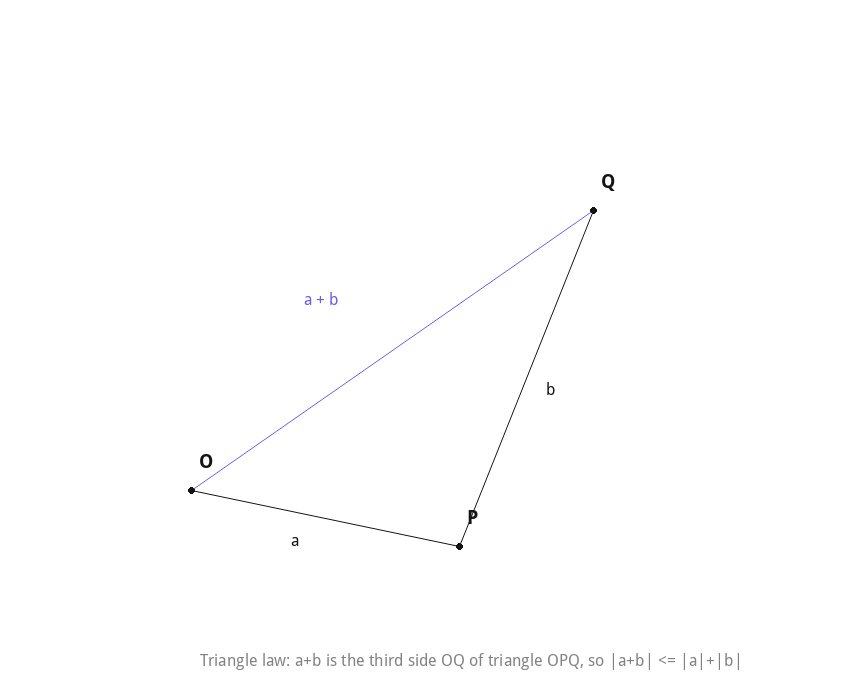
Establish the following vector inequalities geometrically: (a) |a+b| ≤ |a|+|b|; (b) |a+b| ≥ ||a|−|b||; (c) |a−b| ≤ |a|+|b|; (d) |a−b| ≥ ||a|−|b||. Represent a and b as two sides OP and PQ of a triangle OPQ placed head to tail, so that a+b is represented by the third side OQ. (a) In any triangle, one side is always less than or equal to the sum of the other two, so OQ ≤ OP+PQ, i.e. |a+b| ≤ |a|+|b|; equality holds only when a and b are parallel (point in the same direction), collapsing the triangle onto a straight line. (b) Also in triangle OPQ, OQ+PQ ≥ OP, which rearranges to OQ ≥ OP−PQ, i.e. |a+b| ≥ ||a|−|b||; equality holds when a and b are anti-parallel. (c) Now represent a and (−b) as two sides of a triangle so that a−b is the third side; by the same triangle-side rule, |a−b| ≤ |a|+|b|, with equality when a and b point in opposite directions. (d) From the same triangle, |a−b| ≥ ||a|−|b||, with equality when a and b are parallel (point in the same direction). All four inequalities follow directly from the triangle-side property that no side of a triangle can exceed the sum of the other two, or be less than their difference.
Q7. : Vector Sum a + b + c + d = 0 – True/False Statements — Given a+b+c+d = 0, which of the following statements are correct? (a) a, b, c and d must…
Given a+b+c+d = 0, which of the following statements are correct? (a) a, b, c and d must each be a null vector; (b) the magnitude of (a+c) equals the magnitude of (b+d); (c) the magnitude of a can never be greater than the sum of the magnitudes of b, c and d; (d) b+c must lie in the plane of a and d if a and d are not collinear (and along their common line if they are collinear). (a) False – four non-zero vectors can easily cancel out in sum (e.g., four equal vectors 90° apart), so it is not necessary that each be a null vector. (b) True – rearranging the given equation, a+c = −(b+d); taking the magnitude of both sides removes the sign, so |a+c| = |b+d|. (c) True – since a = −(b+c+d), the triangle inequality gives |a| ≤ |b|+|c|+|d|. (d) True – writing the sum as a+(b+c)+d = 0, this three-term sum can only vanish if all three vectors are coplanar; if a and d happen to be collinear, then (b+c) must lie along that same line for the sum to be zero. (a) Incorrect, (b) Correct, (c) Correct, (d) Correct.
Q8. : Displacement of Three Girls Skating on a Circular Ground — Three girls skate from a point P on the edge of a circular ice ground of radius 200 m…
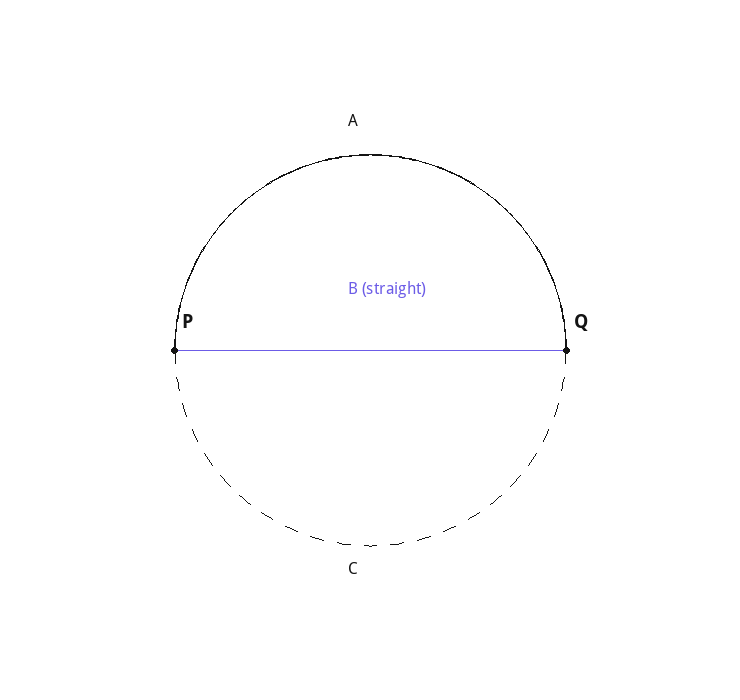
Three girls skate from a point P on the edge of a circular ice ground of radius 200 m to a diametrically opposite point Q, following different paths. What is the magnitude of the displacement vector for each, and for which girl is this equal to the actual path length skated? Displacement depends only on the initial and final positions, not on the path taken, so all three girls have exactly the same displacement – the straight line PQ, which is a diameter of the ground. Diameter = 2 × radius = 2 × 200 m = 400 m. This magnitude of displacement equals the actual distance skated only for the girl whose path was itself the straight diameter PQ (the girl who skated straight across, conventionally girl B in the textbook figure); the other two girls travelled longer, curved paths, so their path length exceeds 400 m. Displacement = 400 m for each girl; it equals the path length only for the girl who skated straight along the diameter.
Q9. : Net Displacement, Average Velocity and Average Speed of a Cyclist — A cyclist starts from the centre O of a circular park of radius 1 km, cycles to the…
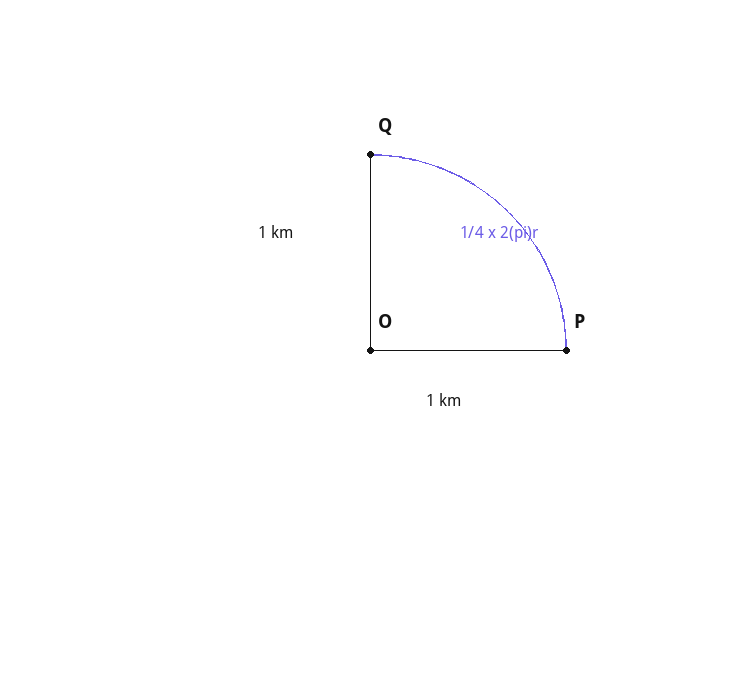
A cyclist starts from the centre O of a circular park of radius 1 km, cycles to the edge P, then along the circumference to Q, and back to the centre along QO. If the round trip takes 10 minutes, find (a) the net displacement, (b) the average velocity, and (c) the average speed. (a) The cyclist returns to the exact starting point O, so the initial and final positions coincide and the net displacement is zero. (b) Average velocity = net displacement ÷ total time; since the displacement is zero, the average velocity is also zero. (c) Average speed = total path length ÷ total time. Path length = OP + arc PQ + QO = 1 km + ¼(2π × 1 km) + 1 km = 2 + π/2 = 2 + 1.571 = 3.571 km. Total time = 10 min = 1/6 h. Average speed = 3.571 ÷ (1/6) = 3.571 × 6 = 21.43 km/h. Net displacement = 0; average velocity = 0; average speed ≈ 21.43 km/h.
Q10. : Displacement of a Motorist on a Hexagonal Track — On an open ground, a motorist follows a track that turns left by 60° after every…
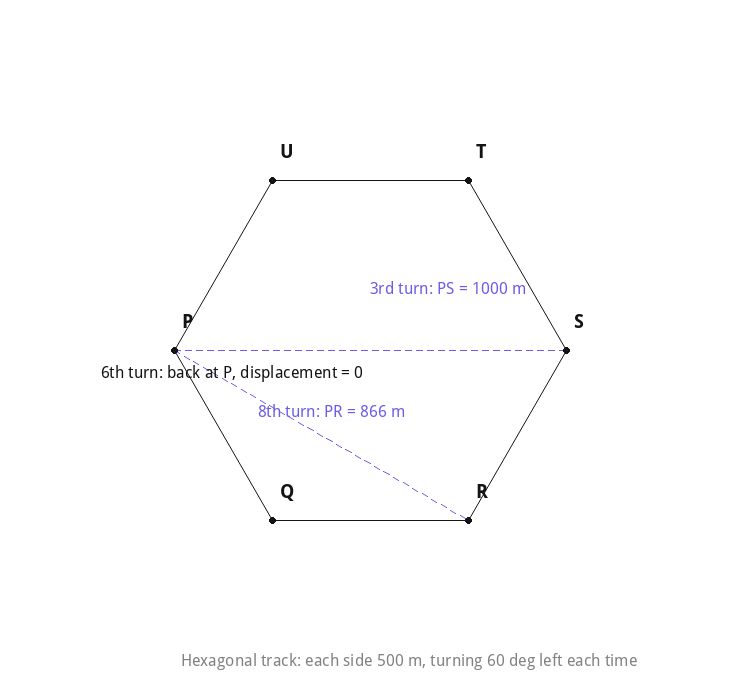
On an open ground, a motorist follows a track that turns left by 60° after every 500 m. Find the displacement at the third, sixth and eighth turn, and compare each with the total path length covered. Turning left by a fixed 60° after every 500 m segment traces out a regular hexagon of side 500 m; label the vertices P (start), Q, R, S, T, U. At the third turn the motorist is at S: since P and S are opposite vertices of the hexagon, PS is a diagonal equal to twice the side length, so displacement = 2 × 500 = 1000 m, while the path length covered is 3 × 500 = 1500 m. At the sixth turn the motorist has gone all the way round back to the starting point P, so displacement = 0, while the path length is 6 × 500 = 3000 m. At the eighth turn the motorist has gone one full hexagon (back to P) plus two more sides, ending at R; using the law of cosines with the 60° angle between successive 500 m sides, PR = √(500²+500²+2(500)(500)cos60°) = √(250000+250000+250000) = √750000 = 866.03 m, directed at β = tan-1[500 sin60° ÷ (500+500cos60°)] = 30° from the initial direction of travel; the path length covered by then is 8 × 500 = 4000 m. 3rd turn: 1000 m displacement, 1500 m path length; 6th turn: 0 m displacement, 3000 m path length; 8th turn: 866.03 m displacement at 30°, 4000 m path length.
Q11. : Average Speed vs Average Velocity of a Taxi — A passenger wants to go from the station to a hotel 10 km away on a straight road. A…
A passenger wants to go from the station to a hotel 10 km away on a straight road. A cabman drives him along a circuitous 23 km route, reaching the hotel in 28 minutes. Find (a) the average speed of the taxi, and (b) the magnitude of average velocity; are the two equal? (a) Average speed = total distance travelled ÷ total time = 23 km ÷ (28/60 h) = 23 × 60/28 = 49.29 km/h. (b) The displacement is the straight-line distance from station to hotel, 10 km (not the 23 km actually driven), so average velocity = 10 km ÷ (28/60 h) = 10 × 60/28 = 21.43 km/h. The two values, 49.29 km/h and 21.43 km/h, are clearly not equal because the path taken was much longer than the straight-line distance. Average speed ≈ 49.29 km/h; average velocity ≈ 21.43 km/h; the two are not equal.
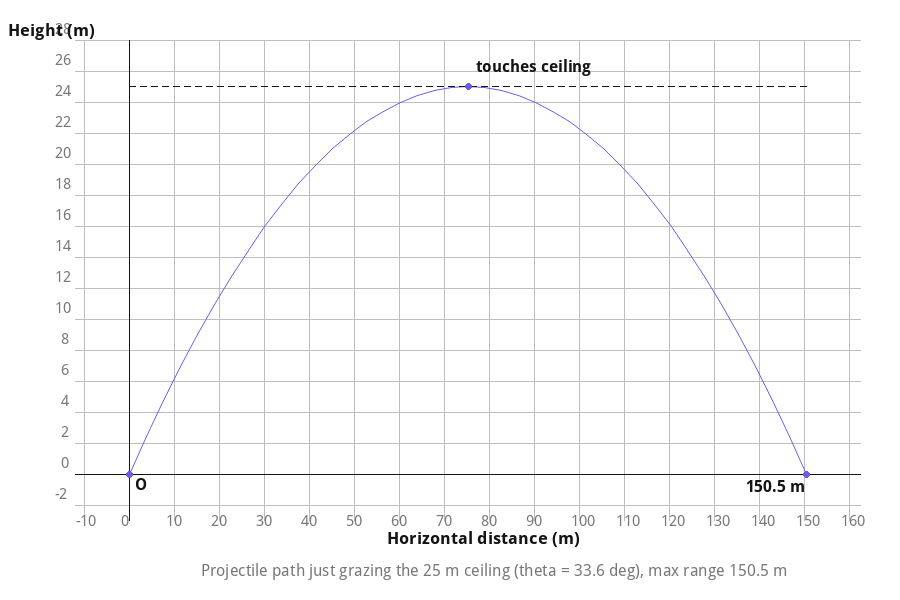
Q12. : Maximum Horizontal Distance of a Ball Thrown Below a Ceiling — The ceiling of a long hall is 25 m high. What is the maximum horizontal distance that a…
The ceiling of a long hall is 25 m high. What is the maximum horizontal distance that a ball thrown with a speed of 40 m/s can go without hitting the ceiling? The ball must be thrown at the largest possible angle θ for which its maximum height stays at or below 25 m, since range increases with angle up to 45°. Using h = u²sin²θ/2g with h = 25 m, u = 40 m/s and g = 9.8 m/s²: sin²θ = 25 × 2 × 9.8 ÷ 1600 = 0.30625, so sinθ = 0.5534 and θ = sin-1(0.5534) = 33.60° (this is less than 45°, confirming a valid solution). The corresponding horizontal range is R = u²sin2θ/g = (1600 × sin67.2°)/9.8 = (1600 × 0.9219)/9.8 = 1475.0/9.8 = 150.5 m. 150.5 m.
Q13. : Maximum Height a Cricketer Can Throw a Ball — A cricketer can throw a ball to a maximum horizontal distance of 100 m. How high above…
A cricketer can throw a ball to a maximum horizontal distance of 100 m. How high above the ground can the cricketer throw the same ball? Maximum horizontal range for a given launch speed u always occurs at θ = 45°, where R = u²sin90°/g = u²/g. So 100 = u²/g, giving u² = 100g = 100 × 9.8 = 980 m²/s². The cricketer throws with the same speed u; the greatest height is reached when the ball is thrown straight up, where the final velocity is zero at the top: using v² − u² = −2gH, the maximum height H = u²/2g = 980/(2 × 9.8) = 980/19.6 = 50 m. 50 m.
Q14. : Centripetal Acceleration of a Stone Whirled in a Circle — A stone tied to a string 80 cm long is whirled in a horizontal circle with constant…
A stone tied to a string 80 cm long is whirled in a horizontal circle with constant speed, making 14 revolutions in 25 s. Find the magnitude and direction of its acceleration. Radius, r = 0.8 m. Frequency, ν = 14 revolutions ÷ 25 s = 0.56 Hz. Angular speed, ω = 2πν = 2 × (22/7) × (14/25) = 3.52 rad/s. Centripetal acceleration, ac = ω²r = (3.52)² × 0.8 = 12.39 × 0.8 = 9.91 m/s². Because the motion is uniform circular motion, this acceleration is directed along the string, towards the centre of the circle, at every instant. 9.91 m/s², directed towards the centre along the string.
Q15. : Centripetal Acceleration of an Aircraft in a Horizontal Loop — An aircraft executes a horizontal loop of radius 1.00 km with a steady speed of…
An aircraft executes a horizontal loop of radius 1.00 km with a steady speed of 900 km/h. Compare its centripetal acceleration with the acceleration due to gravity. Convert speed to SI units: v = 900 × 5/18 = 250 m/s. Radius, r = 1000 m. Centripetal acceleration, ac = v²/r = (250)²/1000 = 62500/1000 = 62.5 m/s². Comparing with g = 9.8 m/s²: ac/g = 62.5/9.8 = 6.38. 62.5 m/s², which is 6.38 times the acceleration due to gravity.
Q16. : True or False – Uniform Circular Motion — State, with reasons, if the following are true or false: (a) the net acceleration of a…
State, with reasons, if the following are true or false: (a) the net acceleration of a particle in circular motion is always directed along the radius towards the centre; (b) the velocity vector of a particle is always along the tangent to its path; (c) the acceleration vector of a particle in uniform circular motion, averaged over one full cycle, is a null vector. (a) False – a purely radial (centripetal) acceleration occurs only when the speed around the circle is constant (uniform circular motion); if the speed is changing, there is also a tangential component of acceleration, so the net acceleration is not purely radial. (b) True – by the geometric definition of velocity as the instantaneous rate of change of position, the velocity vector at any point on a curved path is always tangent to that path at that point. (c) True – in uniform circular motion the centripetal acceleration vector continuously rotates in direction (always pointing to the centre) but keeps the same magnitude; averaged over one complete revolution, these vectors pointing symmetrically in every direction cancel out to give a net average of zero. (a) False, (b) True, (c) True.
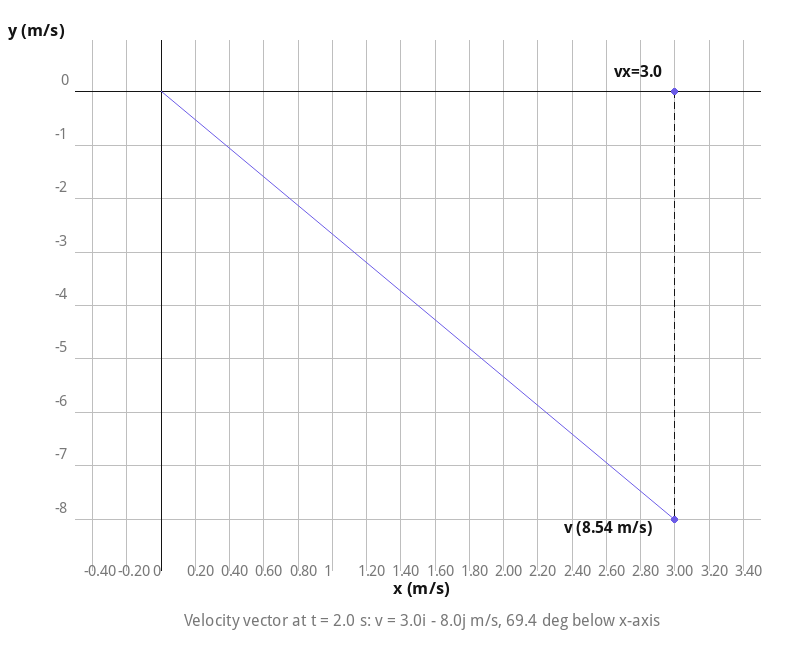
Q17. : Velocity and Acceleration from a Position Vector — The position of a particle is given by r = 3.0tî − 2.0t²ĵ + 4.0k̂ m, where t is in…
The position of a particle is given by r = 3.0tî − 2.0t²ĵ + 4.0k̂ m, where t is in seconds. (a) Find v and a of the particle. (b) What are the magnitude and direction of the velocity at t = 2.0 s? (a) Velocity is the time derivative of position: v = dr/dt = 3.0î − 4.0tĵ (the k-component is constant, so it contributes nothing to velocity). Acceleration is the time derivative of velocity: a = dv/dt = −4.0ĵ m/s² (constant, with no i- or k-component). (b) At t = 2.0 s: v = 3.0î − 8.0ĵ m/s. Magnitude, |v| = √(3.0²+8.0²) = √73 = 8.54 m/s. Direction, θ = tan-1(vy/vx) = tan-1(−8/3) = −69.4°, i.e. 69.4° below the x-axis. v = (3.0î − 4.0tĵ) m/s, a = −4.0ĵ m/s²; at t = 2.0 s, speed = 8.54 m/s directed 69.4° below the x-axis.
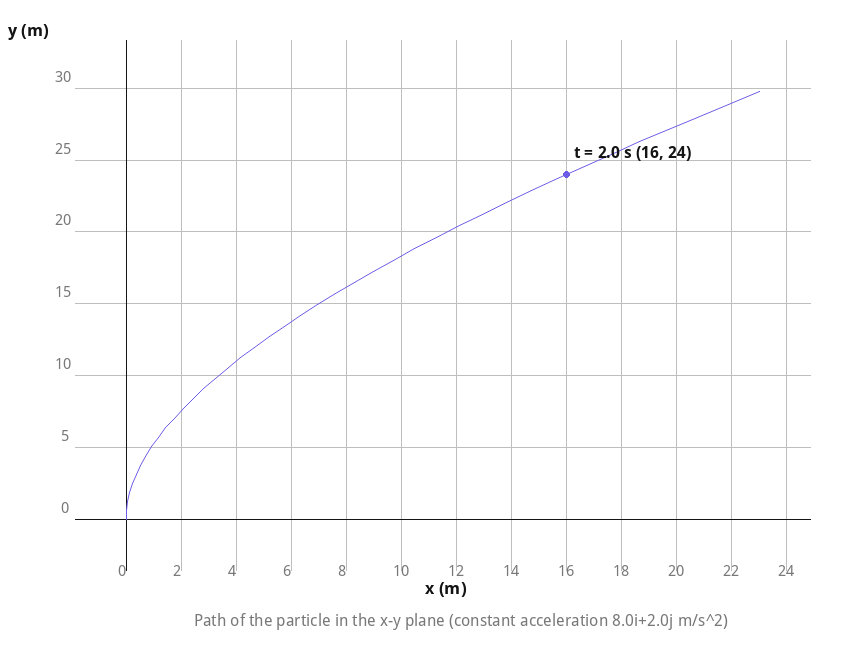
Q18. : Position and Speed of a Particle Under Constant Acceleration — A particle starts from the origin at t = 0 s with velocity 10.0ĵ m/s and moves in the…
A particle starts from the origin at t = 0 s with velocity 10.0ĵ m/s and moves in the x-y plane with constant acceleration (8.0î + 2.0ĵ) m/s². (a) At what time is the x-coordinate 16 m, and what is the y-coordinate then? (b) What is the speed at that time? Using v(t) = v₀ + at = 8.0tî + (10.0+2.0t)ĵ, and integrating again, r(t) = v₀t + ½at² gives x(t) = 4.0t² and y(t) = 10.0t + 1.0t². (a) Setting x = 16: 4.0t² = 16, so t² = 4 and t = 2.0 s. Then y = 10.0(2) + (2)² = 20 + 4 = 24 m. (b) At t = 2.0 s: vx = 8.0(2) = 16 m/s and vy = 10.0 + 2.0(2) = 14 m/s. Speed = √(16²+14²) = √(256+196) = √452 = 21.26 m/s. t = 2.0 s, y = 24 m; speed = 21.26 m/s.
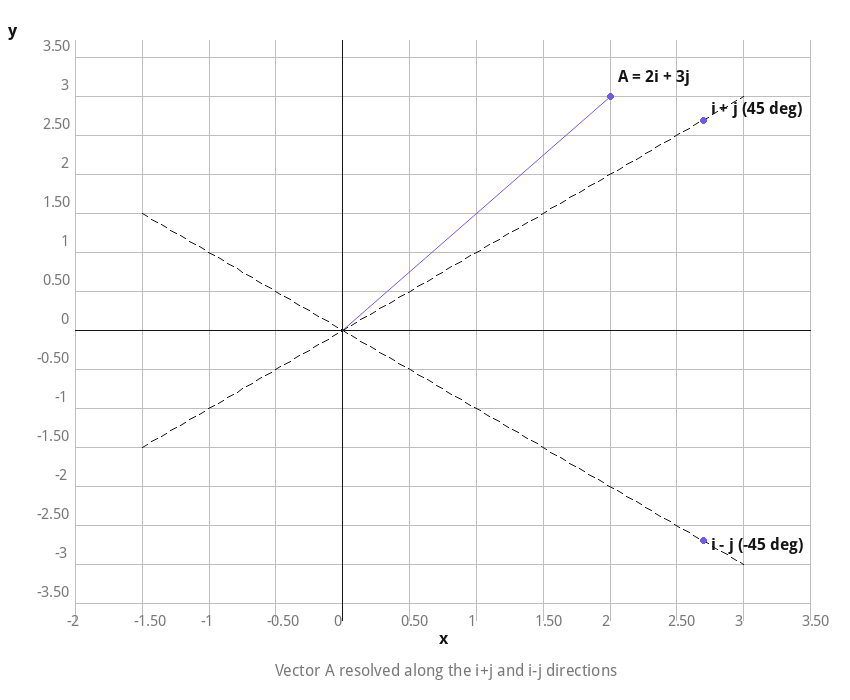
Q19. : Magnitude, Direction and Components of Unit Vectors — If î and ĵ are unit vectors along the x- and y-axes, what are the magnitude and…
If î and ĵ are unit vectors along the x- and y-axes, what are the magnitude and direction of î+ĵ and î−ĵ? What are the components of A = 2î+3ĵ along the directions of î+ĵ and î−ĵ? For î+ĵ: magnitude = √(1²+1²) = √2, at θ = tan-1(1/1) = 45° from the x-axis. For î−ĵ: magnitude = √(1²+1²) = √2, at θ = −45° from the x-axis. Vector A = 2î+3ĵ has magnitude |A| = √(2²+3²) = √13 and makes an angle tan-1(3/2) = 56.31° with the x-axis. The component of A along (î+ĵ)/√2 is the dot product A·(î+ĵ)/√2 = (2+3)/√2 = 5/√2. The component of A along (î−ĵ)/√2 is A·(î−ĵ)/√2 = (2−3)/√2 = −1/√2. î+ĵ has magnitude √2 at 45°; î−ĵ has magnitude √2 at −45°; A has components 5/√2 along (î+ĵ) and −1/√2 along (î−ĵ).
Q20. : True or False – Equations of Motion for Arbitrary Motion — For any arbitrary motion in space, which of the following relations are true? (a)…
For any arbitrary motion in space, which of the following relations are true? (a) vaverage = ½[v(t₁)+v(t₂)]; (b) vaverage = [r(t₂)−r(t₁)]/(t₂−t₁); (c) v(t) = v(0)+at; (d) r(t) = r(0)+v(0)t+½at²; (e) aaverage = [v(t₂)−v(t₁)]/(t₂−t₁). (a) False – averaging just the initial and final velocities only gives the true average velocity if the acceleration is constant, which is not guaranteed for arbitrary motion. (b) True – this is simply the definition of average velocity (net displacement over time) and holds for any motion whatsoever. (c) False – this equation assumes constant acceleration a, which need not hold for arbitrary motion. (d) False – this too assumes constant acceleration, which is not true in general. (e) True – this is simply the definition of average acceleration (change in velocity over time) and always holds. (a) False, (b) True, (c) False, (d) False, (e) True.
Q21. : True or False – Properties of Scalar Quantities — State, with reasons and examples, if the following are true or false. A scalar quantity…
State, with reasons and examples, if the following are true or false. A scalar quantity is one that: (a) is conserved in a process; (b) can never take negative values; (c) must be dimensionless; (d) does not vary from one point to another in space; (e) has the same value for observers with different orientations of axes. (a) False – kinetic energy, a scalar, is not conserved in an inelastic collision even though total energy is; conservation is not a defining property of all scalars. (b) False – temperature in Celsius and electric potential can both take negative values, yet both are scalars. (c) False – total path length is a scalar quantity but has the dimension of length, so scalars need not be dimensionless. (d) False – gravitational potential is a scalar that varies continuously from point to point in space. (e) True – a scalar’s value does not depend on how the coordinate axes are oriented, since it has no directional component to be affected by rotation; this is essentially the defining property of a scalar. (a) False, (b) False, (c) False, (d) False, (e) True.
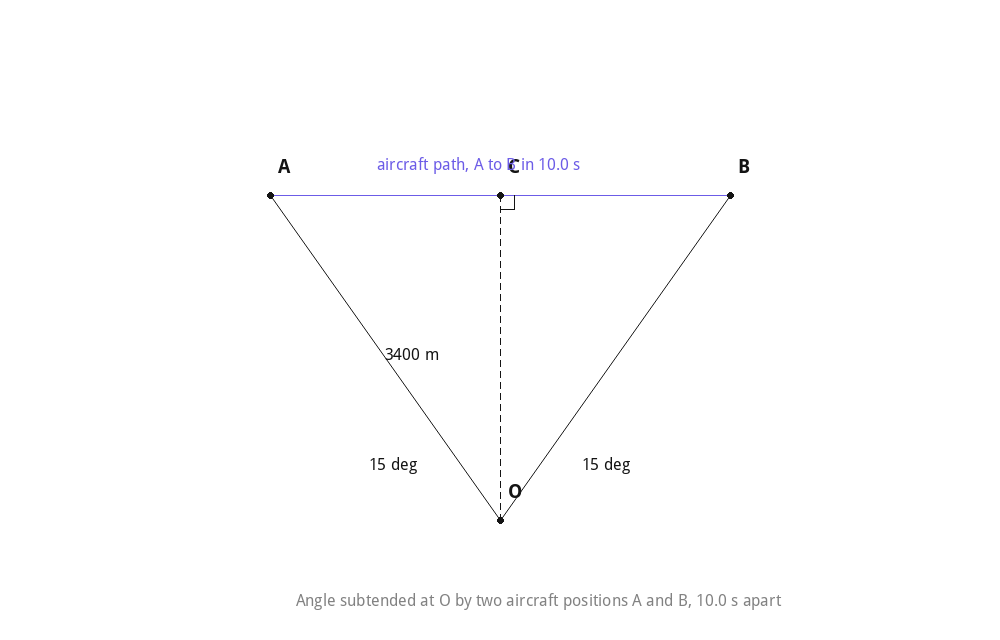
Q22. : Speed of an Aircraft from the Angle it Subtends — An aircraft is flying at a height of 3400 m above the ground. If the angle subtended at…
An aircraft is flying at a height of 3400 m above the ground. If the angle subtended at a ground observation point by two aircraft positions 10.0 s apart is 30°, what is the speed of the aircraft? Let O be the observation point directly below the midpoint of the aircraft’s path, so that the perpendicular height OC = 3400 m, and the 30° angle is split symmetrically into two 15° angles on either side of OC. In the right triangle formed on each side, half the distance travelled, AC = OC × tan15° = 3400 × 0.2679 = 910.9 m. The full distance covered in 10 s is AB = 2 × AC = 2 × 910.9 = 1821.7 m. Speed = distance ÷ time = 1821.7 ÷ 10.0 = 182.2 m/s. 182.2 m/s.
Class 11 Physics Chapter 3 – Notes and Extra Questions
Along with these NCERT Solutions, students can also use the Class 11 Physics Chapter 3 Extra Questions and Class 11 Physics Chapter 3 Revision Notes for quick revision and extra practice.
- Chapter 1: Units and Measurements (2026-27)
- Chapter 2: Motion in a Straight Line – Free PDF Download
- Chapter 4: Laws of Motion – Free PDF Download
- Chapter 5: Work, Energy and Power – Free PDF Download
- Chapter 6: System of Particles and Rotational Motion – Free PDF Download
- Chapter 7: Gravitation – Free PDF Download
- Chapter 8: Mechanical Properties of Solids – Free PDF Download
- Chapter 9: Mechanical Properties of Fluids – Free PDF Download
- Chapter 10: Thermal Properties of Matter – Free PDF Download
- Chapter 11: Thermodynamics – Free PDF Download
- Chapter 12: Kinetic Theory – Free PDF Download
- Chapter 13: Oscillations – Free PDF Download
- Chapter 14: Waves – Free PDF Download
Frequently Asked Questions
What is the difference between a scalar and a vector quantity?
A scalar quantity is completely described by its magnitude alone (a number and a unit), such as mass, speed, distance, or temperature. A vector quantity needs both a magnitude and a direction to be fully specified, such as displacement, velocity, acceleration, or force. Vectors also follow special rules of addition (the triangle or parallelogram law), unlike scalars, which are added by simple arithmetic.
How do you find the resultant of two vectors?
Two vectors can be added graphically using the triangle law (place the tail of the second vector at the head of the first; the resultant is the vector from the tail of the first to the head of the second) or the parallelogram law (place both vectors tail to tail as adjacent sides of a parallelogram; the resultant is the diagonal from the common tail). Analytically, if A and B make an angle θ with each other, the magnitude of the resultant is R = √(A²+B²+2AB cosθ), and its direction relative to A is given by tanφ = B sinθ ÷ (A + B cosθ).
What are the formulas for the range, maximum height and time of flight of a projectile?
For a projectile launched with speed u at an angle θ above the horizontal (with g as the acceleration due to gravity and air resistance neglected): time of flight T = 2u sinθ ÷ g; maximum height H = u²sin²θ ÷ 2g; and horizontal range R = u²sin2θ ÷ g. The range is maximum when θ = 45°, since sin2θ is then at its peak value of 1.
What is uniform circular motion, and how is centripetal acceleration calculated?
Uniform circular motion is motion along a circular path at constant speed. Even though the speed does not change, the direction of the velocity is continuously changing, so the object is still accelerating. This acceleration, called centripetal acceleration, always points from the object towards the centre of the circle and has magnitude ac = v²/r = ω²r, where v is the speed, r is the radius of the circle, and ω = v/r is the angular speed.
Recommended: Buy the Printed NCERT Class 11 Physics Book Set
Contains Amazon affiliate links.
If you’d like a printed copy alongside the PDF, here’s a verified option:
Rs. 280
Price and availability may change on Amazon. As an Amazon Associate, ncertbooks.org earns from qualifying purchases.



Pingback: Class 11 Physics Chapter 11 Thermodynamics Extra Questions (2026-27)