
NCERT Solutions for Class 11 Physics Chapter 13, Oscillations, cover the complete set of 18 exercise questions from the current rationalised (2023, 2026-27 reprint) textbook. This chapter builds on the idea of periodic motion, develops simple harmonic motion (SHM) both algebraically and through the reference-circle method, and applies these ideas to springs, pendulums, floating bodies and oscillating liquid columns. Every solution below has been independently re-derived from first principles, with clear step-by-step working, so students can follow the physics rather than just copy a final number.
NCERT Class 11 Physics Chapter 13 Oscillations – Exercise Solutions
13.1 Which of the following examples represent periodic motion?
(a) A swimmer completing one (return) trip from one bank of a river to the other and back. (b) A freely suspended bar magnet displaced from its N-S direction and released. (c) A hydrogen molecule rotating about its centre of mass. (d) An arrow released from a bow.
Last Updated: September 23, 2026
Solution: A motion is periodic only if it repeats itself identically after equal intervals of time, indefinitely (or for as long as the motion continues in the same fashion).
(a) Periodic – the swimmer repeats the same to-and-fro trip again and again.
(b) Periodic – the magnet oscillates back and forth about its equilibrium (N-S) orientation.
(c) Periodic – the rotating molecule returns to the same orientation after every rotation.
(d) Not periodic – once released, the arrow moves away and the motion is never repeated.
13.2 Which examples represent SHM and which represent periodic but not SHM?
(a) Rotation of earth about its axis. (b) Motion of an oscillating mercury column in a U-tube. (c) Motion of a ball bearing inside a smooth curved bowl, released from a point slightly above the lowest point. (d) General vibrations of a polyatomic molecule about its equilibrium position.
Solution: SHM requires a restoring force (or torque) directly proportional to displacement from a fixed mean position, F = −kx.
(a) Periodic but not SHM – uniform circular motion, no restoring force towards a mean position along the motion.
(b) SHM – the restoring pressure difference is proportional to the displacement of the mercury column.
(c) SHM (for small oscillations) – behaves like a simple pendulum near the lowest point of the bowl.
(d) Periodic but not SHM in general – a polyatomic molecule vibrates as a superposition of several normal modes, so overall motion, though periodic, is not simple harmonic.
13.3 Which of the x-t plots (Fig. 13.18) represent periodic motion? Give the period.
The four given x-t graphs must each be checked for whether the displacement pattern repeats identically after a fixed time interval.
Solution: Graph (a) repeats its shape every 2 s, so it is periodic with period T = 2 s. Graph (b) never repeats the same pattern again (the motion changes character with time), so it is non-periodic. Graph (c) repeats itself every 2 s (even though there is a sudden change/discontinuity within a cycle, the full waveform recurs), so it is periodic with T = 2 s. Graph (d) does not repeat itself and is therefore non-periodic. (Only a curve that exactly reproduces its shape after a fixed interval qualifies as periodic – apply this test to whichever exact figure is printed in your copy of the book.)
13.4 Which functions represent (a) SHM, (b) periodic but not SHM, (c) non-periodic motion? Give the period for each periodic case.
(a) sin ωt – cos ωt (b) sin³ ωt (c) 3 cos(π/4 − 2ωt) (d) cos ωt + cos 3ωt + cos 5ωt (e) exp(−ω²t²) (f) 1 + ωt + ω²t²
Solution:
(a) sinωt − cosωt = √2 sin(ωt − π/4). This is a single sine function of one frequency ⇒ SHM, period T = 2π/ω.
(b) sin³ωt = ¾ sinωt − ¼ sin3ωt. Sum of harmonics of different frequency ⇒ periodic, not SHM, period T = 2π/ω.
(c) 3 cos(π/4 − 2ωt) = 3 cos(2ωt − π/4). Single cosine of one frequency ⇒ SHM, period T = 2π/(2ω) = π/ω.
(d) cosωt + cos3ωt + cos5ωt is a sum of three different frequencies ⇒ periodic, not SHM; the combined period is the LCM of 2π/ω, 2π/3ω, 2π/5ω, which is T = 2π/ω.
(e) exp(−ω²t²) decays monotonically to zero as t → ∞ and never repeats ⇒ non-periodic.
(f) 1 + ωt + ω²t² increases without bound and never repeats ⇒ non-periodic.
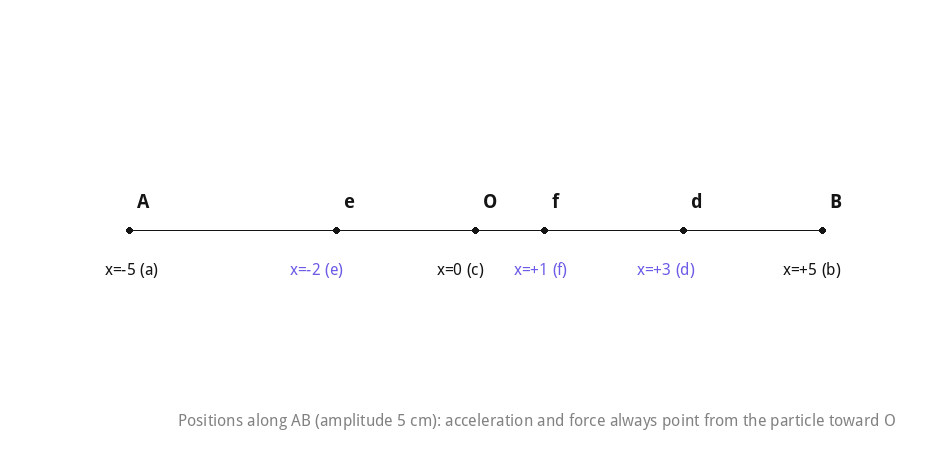
13.5 Signs of velocity, acceleration and force in SHM between A and B (10 cm apart)
Take the direction from A to B as positive. Give signs of velocity, acceleration and force when the particle is: (a) at end A, (b) at end B, (c) at the midpoint going towards A, (d) 2 cm from B going towards A, (e) 3 cm from A going towards B, (f) 4 cm from B going towards A.
Solution: Place the mean position O at the centre of AB, so the amplitude is 5 cm, with A at x = −5 cm and B at x = +5 cm. In SHM, acceleration and the restoring force always point from the particle’s position towards O (i.e., a and F have sign opposite to x), while velocity is zero only at the extremes.
(a) At A (x = −5, extreme): v = 0; a and F are positive (directed towards B).
(b) At B (x = +5, extreme): v = 0; a and F are negative (directed towards A).
(c) At the midpoint (x = 0) moving towards A: v is negative (maximum speed); a = 0 and F = 0.
(d) 2 cm from B towards A (x = +3, moving towards A): v is negative; a and F are negative.
(e) 3 cm from A towards B (x = −2, moving towards B): v is positive; a and F are positive.
(f) 4 cm from B towards A (x = +1, moving towards A): v is negative; a and F are negative.
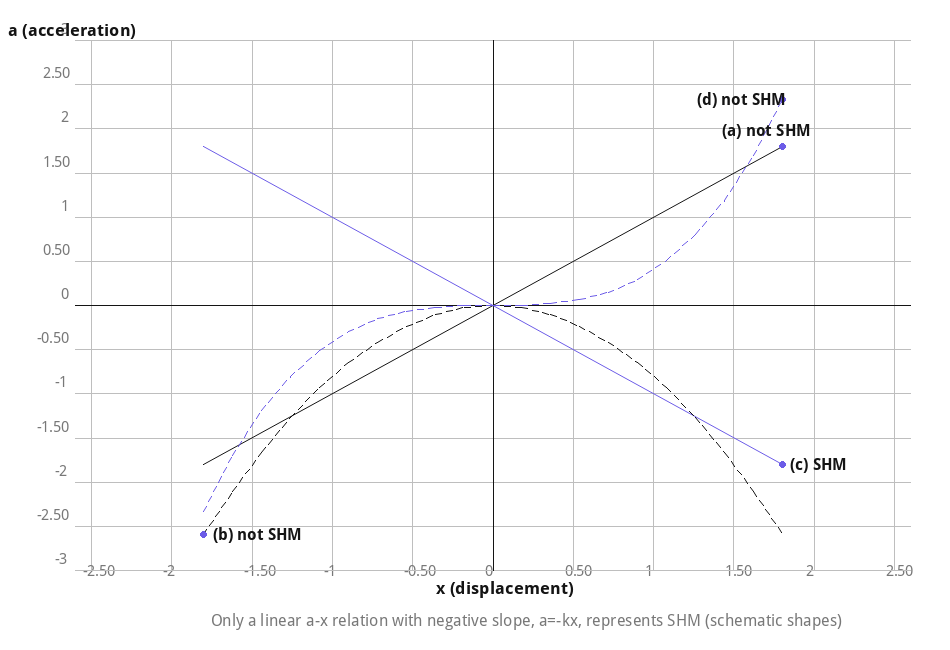
13.6 Which acceleration–displacement relations represent SHM?
(a) a = 0.7x (b) a = −200x² (c) a = −10x (d) a = 100x³
Solution: SHM requires a ∝ −x, i.e. a linear relation with a negative constant of proportionality. (a) is linear but positive (not restoring – unstable equilibrium). (b) and (d) are non-linear (quadratic and cubic). Only (c) a = −10x satisfies a = −ω²x with ω² = 10, so only (c) represents SHM.
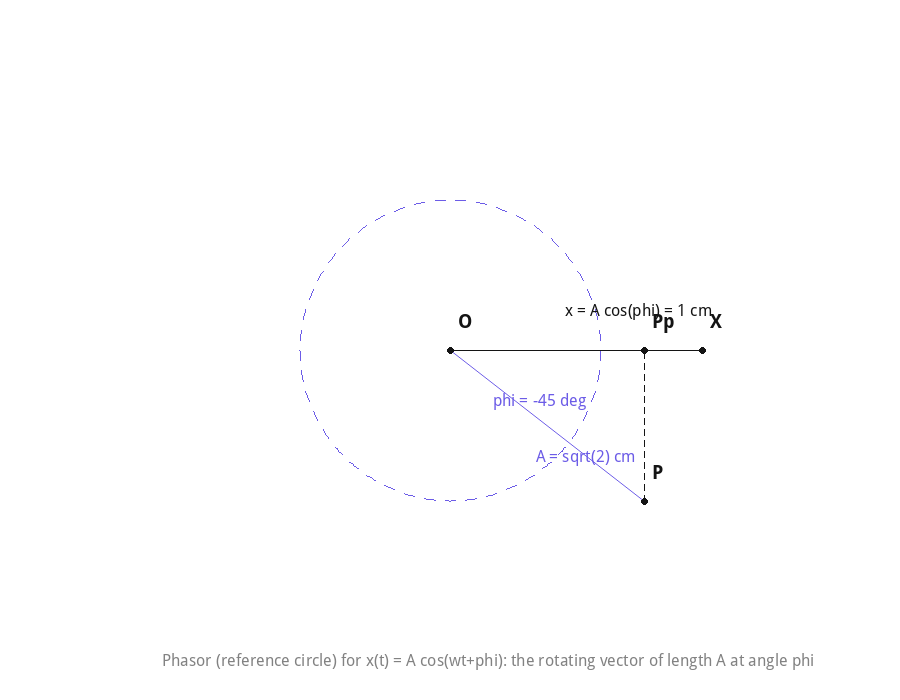
13.7 Amplitude and initial phase from x(t) = A cos(ωt + φ)
Initial position x(0) = 1 cm, initial velocity = ω cm/s, ω = π s⁻¹. Find A and φ. Also find B and α if the same motion is written as x = B sin(ωt + α).
Solution: For x = A cos(ωt + φ): x(0) = A cosφ = 1. v(t) = −Aω sin(ωt+φ), so v(0) = −Aω sinφ = ω ⇒ A sinφ = −1.
Then A² = (A cosφ)² + (A sinφ)² = 1 + 1 = 2 ⇒ A = √2 cm. Since cosφ = 1/√2 > 0 and sinφ = −1/√2 < 0, φ lies in the fourth quadrant: φ = −π/4 rad.
For x = B sin(ωt + α): x(0) = B sinα = 1; v(0) = Bω cosα = ω ⇒ B cosα = 1. So B² = 1 + 1 = 2 ⇒ B = √2 cm, and since both sinα and cosα are positive and equal, α = π/4 rad.
13.8 Spring balance: weight of the oscillating body
A spring balance reads 0 to 50 kg over a scale length of 20 cm. A body suspended from it, when displaced and released, oscillates with period 0.6 s. Find the weight of the body.
Solution: The full-scale force stretches the spring by the full scale length, so the spring constant is
k = (50 kg × 9.8 m/s²) / 0.20 m = 490 / 0.20 = 2450 N/m.
For the suspended body, T = 2π√(m/k) ⇒ m = k T² / (4π²) = 2450 × (0.6)² / (4π²) = 2450 × 0.36 / 39.48 ≈ 22.34 kg.
Weight = mg = 22.34 × 9.8 ≈ 218.9 N (≈ 219 N).
13.9 Spring–mass system: frequency, maximum acceleration, maximum speed
A spring of force constant k = 1200 N/m is mounted horizontally. A mass of 3 kg is attached, pulled 2.0 cm sideways, and released. Find (i) frequency, (ii) maximum acceleration, (iii) maximum speed.
Solution: ω = √(k/m) = √(1200/3) = √400 = 20 rad/s. Amplitude A = 0.02 m.
(i) Frequency f = ω/2π = 20/(2π) ≈ 3.18 Hz.
(ii) Maximum acceleration = ω²A = 400 × 0.02 = 8 m/s².
(iii) Maximum speed = ωA = 20 × 0.02 = 0.4 m/s.
13.10 Displacement functions x(t) for the mass in Exercise 13.9
Take x = 0 at the unstretched position and the left-to-right direction as positive. Give x(t) if at t = 0 the mass is (a) at the mean position, (b) at the maximum stretched position, (c) at the maximum compressed position. How do these functions differ?
Solution: Using A = 0.02 m and ω = 20 rad/s from Exercise 13.9:
(a) Starting at the mean position (moving in the positive direction, say): x(t) = 0.02 sin(20t) m.
(b) Starting at maximum extension: x(t) = 0.02 cos(20t) m.
(c) Starting at maximum compression: x(t) = −0.02 cos(20t) m.
All three motions have the same amplitude (0.02 m) and the same frequency/angular frequency (20 rad/s) – they differ only in initial phase (0, −π/2, and π type shifts depending on convention used).
13.11 Circular motion → SHM projections
Figures 13.20 show two circular motions with given radius, period, initial position and sense of rotation. Obtain the corresponding SHM of the x-projection of the revolving particle P in each case.
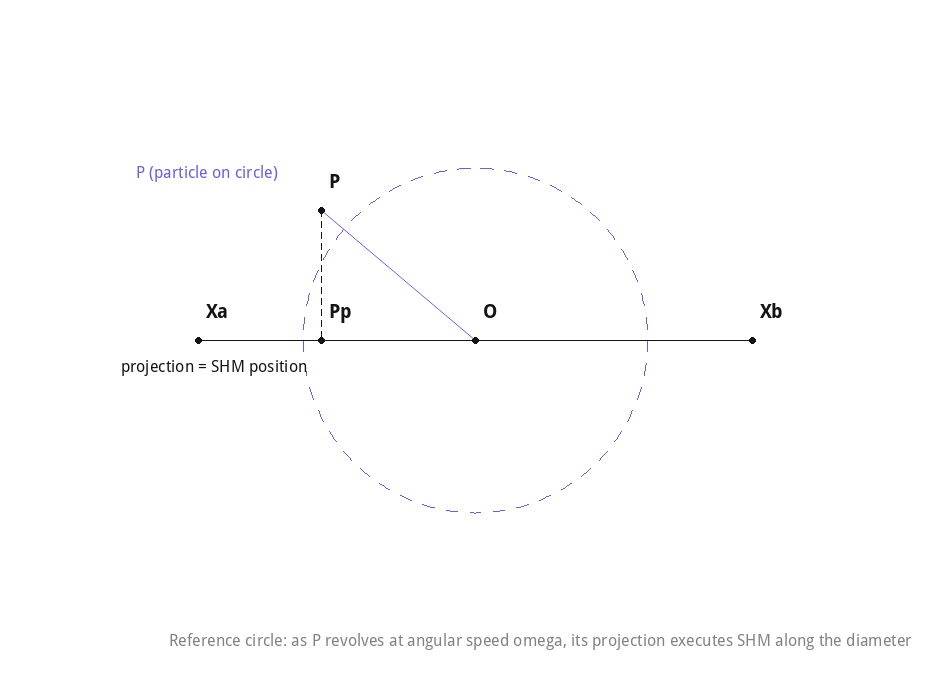
Solution: The general method: if a particle moves on a circle of radius R with angular speed ω = 2π/T, and its angular position at t = 0 is θ₀ (measured from the positive x-axis, taking anticlockwise as positive), then the x-projection is x(t) = R cos(θ₀ ± ωt), with the sign inside depending on the sense of rotation (+ for anticlockwise, − for clockwise).
For the standard figure (radius 3 cm, T = 2 s, particle starting on the negative x-axis and moving clockwise): ω = 2π/2 = π rad/s, so x(t) = −3 cos(πt) cm.
For the second case (radius 2 cm, T = 4 s, particle starting on the positive y-axis and moving clockwise): ω = 2π/4 = π/2 rad/s, so x(t) = 2 sin(πt/2) cm.
(Apply the same R cos(θ₀ ± ωt) rule to the exact radius, period, starting point and rotation sense shown in your printed figure if it differs.)
13.12 Reference circles for given SHM equations
Plot the reference circle for each SHM below (anticlockwise rotation assumed), indicating radius, initial position and angular speed (x in cm, t in s): (a) x = −2 sin(3t + π/3) (b) x = cos(π/6 − t) (c) x = 3 sin(2πt + π/4) (d) x = 2 cos πt
Solution: Convert each to the standard cosine form x = R cos(ωt + θ₀):
(a) −2 sin(3t+π/3) = 2 cos(3t+π/3+π/2) = 2 cos(3t + 5π/6). Radius 2 cm, ω = 3 rad/s, initial angular position 5π/6 (150°).
(b) cos(π/6−t) = cos(t−π/6). Radius 1 cm, ω = 1 rad/s, initial angular position −π/6 (−30°).
(c) 3 sin(2πt+π/4) = 3 cos(2πt+π/4−π/2) = 3 cos(2πt − π/4). Radius 3 cm, ω = 2π rad/s, initial angular position −π/4 (−45°).
(d) 2 cos πt. Radius 2 cm, ω = π rad/s, initial angular position 0° (starts on the positive x-axis).
13.13 Spring stretched by force F: one fixed end vs both ends free
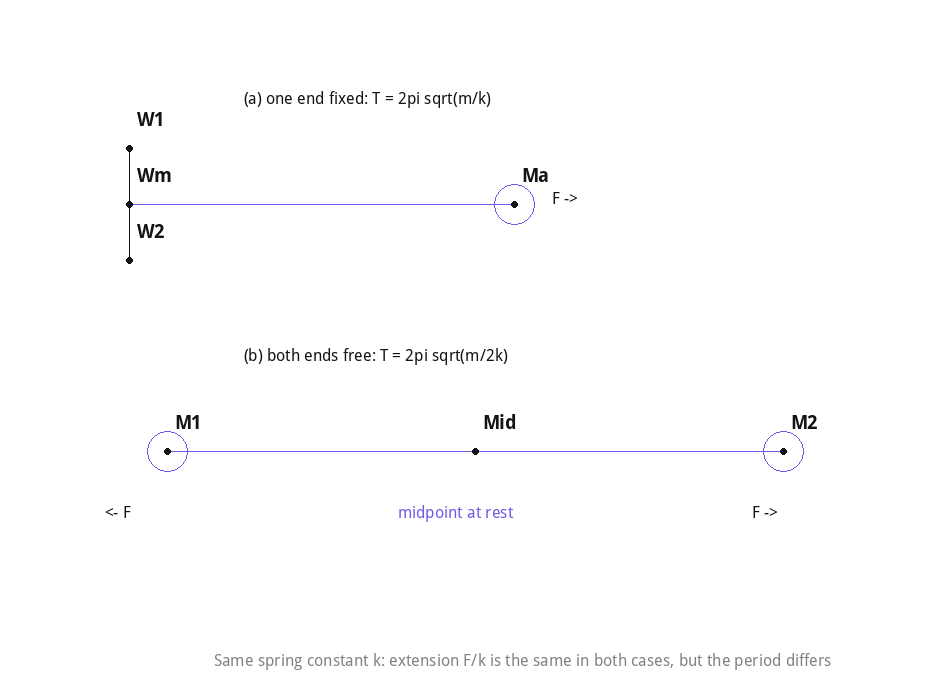
(a) Fig. 13.21(a): spring of constant k, one end clamped, mass m at the free end, force F applied at the free end. Fig. 13.21(b): the same spring free at both ends, with a mass m at each end, and each end stretched by the same force F. Find (a) the maximum extension of the spring in each case, (b) the period of oscillation in each case, if the mass(es) are released.
Solution:
Extension: In both cases, the tension throughout the spring equals F, so the maximum extension is the same in both cases: x₀ = F/k.
Period, case (a): A single mass on a spring of constant k fixed at the other end: T = 2π√(m/k).
Period, case (b): By symmetry the midpoint of the spring stays at rest, so each mass effectively oscillates against “half” the spring; a spring cut in half has twice the spring constant of the original (2k). Equivalently, using the reduced mass μ = m²/(m+m) = m/2 for the two-body problem, ω = √(k/μ) = √(2k/m). Hence T = 2π√(m/2k) – i.e. the two-mass system oscillates faster (by a factor of √2) than the single-mass case.
13.14 Locomotive piston: maximum speed
The piston has a stroke (twice the amplitude) of 1.0 m and moves with SHM of angular frequency 200 rad/min. Find its maximum speed.
Solution: Amplitude A = stroke/2 = 0.5 m. Convert ω to rad/s: ω = 200 rad/min × (1 min/60 s) = 3.333 rad/s.
Maximum speed vₓₓₓ = ωA = 3.333 × 0.5 ≈ 1.67 m/s.
13.15 Simple pendulum on the Moon
g on the Moon = 1.7 m/s², g on Earth = 9.8 m/s². If the period of a simple pendulum on Earth is 3.5 s, find its period on the Moon.
Solution: T = 2π√(l/g), so T ∝ 1/√g for the same pendulum (same length l).
Tᵣᵣᵣᵣ = Tᵢᵢᵢᵢ × √(gᵢᵢᵢᵢ/gᵣᵣᵣᵣ) = 3.5 × √(9.8/1.7) = 3.5 × √5.765 = 3.5 × 2.401 ≈ 8.40 s.
13.16 Pendulum in a car moving on a circular track
A simple pendulum of length l and bob mass M is suspended in a car moving on a circular track of radius R at uniform speed v. For small radial oscillations about equilibrium, find the time period.
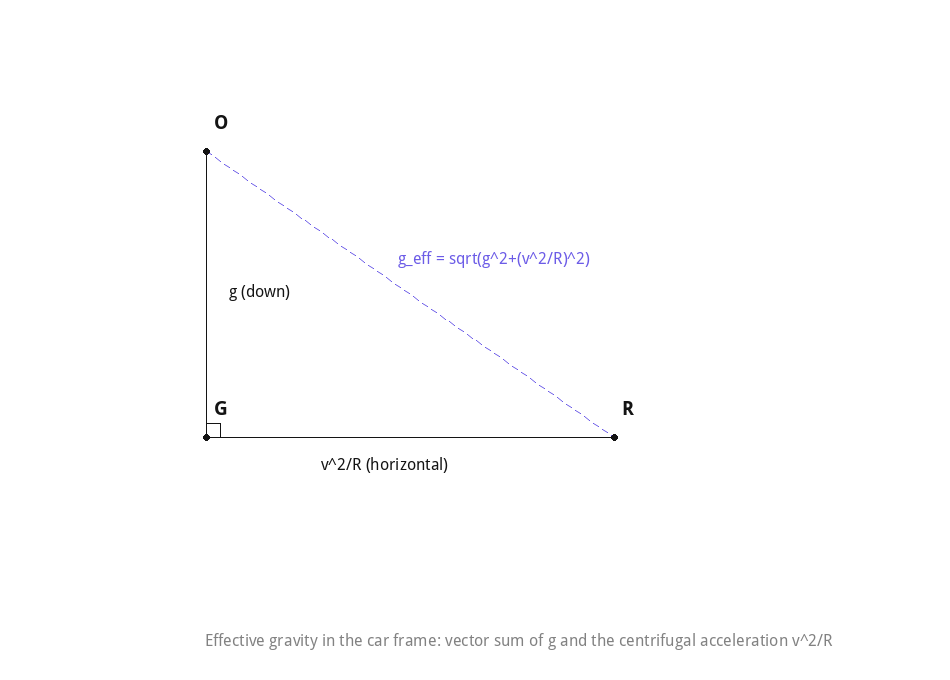
Solution: In the car’s (non-inertial) frame, the bob experiences gravity g (vertically down) and a pseudo centrifugal acceleration v²/R (horizontally outward), since the car is in uniform circular motion. These two accelerations combine at right angles to give an effective gravity:
gᵀᵍᴹ = √[g² + (v²/R)²]
The pendulum then behaves as a simple pendulum under this effective gravity:
T = 2π √{ l / √[g² + (v²/R)²] }
13.17 Floating cork: show SHM and find the period
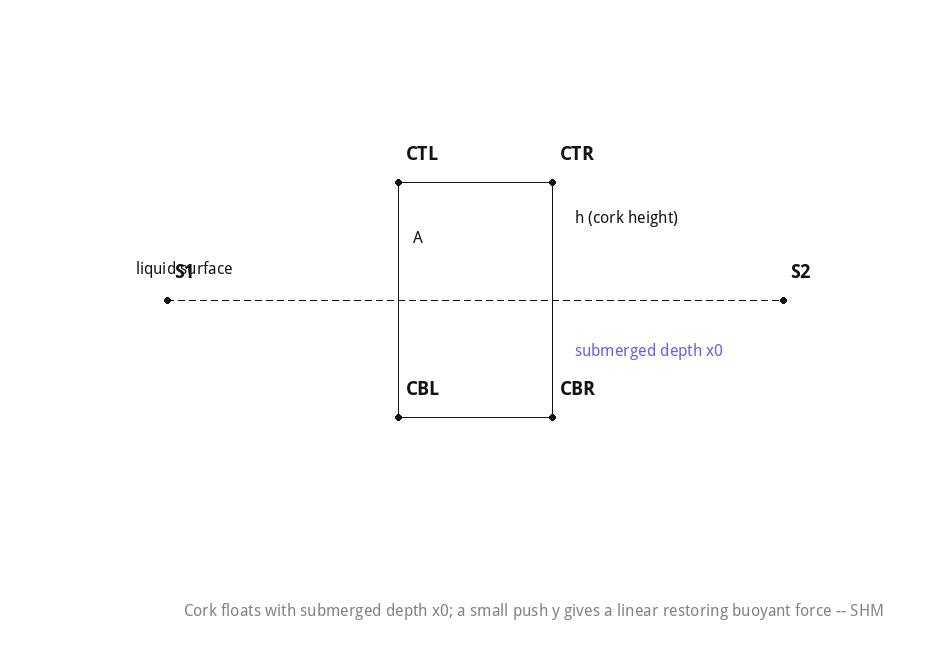
A cylindrical cork of base area A, height h, and density ρ floats in a liquid of density ρₛ. Show that when depressed slightly and released, it executes SHM with T = 2π√[(h/g)(ρ/ρₛ)]. (Ignore viscous damping.)
Solution: At equilibrium, weight = buoyant force: ρAhg = ρₛAx₀g, where x₀ is the submerged depth. If the cork is pushed down by an additional small distance y, the extra buoyant (restoring) force is
F = −ρₛAg·y,
which is linear in y, confirming SHM with effective “spring constant” k = ρₛAg. The mass of the cork is m = ρAh. So
T = 2π√(m/k) = 2π√[ρAh / (ρₛAg)] = 2π√[(h/g)(ρ/ρₛ)], exactly as required.
13.18 Mercury in a U-tube: show SHM
One end of a U-tube containing mercury is connected to a suction pump, the other end to the atmosphere. A small pressure difference is maintained. Show that when the pump is removed, the mercury column executes SHM.
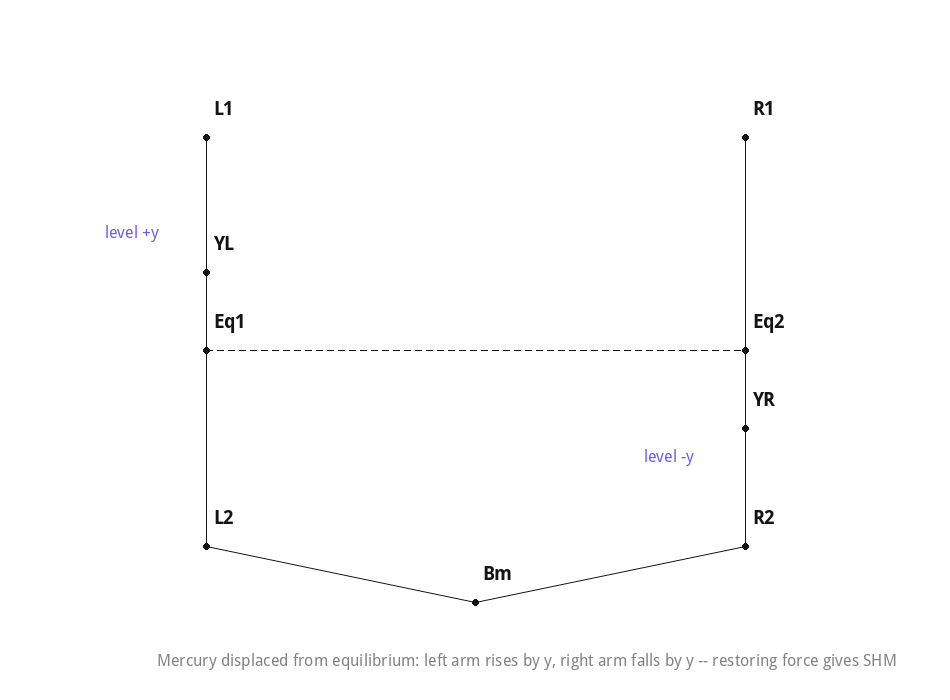
Solution: Let the total length of the mercury column be L, cross-sectional area A, and density ρ, so the total mass is m = ρAL. If the mercury level is displaced by y from its equilibrium (level) position, one arm rises by y and the other falls by y, creating a height difference of 2y between the two columns. This produces a restoring pressure difference ΔP = ρg(2y), and hence a restoring force
F = −ΔP·A = −2ρgAy,
which is linear in y (SHM), with effective spring constant k = 2ρgA. Therefore
T = 2π√(m/k) = 2π√[ρAL / (2ρgA)] = 2π√(L/2g), confirming the mercury column oscillates simple harmonically about its equilibrium level.
Notes and Extra Questions
Key formulas to remember:
• Displacement in SHM: x(t) = A cos(ωt + φ), with velocity v(t) = −Aω sin(ωt + φ) and acceleration a(t) = −ω²x(t).
• Spring–mass system: ω = √(k/m), T = 2π√(m/k).
• Simple pendulum: T = 2π√(l/g) (valid for small angular amplitude, θ < ~10°).
• Total energy in SHM: E = ½mω²A² (constant), split between kinetic energy ½mω²(A²−x²) and potential energy ½mω²x² at displacement x.
• The reference-circle (uniform circular motion) picture is a powerful way to visualise SHM: the projection of a point moving on a circle at constant angular speed ω onto any diameter executes SHM of the same ω.
Common student errors in this chapter: confusing “periodic” with “simple harmonic” (all SHM is periodic, but not all periodic motion is SHM – check that the restoring force/acceleration is strictly linear in displacement); forgetting to convert angular frequency units (e.g. rad/min to rad/s, as in Exercise 13.14); and mixing up amplitude with total path length (amplitude is the maximum displacement from the mean position, not the distance between the two extremes).
Note on the current syllabus: As per the CBSE/NCERT 2023 rationalisation, the topic “free, forced and damped oscillations (qualitative ideas only), resonance” has been removed from the current Class 11 Physics theory syllabus for this chapter, along with the corresponding “Additional Exercises” that dealt with damped oscillators, forced/resonant oscillations and related applications found in older editions of the textbook. The current chapter therefore ends at Exercise 13.18; students using older PDFs or solution sets that list up to Exercise 13.25 are looking at the pre-2023 edition, and those extra questions are not part of the current syllabus.
- Chapter 1: Units and Measurements (2026-27)
- Chapter 2: Motion in a Straight Line – Free PDF Download
- Chapter 3: Motion in a Plane – Free PDF Download
- Chapter 4: Laws of Motion – Free PDF Download
- Chapter 5: Work, Energy and Power – Free PDF Download
- Chapter 6: System of Particles and Rotational Motion – Free PDF Download
- Chapter 7: Gravitation – Free PDF Download
- Chapter 8: Mechanical Properties of Solids – Free PDF Download
- Chapter 9: Mechanical Properties of Fluids – Free PDF Download
- Chapter 10: Thermal Properties of Matter – Free PDF Download
- Chapter 11: Thermodynamics – Free PDF Download
- Chapter 12: Kinetic Theory – Free PDF Download
- Chapter 14: Waves – Free PDF Download
FAQs on NCERT Class 11 Physics Chapter 13 Oscillations
Q1. How many exercise questions are there in the current NCERT Class 11 Physics Chapter 13, Oscillations?
The current (2023 rationalised, 2026-27 reprint) edition has 18 exercise questions, numbered 13.1 to 13.18. Older editions had 25 questions (13.1 to 13.25), with the last seven (“Additional Exercises”) covering damped/forced oscillations and resonance-related applications that have since been removed from the syllabus.
Q2. What is the difference between periodic motion and simple harmonic motion?
Every SHM is periodic, but not every periodic motion is SHM. Periodic motion only requires that the motion repeat itself after a fixed time interval (e.g. uniform circular motion, or a bouncing ball). SHM is a special, more restrictive case where the restoring force (and hence acceleration) is directly proportional to the displacement from the mean position and always directed towards it, i.e. F = −kx.
Q3. Does the time period of a simple pendulum depend on the mass of the bob or the amplitude of swing?
No. For small angular amplitudes, T = 2π√(l/g) depends only on the pendulum’s length l and the local acceleration due to gravity g – it is independent of both the mass of the bob and the amplitude of oscillation. This is why a simple pendulum was historically used as a time-keeping standard.
Q4. Why was the topic of damped and forced oscillations removed from the current CBSE/NCERT syllabus?
As part of the 2023 curriculum rationalisation exercise (aimed at reducing content load), CBSE and NCERT dropped several qualitative/descriptive sub-topics across science subjects. For this chapter, “free, forced and damped oscillations (qualitative ideas only), resonance” was one such topic removed from the theory portion, and the exercise questions that depended on it (e.g. involving automobile suspension damping, or air-chamber oscillations used to illustrate driven oscillations) were removed accordingly, leaving the chapter’s exercises focused purely on undamped SHM.
Frequently Asked Questions
What is the difference between periodic motion and simple harmonic motion (SHM)?
Periodic motion is any motion that repeats itself after a fixed time interval; SHM is a special, more restricted type of periodic motion where the restoring force (and acceleration) is directly proportional to displacement from the mean position and always directed towards it.
How are time period and frequency related in oscillations?
Frequency (f) is the number of oscillations per second, and time period (T) is the time for one complete oscillation — they are reciprocals of each other, f = 1/T, so a higher frequency always means a shorter time period.
Recommended: Buy the Printed NCERT Class 11 Physics Book Set
Contains Amazon affiliate links.
If you’d like a printed copy alongside the PDF, here’s a verified option:
Rs. 280
Price and availability may change on Amazon. As an Amazon Associate, ncertbooks.org earns from qualifying purchases.


