
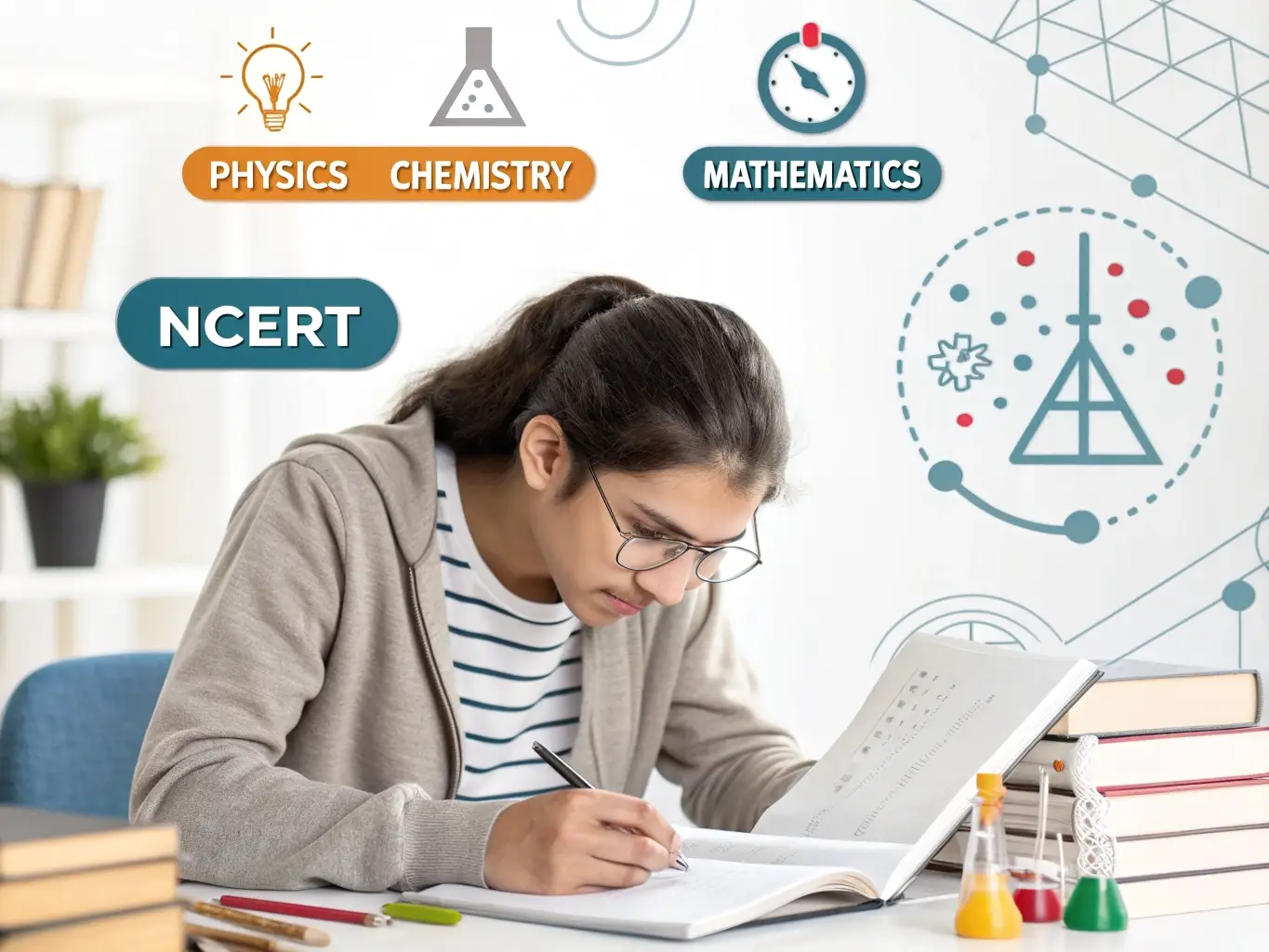
JEE Main and Advanced test far more depth than board exams, but nearly every serious aspirant still starts their preparation with NCERT textbooks before moving to advanced problem sets.
The Core JEE NCERT List
- Class 11 & 12 Physics — for concepts and derivations
- Class 11 & 12 Chemistry — especially inorganic and physical chemistry
- Class 11 & 12 Mathematics — for foundational problem-solving methods
Where NCERT Is Enough — and Where It Isn’t
NCERT Chemistry (especially inorganic) closely matches JEE-level questions, but NCERT Physics and Mathematics generally need to be supplemented with advanced reference books for JEE Advanced-level problem-solving.
A Practical Approach
Use NCERT to build the conceptual base for every topic first — attempting advanced problems without this foundation usually leads to inefficient, formula-memorisation-based studying.
Download These Books
Get every JEE-relevant NCERT book in our Class 11 and Class 12 catalog pages.
Ready to find your textbook? Browse the full NCERT Book Catalog or head to our complete NCERT Books guide for class-wise and subject-wise downloads.
Topic-by-Topic: Where NCERT Is Enough, and Where It Isn’t
Inorganic Chemistry: NCERT is often described as close to sufficient here. Periodic properties, coordination compounds, and most named reactions map closely onto JEE-level questions, making this the highest-value section to master directly from NCERT.
Physical Chemistry: NCERT builds the conceptual foundation well, but JEE numerical problems — especially in equilibrium, electrochemistry, and thermodynamics — typically require additional practice beyond NCERT’s exercises to reach the required speed and problem variety.
Organic Chemistry: NCERT introduces mechanisms and functional groups clearly, but JEE Advanced-level organic problems often combine multiple concepts in ways NCERT’s exercises don’t fully prepare you for — treat NCERT as the vocabulary and mechanism foundation, not the final practice source.
Physics: NCERT explains derivations well, which is genuinely valuable for understanding where formulas come from, but the numerical problem difficulty in NCERT is noticeably below JEE Main level, let alone JEE Advanced. Advanced problem sets are necessary here.
Mathematics: Similar to Physics — NCERT covers the methods and definitions solidly, but problem difficulty and variety both fall well short of what JEE actually tests, particularly for Advanced.
A Realistic JEE Study Timeline With NCERT
Most successful JEE aspirants complete a first NCERT pass (all three subjects, Class 11 and 12) within 3-4 months of starting serious preparation, treating it as the foundation phase before shifting the majority of study time to advanced problem sets and mock tests. Returning to specific NCERT chapters for quick revision — especially inorganic chemistry and physics derivations — close to the exam is a common and effective strategy, rather than treating the first read as the only time NCERT gets used.
Common Mistakes JEE Aspirants Make With NCERT
- Skipping NCERT entirely: Some aspirants jump straight to coaching material, then struggle with gaps in basic terminology and derivations that NCERT would have covered.
- Over-relying on NCERT for numericals: Assuming NCERT’s exercise difficulty matches JEE’s is a common and costly miscalculation, especially for Physics and Mathematics.
- Not revisiting NCERT later: Many aspirants read NCERT once early on and never return to it, missing the value of using it as a quick concept-refresher during final revision.
A Chapter-Weighted Look at Where JEE Questions Concentrate
Within Physics, Mechanics and Electrodynamics together account for the largest share of JEE Main and Advanced questions, with Modern Physics and Thermodynamics following behind. NCERT explains the underlying concepts in these areas reasonably well, but JEE’s tendency to combine multiple concepts within a single multi-step problem — especially in Advanced — means NCERT’s own end-of-chapter problems rarely resemble the actual difficulty or format of exam questions, making dedicated problem-solving practice non-negotiable here specifically.
In Mathematics, Calculus (differentiation, integration, and differential equations combined) and Coordinate Geometry together dominate the weightage, with Algebra and Trigonometry providing essential supporting groundwork rather than being heavily tested as standalone topics. NCERT’s Mathematics exercises are closer to JEE Main difficulty than its Physics exercises are, but still generally fall short of JEE Advanced’s problem complexity, particularly in problems requiring creative combination of multiple techniques within one question.
In Chemistry, as discussed, Inorganic Chemistry rewards direct NCERT reading almost one-to-one, while Physical and Organic Chemistry need substantially more practice beyond NCERT’s own exercises to reach competitive-exam readiness.
Balancing NCERT With Reference Material: A Sequencing Approach
Rather than treating NCERT and advanced reference material as competing resources, a sequenced approach tends to work better: read the NCERT chapter first for conceptual grounding and the specific derivations or mechanisms it covers, then move to problem sets from advanced reference material for that same topic while the NCERT explanation is still fresh. Attempting advanced problems before establishing the NCERT-level conceptual foundation often leads to memorising problem-solving patterns without genuine understanding, which tends to break down on JEE Advanced questions that deliberately present familiar concepts in unfamiliar framings specifically to test genuine understanding over pattern memorisation.
How Mock Test Performance Should Guide NCERT Revisiting
Once regular mock testing begins, NCERT’s primary role shifts from first-time learning to targeted gap-filling: when a mock test reveals a specific weak concept, returning to that exact NCERT chapter for a focused re-read is usually more efficient than working through generic revision notes, since NCERT’s original explanation and derivation are often clearer and more foundational than condensed third-party summaries. Building a running list of “NCERT chapters to revisit” based on mock test performance, rather than re-reading the entire syllabus uniformly, makes final-weeks revision considerably more targeted and efficient.
The Specific Value of NCERT for JEE Advanced’s Application-Based Questions
JEE Advanced increasingly favours questions that test whether a concept is genuinely understood well enough to apply in an unfamiliar context, rather than questions that reward memorised problem-solving templates. NCERT’s derivation-focused explanations — showing not just a formula but the reasoning that produces it — build exactly the kind of conceptual flexibility these questions test, which is why revisiting NCERT derivations specifically (not just formulas) in the weeks before JEE Advanced tends to pay off more than additional generic problem-set practice at that late stage.
Common Timing Mistakes JEE Aspirants Make With NCERT
Two opposite timing mistakes show up repeatedly. Some aspirants spend so long on a thorough first NCERT pass that they leave insufficient time for the advanced problem-solving practice JEE genuinely requires, effectively over-investing in foundational reading relative to its actual weight in the exam. Others rush through NCERT superficially to reach advanced material sooner, then find themselves repeatedly returning to basic concepts mid-way through advanced problem sets because the foundation was never solid to begin with — which ends up costing more total time than a proper first pass would have. The practical middle ground most successful aspirants land on: a genuinely thorough but time-boxed first NCERT pass (the 3-4 month window mentioned earlier), followed by a firm transition to advanced practice, with NCERT then used surgically for gap-filling rather than revisited wholesale.
Using NCERT Exemplar Alongside the Main Textbook
NCERT also publishes Exemplar problem books for Physics, Chemistry, and Mathematics, which sit at a noticeably higher difficulty level than the main textbook’s own exercises, closer to JEE Main difficulty in many chapters. Aspirants who’ve completed a chapter in the main NCERT textbook often find Exemplar problems for that same chapter a useful, natural next step before moving to external reference material entirely — since Exemplar questions still explicitly follow the NCERT syllabus and framing, making them a smoother difficulty progression than jumping straight from NCERT’s own exercises to substantially harder external question banks.
Frequently Asked Questions
Are NCERT books enough for JEE Main?
NCERT books build strong fundamentals, especially for Chemistry, but most aspirants supplement them with advanced problem sets for full JEE Main coverage.
Are NCERT books enough for JEE Advanced?
NCERT books alone are generally not sufficient for JEE Advanced-level problem-solving, though they remain an essential foundation.
Which NCERT subject is most important for JEE?
NCERT Chemistry, particularly inorganic chemistry, closely matches JEE-level questions and is considered the highest-priority NCERT subject for JEE.
Should I read NCERT Chemistry for JEE?
Yes, NCERT Chemistry is widely recommended as essential reading for both JEE Main and JEE Advanced preparation.
Do JEE toppers recommend NCERT books?
Yes, many JEE toppers recommend starting with NCERT Physics, Chemistry, and Mathematics before moving to advanced reference material.
Can NCERT books help with JEE numerical problems?
NCERT books provide worked examples and foundational problem-solving methods that support tackling more advanced numerical problems later.
Which NCERT books should I start with for JEE preparation?
Most aspirants start with Class 11 NCERT Physics, Chemistry, and Mathematics before progressing to Class 12 content.
Is NCERT Mathematics sufficient for JEE Advanced?
NCERT Mathematics covers foundational methods, but JEE Advanced typically requires additional advanced-level problem practice beyond NCERT.
How should I use NCERT books alongside coaching material for JEE?
Use NCERT books to build conceptual clarity first, then apply that foundation while working through coaching material and advanced problem sets.
Where can I download NCERT books for JEE preparation?
Browse NCERT Physics, Chemistry, and Mathematics for Class 11 and 12 in our Book Catalog.
Recommended: NCERT Books for JEE (Physics, Chemistry, Maths)
Contains Amazon affiliate links.
JEE Main and Advanced draw heavily from NCERT Class 11-12 fundamentals. Verified printed copies:
4.3 out of 5 stars (2,118 ratings) · Rs. 215
4.3 out of 5 stars (1,324 ratings) · Rs. 130
4.2 out of 5 stars (953 ratings) · Rs. 170
4.3 out of 5 stars (899 ratings) · Rs. 94
4.4 out of 5 stars (159 ratings) · Rs. 155
Price and availability may change on Amazon. As an Amazon Associate, ncertbooks.org earns from qualifying purchases.


