
Chapter 8 of Ganita Manjari, “Predicting What Comes Next?: Exploring Sequences and Progressions,” is the final chapter of the Class 9 Maths textbook and one of the most application-heavy chapters in the entire syllabus. It builds on the number patterns students first met in Grades 6-8 and formalises them into three structures: general sequences described by explicit and recursive rules, arithmetic progressions (APs) with a constant common difference, and geometric progressions (GPs) with a constant common ratio. Along the way it connects these ideas to real-life situations such as salary increments, bouncing balls and bacterial growth, and to visual fractal patterns like the Sierpiński triangle and the Sierpiński square carpet. This page provides complete NCERT solutions for Class 9 Maths Chapter 8 Predicting What Comes Next?: Exploring Sequences and Progressions, with detailed answers to every Exercise Set question from the Ganita Manjari textbook.
Last Updated: September 23, 2026
8.1 Sequences — Exercise Set 8.1 (Page 179)
This section opens the chapter with number patterns such as natural numbers, odd numbers, triangular numbers (1, 3, 6, 10, 15, …) and square numbers (1, 4, 9, 16, 25, …), and asks students to describe and extend each pattern. It then introduces the two ways of describing any sequence: an explicit rule, which gives tₙ directly in terms of n (for example uₙ = 2n − 1 for odd numbers), and a recursive rule, which gives a term using the term(s) before it (for example t₁ = 1, tₙ = tₙ₋₁ + 2). The chapter also introduces the Virahānka-Fibonacci sequence 1, 1, 2, 3, 5, 8, 13, 21, 34, … (each term the sum of the previous two), named after the Indian prosody scholar Virahānka, who described this pattern in the 7th century CE while analysing Sanskrit and Prakrit poetic metre – centuries before it was studied in Europe by Fibonacci. Exercise Set 8.1 tests these ideas: finding terms from explicit and recursive rules, and checking whether a given number belongs to a sequence.
Q1. Find the first five terms of the sequence in which the nth term is given by (i) tₙ = 3n − 4, (ii) tₙ = 2 − 5n, and (iii) tₙ = n² − 2n + 3 for n ≥ 1 — Answer: (i) tₙ = 3n − 4: t₁ = 3(1) − 4 = −1, t₂ = 3(2) − 4 = 2, t₃ =…
Answer: (i) tₙ = 3n − 4: t₁ = 3(1) − 4 = −1, t₂ = 3(2) − 4 = 2, t₃ = 3(3) − 4 = 5, t₄ = 3(4) − 4 = 8, t₅ = 3(5) − 4 = 11.
First five terms: −1, 2, 5, 8, 11.
(ii) tₙ = 2 − 5n: t₁ = 2 − 5 = −3, t₂ = 2 − 10 = −8, t₃ = 2 − 15 = −13, t₄ = 2 − 20 = −18, t₅ = 2 − 25 = −23.
First five terms: −3, −8, −13, −18, −23.
(iii) tₙ = n² − 2n + 3: t₁ = 1 − 2 + 3 = 2, t₂ = 4 − 4 + 3 = 3, t₃ = 9 − 6 + 3 = 6, t₄ = 16 − 8 + 3 = 11, t₅ = 25 − 10 + 3 = 18.
First five terms: 2, 3, 6, 11, 18.
Q2. Find the 10th and 15th terms of the sequence tₙ = 5n − 3 for n ≥ 1 — Answer: t₁₀ = 5(10) − 3 = 50 − 3 = 47. t₁₅ = 5(15) − 3 = 75 − 3 = 72.…
Answer: t₁₀ = 5(10) − 3 = 50 − 3 = 47.
t₁₅ = 5(15) − 3 = 75 − 3 = 72.
So, 10th term = 47 and 15th term = 72.
Q3. Determine whether 97 and 172 are terms of the sequence tₙ = 5n − 3 for n ≥ 1 — Answer: Let tₙ = 97 ⟹ 5n − 3 = 97 ⟹ 5n = 100 ⟹ n = 20. Since n = 20 is a…
Answer: Let tₙ = 97 ⟹ 5n − 3 = 97 ⟹ 5n = 100 ⟹ n = 20. Since n = 20 is a natural number, 97 is the 20th term.
Let tₙ = 172 ⟹ 5n − 3 = 172 ⟹ 5n = 175 ⟹ n = 35. Since n = 35 is a natural number, 172 is the 35th term.
So, both 97 and 172 are terms of the sequence.
Q4. Which term of the sequence tₙ = 5n − 3 for n ≥ 1 is 607? — Answer: Let tₙ = 607 ⟹ 5n − 3 = 607 ⟹ 5n = 610 ⟹ n = 122. So, 607 is the 122nd…
Answer: Let tₙ = 607 ⟹ 5n − 3 = 607 ⟹ 5n = 610 ⟹ n = 122.
So, 607 is the 122nd term of the sequence.
Q5. A sequence is given by the recursive rule t₁ = −5, tₙ₊₁ = tₙ + 3 for n ≥ 1. Find the first five terms of the sequence. Is 52 a term of this sequence? If so, which term is it? — Answer: t₁ = −5 t₂ = t₁ + 3 = −5 + 3 = −2 t₃ = t₂ + 3 = −2 + 3 = 1…
Answer: t₁ = −5
t₂ = t₁ + 3 = −5 + 3 = −2
t₃ = t₂ + 3 = −2 + 3 = 1
t₄ = t₃ + 3 = 1 + 3 = 4
t₅ = t₄ + 3 = 4 + 3 = 7
First five terms: −5, −2, 1, 4, 7.
This is an AP with a = −5, d = 3, so its explicit rule is tₙ = −5 + (n − 1)(3) = 3n − 8.
Set 3n − 8 = 52 ⟹ 3n = 60 ⟹ n = 20, a natural number.
So, yes, 52 is a term of the sequence — it is the 20th term.
Q6. Let T₁ = 1, T₂ = 2, T₃ = 4, and Tₙ = Tₙ₋₁ + Tₙ₋₂ + Tₙ₋₃ for n ≥ 4. Find T₄, T₅, T₆, T₇, and T₈ — Answer: T₄ = T₃ + T₂ + T₁ = 4 + 2 + 1 = 7 T₅ = T₄ + T₃ + T₂ = 7 + 4 + 2…
Answer: T₄ = T₃ + T₂ + T₁ = 4 + 2 + 1 = 7
T₅ = T₄ + T₃ + T₂ = 7 + 4 + 2 = 13
T₆ = T₅ + T₄ + T₃ = 13 + 7 + 4 = 24
T₇ = T₆ + T₅ + T₄ = 24 + 13 + 7 = 44
T₈ = T₇ + T₆ + T₅ = 44 + 24 + 13 = 81
So, T₄ = 7, T₅ = 13, T₆ = 24, T₇ = 44, T₈ = 81.
8.2 Arithmetic Progressions — Exercise Set 8.2 (Page 187)
An arithmetic progression (AP) is a sequence in which the difference between any two consecutive terms is constant; this constant is called the common difference d. If the first term is a, the nth term of an AP is given by the formula tₙ = a + (n − 1)d. This section also derives, by writing the sum forwards and backwards and adding (the classic Gauss trick), the formula for the sum of the first n natural numbers: Sₙ = n(n + 1)/2 — which is also the explicit formula for the nth triangular number. Growing patterns whose stage-to-stage increase is constant (such as a square pattern that gains 4 squares at every stage) are shown to be APs. Exercise Set 8.2 applies the AP term formula and the sum formula to numeric and real-world problems.
Q1. Find the 10th and 26th terms of the AP: 3, 8, 13, 18, — Answer: First term a = 3, common difference d = 8 − 3 = 5. t₁₀ = a + (10 − 1)d =…
Answer: First term a = 3, common difference d = 8 − 3 = 5.
t₁₀ = a + (10 − 1)d = 3 + 9 × 5 = 3 + 45 = 48.
t₂₆ = a + (26 − 1)d = 3 + 25 × 5 = 3 + 125 = 128.
So, 10th term = 48 and 26th term = 128.
Q2. Which term of the AP: 21, 18, 15, … is −81? Also, is 0 a term of this AP? Give reasons for your answer — Answer: a = 21, d = 18 − 21 = −3, so tₙ = 21 + (n − 1)(−3) = 24 − 3n. For…
Answer: a = 21, d = 18 − 21 = −3, so tₙ = 21 + (n − 1)(−3) = 24 − 3n.
For tₙ = −81: 24 − 3n = −81 ⟹ −3n = −105 ⟹ n = 35. So, −81 is the 35th term.
For tₙ = 0: 24 − 3n = 0 ⟹ 3n = 24 ⟹ n = 8, a natural number. So, yes, 0 is a term of this AP — it is the 8th term.
Q3. Find the nth term of the AP: 11, 8, 5, 2, … Write the recursive rule for this AP — Answer: a = 11, d = 8 − 11 = −3. tₙ = 11 + (n − 1)(−3) = 11 − 3n + 3 = 14…
Answer: a = 11, d = 8 − 11 = −3.
tₙ = 11 + (n − 1)(−3) = 11 − 3n + 3 = 14 − 3n.
Recursive rule: t₁ = 11, tₙ = tₙ₋₁ − 3 for n ≥ 2.
Q4. An AP consists of 50 terms in which the 3rd term is 12 and the last term is 106. Find the 29th term — Answer: Let the first term be a and common difference be d. t₃ = 12 ⟹ a + 2d = 12…
Answer: Let the first term be a and common difference be d.
t₃ = 12 ⟹ a + 2d = 12 …(1)
t₅₀ = 106 ⟹ a + 49d = 106 …(2)
Subtracting (1) from (2): 47d = 94 ⟹ d = 2.
From (1): a + 2(2) = 12 ⟹ a = 8.
t₂₉ = a + (29 − 1)d = 8 + 28 × 2 = 8 + 56 = 64.
So, the 29th term is 64.
Q5. How many 2-digit numbers are divisible by 3? What is the sum of all these 2-digit numbers? — Answer: The 2-digit numbers divisible by 3 are 12, 15, 18, …, 99 — an AP with a =…
Answer: The 2-digit numbers divisible by 3 are 12, 15, 18, …, 99 — an AP with a = 12, d = 3, last term l = 99.
99 = 12 + (n − 1)(3) ⟹ 87 = 3(n − 1) ⟹ n − 1 = 29 ⟹ n = 30.
So, there are 30 such numbers.
Sum: Sₙ = (n/2)(a + l) = (30/2)(12 + 99) = 15 × 111 = 1665.
So, the sum of all these 2-digit numbers is 1665.
Q6. Harish started work at an annual salary of ₹5,00,000 and received an increment of ₹20,000 each year. After how many years did his income reach ₹7,00,000? — Answer: The salary forms an AP with a = ₹5,00,000 and d = ₹20,000. ₹7,00,000 =…
Answer: The salary forms an AP with a = ₹5,00,000 and d = ₹20,000.
₹7,00,000 = ₹5,00,000 + (n − 1)(₹20,000) ⟹ ₹2,00,000 = (n − 1)(₹20,000) ⟹ n − 1 = 10 ⟹ n = 11.
So, Harish’s income reached ₹7,00,000 in the 11th year of his job — that is, after 10 yearly increments (10 years of work).
Q7. A child arranges marbles in rows so that the first row has 1 marble, the second has 2 marbles, the third has 3, and so on up to 25 rows. How many marbles does the child use in all? — Answer: Total marbles = 1 + 2 + 3 + … + 25, the sum of the first 25 natural numbers.…
Answer: Total marbles = 1 + 2 + 3 + … + 25, the sum of the first 25 natural numbers.
Sₙ = n(n + 1)/2 ⟹ S₂₅ = 25 × 26/2 = 325.
So, the child uses 325 marbles in all.
8.3 Geometric Progressions — Exercise Set 8.3 (Page 191)
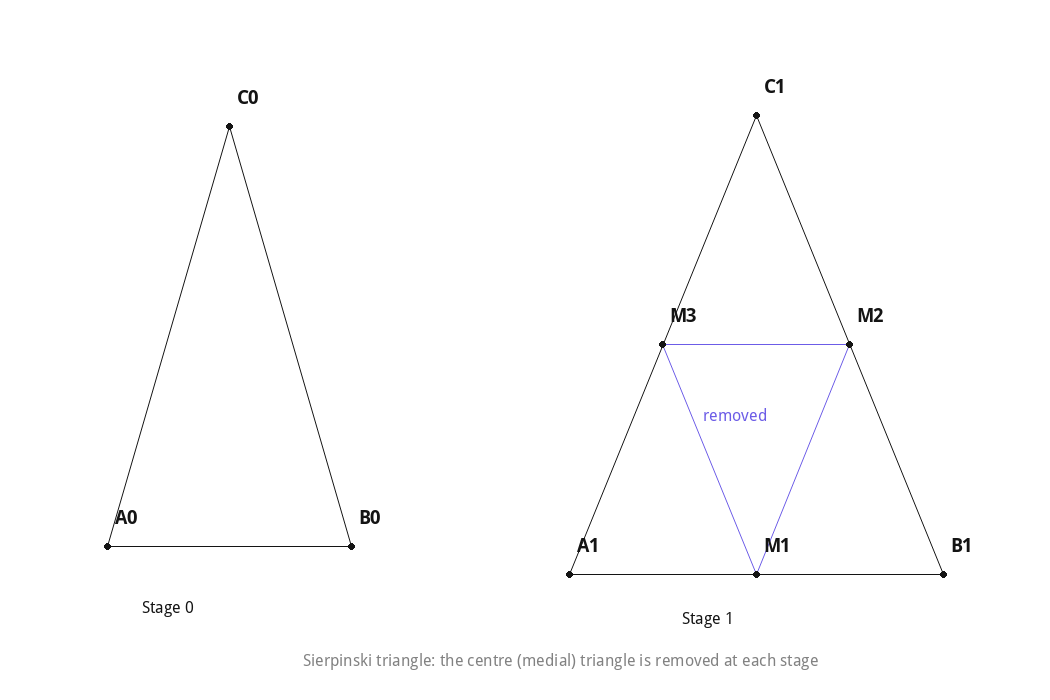
A geometric progression (GP) is a sequence in which the ratio between any two consecutive terms is constant; this constant is called the common ratio r. If the first term is a, the nth term of a GP is given by tₙ = a·rⁿ⁻¹, and the corresponding recursive rule is tₙ = r·tₙ₋₁. This section uses growing patterns that double or triple at every stage (unlike the constant additive growth of an AP) to motivate GPs, and studies two classic fractals — the Sierpiński triangle, where the number of black triangles multiplies by 3 at each stage while the coloured area shrinks by a factor of 3/4, and the Sierpiński square carpet, where the number of red squares multiplies by 8 at each stage while the coloured area shrinks by a factor of 8/9. Exercise Set 8.3 applies the GP term formula to numeric problems and real-world contexts such as a bouncing ball and bacterial growth.
Q1. Find the 12th term of a GP with common ratio 2, whose 8th term is 192 — Answer: t₈ = a·r⁷ = 192, and r = 2, so a × 2⁷ = 192 ⟹ a × 128 = 192 ⟹ a =…
Answer: t₈ = a·r⁷ = 192, and r = 2, so a × 2⁷ = 192 ⟹ a × 128 = 192 ⟹ a = 192/128 = 3/2.
t₁₂ = a·r¹¹ = (3/2) × 2¹¹ = 3 × 2¹⁰ = 3 × 1024 = 3072.
So, the 12th term is 3072.
Q2. Find the 10th and nth terms of the GP: 5, 25, 125, — Answer: a = 5, r = 25/5 = 5. tₙ = a·rⁿ⁻¹ = 5 × 5ⁿ⁻¹ = 5ⁿ. t₁₀ =…
Answer: a = 5, r = 25/5 = 5.
tₙ = a·rⁿ⁻¹ = 5 × 5ⁿ⁻¹ = 5ⁿ.
t₁₀ = 5¹⁰ = 9,765,625.
So, the 10th term is 9,765,625 and the nth term is tₙ = 5ⁿ.
Q3. A sequence is given by the recursive rule t₁ = 2, tₙ₊₁ = 3tₙ − 2 for n ≥ 1. Which term of the sequence is 730? — Answer: t₁ = 2 t₂ = 3(2) − 2 = 4 t₃ = 3(4) − 2 = 10 t₄ = 3(10) − 2 = 28…
Answer: t₁ = 2
t₂ = 3(2) − 2 = 4
t₃ = 3(4) − 2 = 10
t₄ = 3(10) − 2 = 28
t₅ = 3(28) − 2 = 82
t₆ = 3(82) − 2 = 244
t₇ = 3(244) − 2 = 730
So, 730 is the 7th term of the sequence.
Q4. Which term of the GP: 2, 6, 18, … is 4374? Write the explicit formula as well as the recursive formula for the nth term — Answer: a = 2, r = 6/2 = 3. 2 × 3ⁿ⁻¹ = 4374 ⟹ 3ⁿ⁻¹ = 2187 = 3⁷ ⟹ n −…
Answer: a = 2, r = 6/2 = 3.
2 × 3ⁿ⁻¹ = 4374 ⟹ 3ⁿ⁻¹ = 2187 = 3⁷ ⟹ n − 1 = 7 ⟹ n = 8.
So, 4374 is the 8th term.
Explicit formula: tₙ = 2 × 3ⁿ⁻¹.
Recursive formula: t₁ = 2, tₙ = 3·tₙ₋₁ for n ≥ 2.
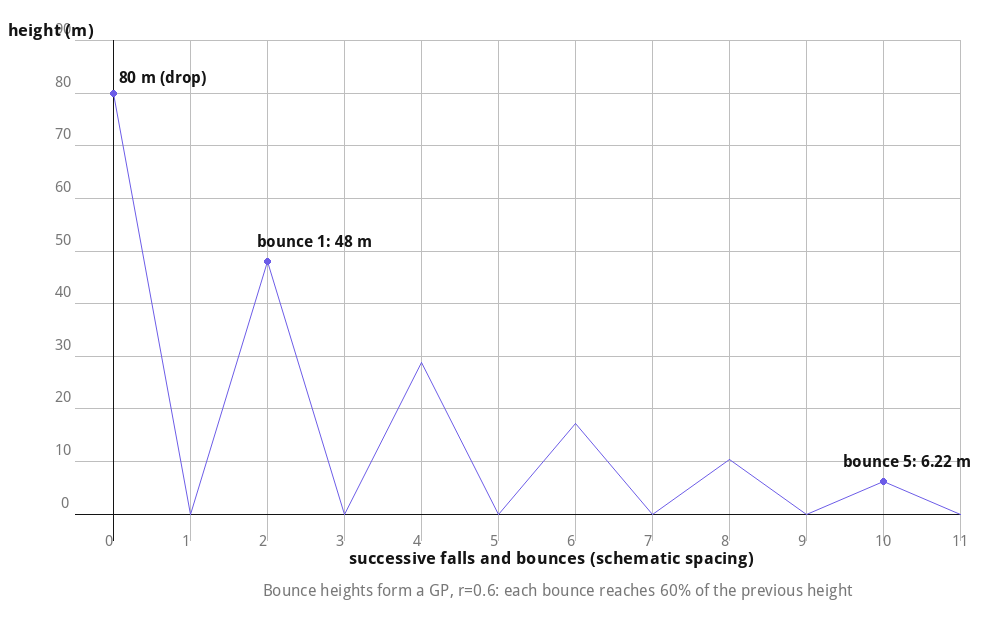
Q5. A ball is dropped from a height of 80 metres. After hitting the ground, it bounces back to 60% of the height from which it fell, and continues bouncing this way — each time rising to 60% of the previous height. (i) What height does the ball reach after the 5th bounce? (ii) What is the total vertical distance the ball has travelled by the time it hits the ground for the 6th time? — Answer: (i) The bounce heights form a GP with a = 80 × 0.6 = 48 (height after the 1st…
Answer: (i) The bounce heights form a GP with a = 80 × 0.6 = 48 (height after the 1st bounce) and r = 0.6.
Height after the 5th bounce: h₅ = 80 × (0.6)⁵ = 80 × 0.07776 = 6.2208 m ≈ 6.22 m.
(ii) The successive bounce heights are: h₁ = 48, h₂ = 28.8, h₃ = 17.28, h₄ = 10.368, h₅ = 6.2208.
By the 6th time the ball hits the ground, it has fallen the initial 80 m once, and travelled up-and-down through each of the first 5 bounce heights (each height covered twice — once going up, once coming down).
Total distance = 80 + 2 × (48 + 28.8 + 17.28 + 10.368 + 6.2208) = 80 + 2 × 110.6688 = 80 + 221.3376 = 301.3376 m ≈ 301.34 m.
Q6. Which term of the sequence 2, 2√2, 4, … is 128? — Answer: Common ratio r = 2√2/2 = √2 (also 4/2√2 = √2, confirming it is a GP).…
Answer: Common ratio r = 2√2/2 = √2 (also 4/2√2 = √2, confirming it is a GP).
tₙ = a·rⁿ⁻¹ = 2 × (√2)ⁿ⁻¹.
Set 2 × (√2)ⁿ⁻¹ = 128 ⟹ (√2)ⁿ⁻¹ = 64.
Since 64 = 2⁶ = (√2)¹², we get n − 1 = 12 ⟹ n = 13.
So, 128 is the 13th term of the sequence.
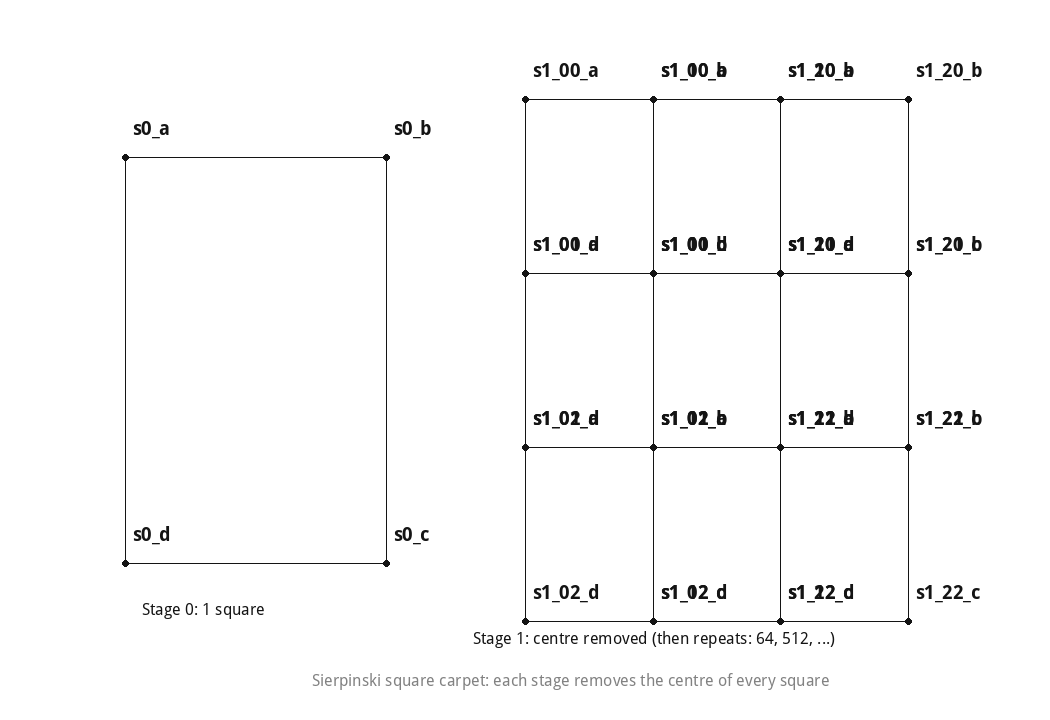
Q7. Stages 0 to 3 of the Sierpiński square carpet are shown: Stage 0 is a square sheet; at each stage, every remaining square is divided into 9 smaller squares, the centre square is removed, and the process repeats on the 8 shaded squares. (i) How many red squares are there in Stages 0 to 3? (ii) Predict the number of red squares in Stages 4 and 5. (iii) Find the explicit and recursive rule for the number of red squares at the nth stage. (iv) If the area of the Stage 0 square is 1 square unit, find the area of the red region in Stages 1, 2, 3 (and predict Stages 4, 5), and give explicit and recursive formulas for the area at the nth stage. What happens to this area as n increases? — Answer: (i) Stage 0: 1 square. Each stage keeps 8 of the 9 smaller squares from the…
Answer: (i) Stage 0: 1 square. Each stage keeps 8 of the 9 smaller squares from the previous stage, so: Stage 1 = 8, Stage 2 = 8 × 8 = 64, Stage 3 = 64 × 8 = 512.
(ii) Stage 4 = 512 × 8 = 4096; Stage 5 = 4096 × 8 = 32,768.
(iii) This is a GP with a = 1 (Stage 0) and r = 8. Explicit formula: tₙ = 8ⁿ. Recursive formula: t₀ = 1, tₙ = 8·tₙ₋₁ for n ≥ 1.
(iv) Each stage retains 8/9 of the previous stage’s area: Stage 1 = 8/9, Stage 2 = (8/9)² = 64/81, Stage 3 = (8/9)³ = 512/729. Predicted: Stage 4 = (8/9)⁴ = 4096/6561, Stage 5 = (8/9)⁵ = 32768/59049.
Explicit formula: Area at stage n = (8/9)ⁿ. Recursive formula: A₀ = 1, Aₙ = (8/9)·Aₙ₋₁ for n ≥ 1.
Since 8/9 < 1, this area keeps decreasing and approaches 0 as n increases (though it never actually becomes 0).
End-of-Chapter Exercises (Page 192)
Q1. Find the 31st term of an AP whose 11th term is 38 and 16th term is 73 — Answer: a + 10d = 38 …(1) a + 15d = 73 …(2) (2) − (1): 5d = 35 ⟹ d = 7. From…
Answer: a + 10d = 38 …(1)
a + 15d = 73 …(2)
(2) − (1): 5d = 35 ⟹ d = 7.
From (1): a + 70 = 38 ⟹ a = −32.
t₃₁ = a + 30d = −32 + 30 × 7 = −32 + 210 = 178.
So, the 31st term is 178.
Q2. Determine the AP whose third term is 16 and whose 7th term exceeds the 5th term by 12 — Answer: t₃ = a + 2d = 16 …(1) t₇ − t₅ = 12 ⟹ (a + 6d) − (a + 4d) = 12 ⟹…
Answer: t₃ = a + 2d = 16 …(1)
t₇ − t₅ = 12 ⟹ (a + 6d) − (a + 4d) = 12 ⟹ 2d = 12 ⟹ d = 6.
From (1): a + 12 = 16 ⟹ a = 4.
So, the required AP is 4, 10, 16, 22, 28, 34, ….
Q3. How many three-digit numbers are divisible by 7? — Answer: Smallest three-digit multiple of 7: 105. Largest: 994. This is an AP with a =…
Answer: Smallest three-digit multiple of 7: 105. Largest: 994. This is an AP with a = 105, d = 7, last term l = 994.
994 = 105 + (n − 1)(7) ⟹ 889 = 7(n − 1) ⟹ n − 1 = 127 ⟹ n = 128.
So, there are 128 three-digit numbers divisible by 7.
Q4. How many multiples of 4 lie between 10 and 250? — Answer: Smallest multiple of 4 greater than 10: 12. Largest multiple of 4 less than 250:…
Answer: Smallest multiple of 4 greater than 10: 12. Largest multiple of 4 less than 250: 248. This is an AP with a = 12, d = 4, last term l = 248.
248 = 12 + (n − 1)(4) ⟹ 236 = 4(n − 1) ⟹ n − 1 = 59 ⟹ n = 60.
So, there are 60 multiples of 4 between 10 and 250.
Q5. Find a GP for which the sum of the first two terms is −4 and the fifth term is 4 times the third term — Answer: Let the first term be a and common ratio be r. a + ar = −4 ⟹ a(1 + r) = −4…
Answer: Let the first term be a and common ratio be r.
a + ar = −4 ⟹ a(1 + r) = −4 …(1)
ar⁴ = 4(ar²) ⟹ r² = 4 ⟹ r = 2 or r = −2.
Case r = 2: a(1 + 2) = −4 ⟹ 3a = −4 ⟹ a = −4/3. GP: −4/3, −8/3, −16/3, …
Case r = −2: a(1 − 2) = −4 ⟹ −a = −4 ⟹ a = 4. GP: 4, −8, 16, −32, …
So, two GPs satisfy the given conditions.
Q6. Find all possible ways of expressing 100 as the sum of consecutive natural numbers — Answer: Let the k consecutive natural numbers start at a: a + (a + 1) + … + (a + k −…
Answer: Let the k consecutive natural numbers start at a: a + (a + 1) + … + (a + k − 1) = 100 ⟹ ka + k(k − 1)/2 = 100 ⟹ k(2a + k − 1) = 200.
Testing divisors k of 200 for a positive integer value of a:
k = 5: 2a + 4 = 40 ⟹ a = 18. Sequence: 18, 19, 20, 21, 22 (sum = 100).
k = 8: 2a + 7 = 25 ⟹ a = 9. Sequence: 9, 10, 11, 12, 13, 14, 15, 16 (sum = 100).
No other factor pair of 200 gives a valid positive integer value of a with k ≥ 2.
So, 100 = 18 + 19 + 20 + 21 + 22 = 9 + 10 + 11 + 12 + 13 + 14 + 15 + 16.
Q7. The number of bacteria in a certain culture doubles every hour. If there were 30 bacteria present in the culture originally, how many bacteria will be present at the end of the 2nd hour, 4th hour and nth hour? — Answer: This is a GP with a = 30 and r = 2. Number of bacteria at the end of n hours =…
Answer: This is a GP with a = 30 and r = 2. Number of bacteria at the end of n hours = 30 × 2ⁿ.
End of 2nd hour: 30 × 2² = 30 × 4 = 120.
End of 4th hour: 30 × 2⁴ = 30 × 16 = 480.
End of nth hour: 30 × 2ⁿ.
Q8. The sum of the 4th and 8th terms of an AP is 24 and the sum of the 6th and 10th terms is 44. Find the first three terms of the AP — Answer: t₄ + t₈ = 24 ⟹ (a + 3d) + (a + 7d) = 24 ⟹ a + 5d = 12 …(1) t₆ +…
Answer: t₄ + t₈ = 24 ⟹ (a + 3d) + (a + 7d) = 24 ⟹ a + 5d = 12 …(1)
t₆ + t₁₀ = 44 ⟹ (a + 5d) + (a + 9d) = 44 ⟹ a + 7d = 22 …(2)
(2) − (1): 2d = 10 ⟹ d = 5.
From (1): a + 25 = 12 ⟹ a = −13.
So, the first three terms of the AP are −13, −8, −3.
Q9. Find the smallest value of n such that the sum of the first n natural numbers is greater than 1,000 — Answer: Sₙ = n(n + 1)/2 > 1000 ⟹ n(n + 1) > 2000. For n = 44: S₄₄ = 44 × 45/2 =…
Answer: Sₙ = n(n + 1)/2 > 1000 ⟹ n(n + 1) > 2000.
For n = 44: S₄₄ = 44 × 45/2 = 990 (not enough).
For n = 45: S₄₅ = 45 × 46/2 = 1035 (exceeds 1000).
So, the smallest value of n is 45.
Q10. Which term of the GP: 2, 8, 32, … is 131072? Write the explicit formula as well as the recursive formula for the nth term — Answer: a = 2, r = 8/2 = 4. 2 × 4ⁿ⁻¹ = 131072 ⟹ 4ⁿ⁻¹ = 65536 = 4⁸ ⟹ n…
Answer: a = 2, r = 8/2 = 4.
2 × 4ⁿ⁻¹ = 131072 ⟹ 4ⁿ⁻¹ = 65536 = 4⁸ ⟹ n − 1 = 8 ⟹ n = 9.
So, 131072 is the 9th term.
Explicit formula: tₙ = 2 × 4ⁿ⁻¹.
Recursive formula: t₁ = 2, tₙ = 4·tₙ₋₁ for n ≥ 2.
Q11. The sum of the first three terms of a GP is 13/12 and their product is −1. Find the common ratio and the terms — Answer: Let the three terms be a/r, a, ar. Product: (a/r) × a × ar = a³ = −1 ⟹ a…
Answer: Let the three terms be a/r, a, ar.
Product: (a/r) × a × ar = a³ = −1 ⟹ a = −1.
Sum: (a/r) + a + ar = 13/12. Substituting a = −1: −1/r − 1 − r = 13/12.
Multiplying by −12r: 12 + 12r + 12r² = −13r ⟹ 12r² + 25r + 12 = 0 ⟹ (3r + 4)(4r + 3) = 0 ⟹ r = −4/3 or r = −3/4.
Taking r = −3/4: terms are a/r = −1/(−3/4) = 4/3, a = −1, ar = (−1)(−3/4) = 3/4.
Check: sum = 4/3 − 1 + 3/4 = 16/12 − 12/12 + 9/12 = 13/12 ✓; product = (4/3)(−1)(3/4) = −1 ✓.
So, the common ratio is −3/4 (equivalently −4/3, giving the same terms in reverse order), and the terms are 4/3, −1, 3/4.
Q12. If the 4th, 10th and 16th terms of a GP are x, y and z respectively, prove that x, y, z are in GP — Answer: Let the GP have first term a and common ratio r. Then: x = t₄ = ar³, y =…
Answer: Let the GP have first term a and common ratio r. Then:
x = t₄ = ar³, y = t₁₀ = ar⁹, z = t₁₆ = ar¹⁵.
To prove x, y, z are in GP, it suffices to show y² = xz.
y² = (ar⁹)² = a²r¹⁸.
xz = (ar³)(ar¹⁵) = a²r¹⁸.
Since y² = xz, x, y, z are in GP (with common ratio r⁶). Hence proved.
Q13. The sum of the first three terms of a geometric progression is 26, and the sum of their squares is 364. Find the terms of the GP — Answer: Let the terms be a/r, a, ar. Sum: a(1/r + 1 + r) = 26 …(1) Squaring (1):…
Answer: Let the terms be a/r, a, ar.
Sum: a(1/r + 1 + r) = 26 …(1)
Squaring (1): a²(1/r + 1 + r)² = 676 ⟹ a²(1/r² + 1 + r²) + 2a²(1/r + r + 1) = 676
Since sum of squares a²(1/r² + 1 + r²) = 364, this gives 364 + 2a²(1/r + r + 1) = 676 ⟹ 2·a·[a(1/r + r + 1)] = 312 ⟹ 2·a·26 = 312 ⟹ a = 6 (the middle term).
From (1): 6(1/r + 1 + r) = 26 ⟹ 1/r + r = 26/6 − 1 = 10/3 ⟹ 3 + 3r² = 10r ⟹ 3r² − 10r + 3 = 0 ⟹ (3r − 1)(r − 3) = 0 ⟹ r = 3 or r = 1/3.
Taking r = 3: terms are 6/3, 6, 6 × 3 = 2, 6, 18.
Check: sum = 2 + 6 + 18 = 26 ✓; sum of squares = 4 + 36 + 324 = 364 ✓.
So, the terms of the GP are 2, 6, 18.
Q14. Suppose P₁ = 1, P₂ = 2 and for n > 2, Pₙ = P₁ + P₂ + … + Pₙ₋₁ + 1. Find the values of P₁, P₂, …, P₈. Can you find a simpler recursive formula for Pₙ? Can you give an explicit formula? — Answer: P₁ = 1, P₂ = 2 P₃ = P₁ + P₂ + 1 = 1 + 2 + 1 = 4 P₄ = P₁ + P₂ +…
Answer: P₁ = 1, P₂ = 2
P₃ = P₁ + P₂ + 1 = 1 + 2 + 1 = 4
P₄ = P₁ + P₂ + P₃ + 1 = 1 + 2 + 4 + 1 = 8
P₅ = 1 + 2 + 4 + 8 + 1 = 16
P₆ = 1 + 2 + 4 + 8 + 16 + 1 = 32
P₇ = 1 + 2 + 4 + 8 + 16 + 32 + 1 = 64
P₈ = 1 + 2 + 4 + 8 + 16 + 32 + 64 + 1 = 128
So, P₁ to P₈ are 1, 2, 4, 8, 16, 32, 64, 128.
Simpler recursive formula: since Pₙ = (P₁ + … + Pₙ₋₁) + 1 and Pₙ₋₁ = (P₁ + … + Pₙ₋₂) + 1, subtracting gives Pₙ − Pₙ₋₁ = Pₙ₋₁, i.e. Pₙ = 2Pₙ₋₁ for n ≥ 2, with P₁ = 1.
Explicit formula: since the sequence is 1, 2, 4, 8, … (a GP with a = 1, r = 2), Pₙ = 2ⁿ⁻¹.
Q15. Suppose W₁ = 1, W₂ = 2 and for n > 2, Wₙ = W₁ + W₂ + … + Wₙ₋₂ + 2. Find the values of W₁, W₂, …, W₈. Do you recognise this sequence? — Answer: W₁ = 1, W₂ = 2 W₃ = W₁ + 2 = 1 + 2 = 3 W₄ = W₁ + W₂ + 2 = 1 + 2 +…
Answer: W₁ = 1, W₂ = 2
W₃ = W₁ + 2 = 1 + 2 = 3
W₄ = W₁ + W₂ + 2 = 1 + 2 + 2 = 5
W₅ = W₁ + W₂ + W₃ + 2 = 1 + 2 + 3 + 2 = 8
W₆ = 1 + 2 + 3 + 5 + 2 = 13
W₇ = 1 + 2 + 3 + 5 + 8 + 2 = 21
W₈ = 1 + 2 + 3 + 5 + 8 + 13 + 2 = 34
So, W₁ to W₈ are 1, 2, 3, 5, 8, 13, 21, 34 — this is the Virahānka-Fibonacci sequence encountered earlier in the chapter, where every term (from the third onward) is the sum of the two terms before it.
Practice more: Extra Questions for Class 9 Mathematics Chapter 8
Quick revision: Revision Notes for Class 9 Mathematics Chapter 8
- Chapter 1: Orienting Yourself: The Use of Coordinates – Free PDF Download
- Chapter 2: Introduction to Linear Polynomials – Free PDF Download
- Chapter 3: The World of Numbers – Free PDF Download
- Chapter 4: Exploring Algebraic Identities – Free PDF Download
- Chapter 5: I'm Up and Down, and Round and Round – Free PDF Download
- Chapter 6: Measuring Space: Perimeter and Area – Free PDF Download
- Chapter 7: The Mathematics of Maybe: Introduction to Probability – Free PDF Download
Frequently Asked Questions
What is the difference between a sequence and a series?
A sequence is an ordered list of numbers following a specific pattern or rule (e.g. 2, 4, 6, 8…); a series is the sum of the terms of a sequence (e.g. 2+4+6+8…) — a sequence is a list, a series is a total.
What is the difference between an arithmetic and a geometric progression?
In an arithmetic progression, consecutive terms differ by a constant common difference (added each time); in a geometric progression, consecutive terms differ by a constant common ratio (multiplied each time) — this is the key distinguishing test between the two.
Chapter Quiz — Test Your Understanding
Class 9 Mathematics Chapter 8: Predicting What Comes Next?: Exploring Sequences and Progressions – Notes and Extra Questions
Along with these NCERT Solutions, students can also use the Class 9 Mathematics Chapter 8 Extra Questions and Class 9 Mathematics Chapter 8 Revision Notes for quick revision and extra practice.
Recommended: Buy the Printed NCERT Class 9 Maths Book
Contains Amazon affiliate links.
If you’d like a printed copy alongside the PDF, here’s a verified option:
4.0 out of 5 stars (1,313 ratings) · Rs. 106
Price and availability may change on Amazon. As an Amazon Associate, ncertbooks.org earns from qualifying purchases.



Pingback: Class 9 Maths Chapter 8 Sequences and Progressions Extra Questions (2026-27)