
This chapter defines probability the way it’s actually measured in experiments — as the fraction of trials where an event occurs — and covers the key terms like outcome, trial and event that go with it.
Last Updated: September 23, 2026
Key Terms
- Experiment/trial: action with uncertain result.
- Outcome: possible result.
- Event: collection of one or more outcomes.
Empirical Probability
- P(E) = (trials where E happened) / (total trials).
- 0 ≤ P(E) ≤ 1.
- P(E)=0: impossible (in data); P(E)=1: certain (in data).
One-Line Summary
Empirical probability is calculated directly from real experimental/observational data as a fraction (favourable trials/total trials), always falling between 0 and 1, and becomes more reliable as the number of trials increases.
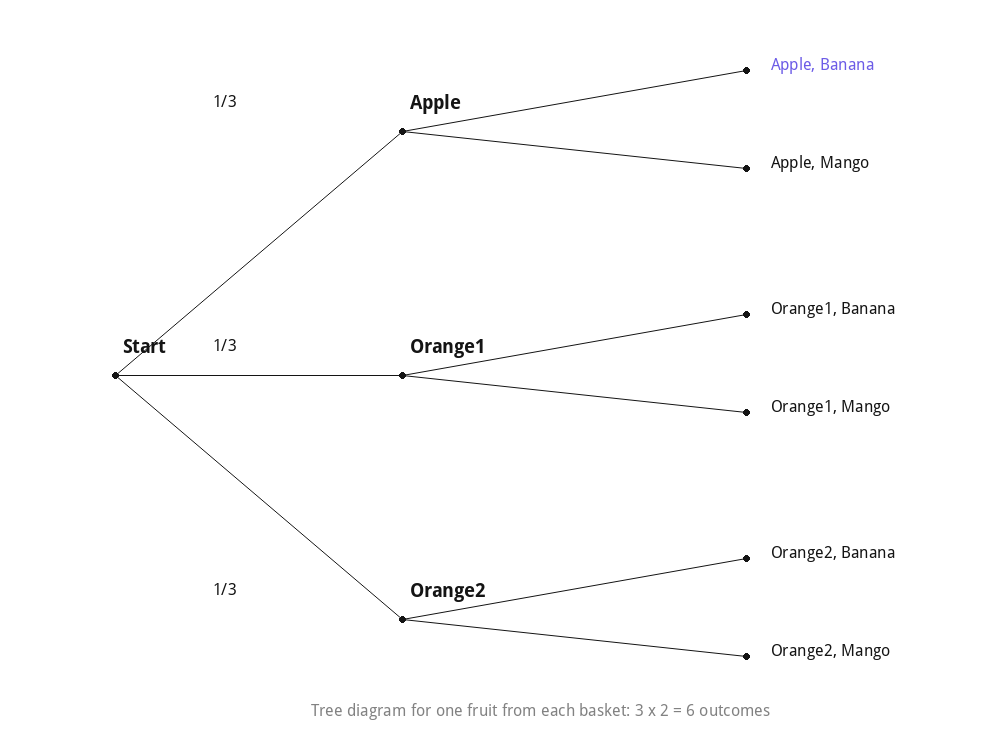
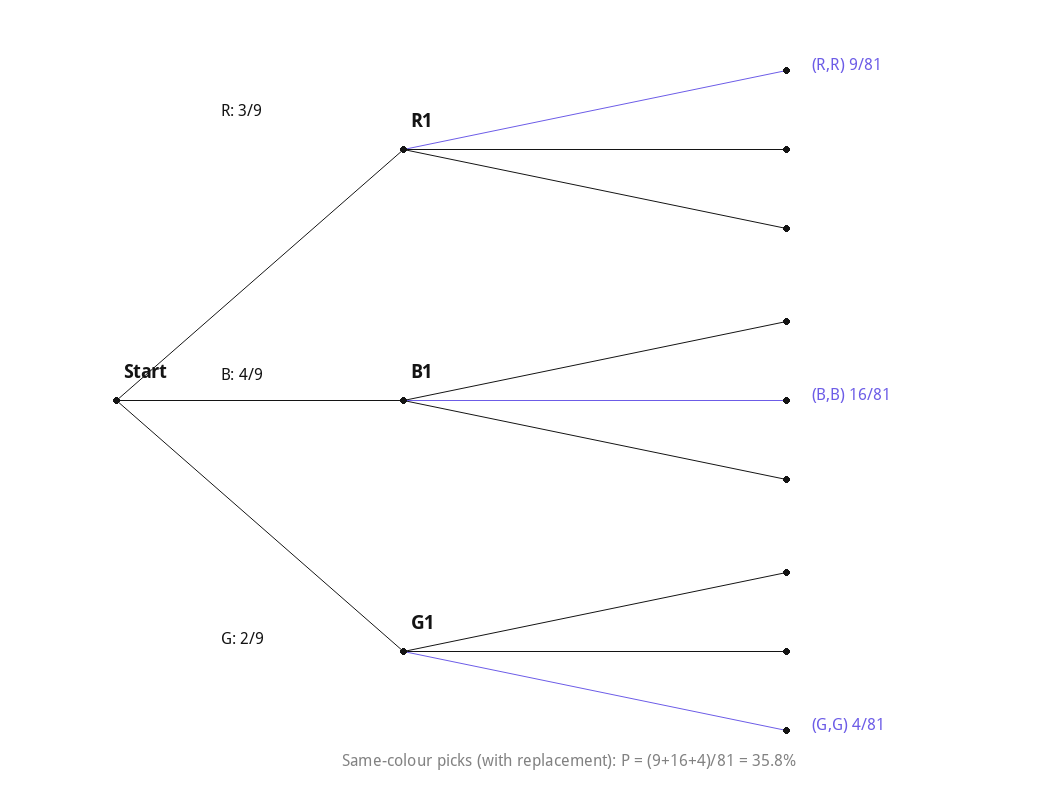
Quick visual: a worked diagram from the full Solutions page, for reference.
- Chapter 1: Orienting Yourself: The Use of Coordinates – Revision Notes
- Chapter 2: Introduction to Linear Polynomials – Revision Notes
- Chapter 3: The World of Numbers – Revision Notes
- Chapter 4: Exploring Algebraic Identities – Revision Notes
- Chapter 5: I'm Up and Down, and Round and Round – Revision Notes
- Chapter 6: Measuring Space: Perimeter and Area – Revision Notes
- Chapter 8: Predicting What Comes Next?: Exploring Sequences and Progressions – Revision Notes
Frequently Asked Questions
What is the difference between theoretical and experimental probability?
Theoretical probability is calculated based on logical reasoning about equally likely outcomes before an event occurs, while experimental probability is calculated based on the actual results observed after performing a real experiment or trial.
Why does experimental probability get closer to theoretical probability as the number of trials increases?
As the number of trials increases, random variations tend to average out, so the observed frequency of an outcome approaches its true underlying probability, a pattern connected to the law of large numbers.
Chapter Quiz — Test Your Understanding
Class 9 Mathematics Chapter 7 – Solutions and Important Questions
Need full answers or more practice? See the Class 9 Mathematics Chapter 7 Solutions and Class 9 Mathematics Chapter 7 Extra Questions.
See also: Chapter 1 | Chapter 2 | Chapter 3 | Chapter 4 | Chapter 5 | Chapter 6 | Chapter 7
Practice more: Chapter 1 | Chapter 2 | Chapter 3 | Chapter 4 | Chapter 5 | Chapter 6 | Chapter 7
Quick revision: Chapter 1 | Chapter 2 | Chapter 3 | Chapter 4 | Chapter 5 | Chapter 6
Recommended: Buy the Printed NCERT Class 9 Maths Book
Contains Amazon affiliate links.
If you’d like a printed copy alongside the PDF, here’s a verified option:
4.0 out of 5 stars (1,313 ratings) · Rs. 106
Price and availability may change on Amazon. As an Amazon Associate, ncertbooks.org earns from qualifying purchases.


