
This chapter covers the small but crucial exception to equation-solving rules: multiplying or dividing an inequality by a negative number reverses its direction, and it extends that idea to graphing inequalities on a number line and plane.
Last Updated: September 23, 2026
Rules
- Add/subtract same value: direction unchanged.
- Multiply/divide by positive: direction unchanged.
- Multiply/divide by negative: direction REVERSES.
Number Line
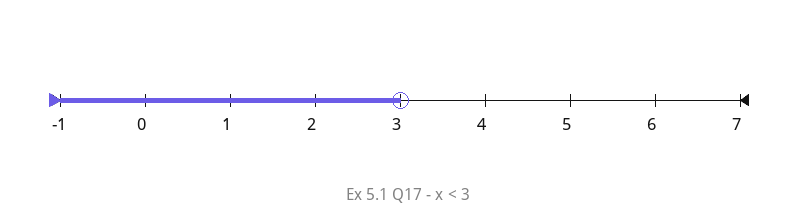
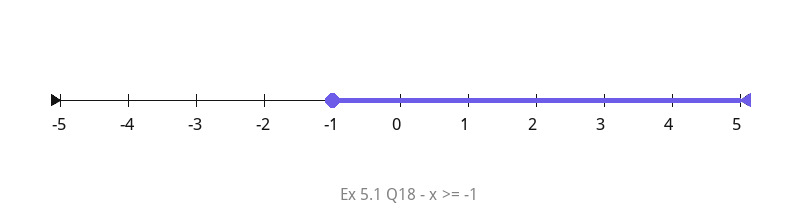
- Open circle: <, > (excluded). Closed circle: ≤, ≥ (included).
Graphing (2 variables)
- Solid line: ≤/≥. Dashed line: </>.
- Test point (often origin) determines which side to shade.
Systems of Inequalities
- Solution = intersection (overlap) of all individual regions.
One-Line Summary
Linear inequalities are solved like equations except multiplying/dividing by a negative reverses the direction, and their solutions are ranges shown on number lines (1 variable) or shaded regions (2 variables), with systems solved by finding the overlapping region.
Quick visual: a worked diagram from the full Solutions page, for reference.
- Chapter 1: Sets - Quick Revision Notes
- Chapter 2: Relations and Functions – Revision Notes
- Chapter 3: Trigonometric Functions – Revision Notes
- Chapter 4: Complex Numbers and Quadratic Equations – Revision Notes
- Chapter 6: Permutations and Combinations – Revision Notes
- Chapter 7: Binomial Theorem – Revision Notes
- Chapter 8: Sequences and Series – Revision Notes
- Chapter 9: Straight Lines – Revision Notes
- Chapter 10: Conic Sections – Revision Notes
- Chapter 11: Introduction to Three Dimensional Geometry – Revision Notes
- Chapter 12: Limits and Derivatives – Revision Notes
- Chapter 13: Statistics – Revision Notes
- Chapter 14: Probability – Revision Notes
Frequently Asked Questions
How does solving a linear inequality differ from solving a linear equation?
The steps are similar (adding, subtracting, multiplying, dividing both sides), but when multiplying or dividing an inequality by a negative number, the inequality sign must be reversed, which has no equivalent rule for equations.
What does the graphical solution of a linear inequality in two variables represent?
It represents a half-plane region on either side of the boundary line. Every point in that region satisfies the inequality, and the boundary line is included (solid line) or excluded (dashed line) depending on whether the inequality is strict.
Chapter Quiz — Test Your Understanding
Class 11 Maths Chapter 5 – Solutions and Important Questions
Need full answers or more practice? See the Class 11 Maths Chapter 5 Solutions and Class 11 Maths Chapter 5 Extra Questions.
See also: Chapter 2 | Chapter 3 | Chapter 4 | Chapter 5
Practice more: Chapter 2 | Chapter 3 | Chapter 4 | Chapter 5
Recommended: Buy the Printed NCERT Class 11 Maths Book
Contains Amazon affiliate links.
If you’d like a printed copy alongside the PDF, here’s a verified option:
4.2 out of 5 stars (953 ratings) · Rs. 170
Price and availability may change on Amazon. As an Amazon Associate, ncertbooks.org earns from qualifying purchases.



Pingback: Class 11 Maths Chapter 5 Linear Inequalities Extra Questions (2026-27)