
Chapter 6 of the new NCERT “Exploration” textbook (Class 9 Science, session 2026-27), How Forces Affect Motion, replaces the older “Force and Laws of Motion” chapter and builds directly on the ideas of position, velocity and acceleration covered earlier. It explains how balanced and unbalanced forces, friction, inertia and Newton’s three laws of motion together decide whether an object stays still, speeds up, slows down or changes direction. These solutions were prepared by working through every exercise and in-text question independently — recalculating each numerical answer from first principles — and cross-checking the results against LearnCBSE and TiwariAcademy’s 2026-27 “Exploration” edition solutions to correct typographical and computational slips found in some source material.
Last Updated: September 23, 2026
How to Approach This Chapter
For any force problem, first identify all the objects involved and which forces act on which object — most errors here come from mixing up which body a force acts on, especially with action-reaction pairs. For momentum questions, fix a consistent positive direction at the start of the problem and stick to it throughout.
NCERT Solutions for Class 9 Science Chapter 6: How Forces Affect Motion
Revise, Reflect, Refine (NCERT Textbook, Page No. 112)
1. Using a horizontal force F, a table is moved across the floor at a constant velocity. How much is the frictional force exerted by the floor on the table?
Since the table moves with constant velocity, its acceleration is zero. By Newton’s first law of motion, a zero acceleration means the net force on the table is zero. So the frictional force exerted by the floor must be equal in magnitude to the applied force F and act in the direction opposite to the motion. Frictional force = F, directed opposite to the table’s motion.
2. For a ball moving on a smooth frictionless surface, choose the appropriate option that will make the following statements physically correct.
(i) If no net force is applied on the ball, the velocity of the ball will remain the same/increase/decrease.
(ii) If a net force is applied on the ball in the direction of its motion, the magnitude of the velocity of the ball will remain the same/increase/decrease.
(iii) If a net force is applied on the ball in a direction opposite to the direction of its motion, the magnitude of the velocity of the ball will remain the same/increase/decrease.
(i) The velocity of the ball will remain the same. By Newton’s first law, a body continues in its state of motion unless acted upon by an unbalanced (net) force.
(ii) The magnitude of the velocity will increase. A force acting in the direction of motion produces acceleration in the same direction, so the ball speeds up.
(iii) The magnitude of the velocity will decrease. A force acting opposite to the direction of motion produces retardation (deceleration), so the ball slows down.
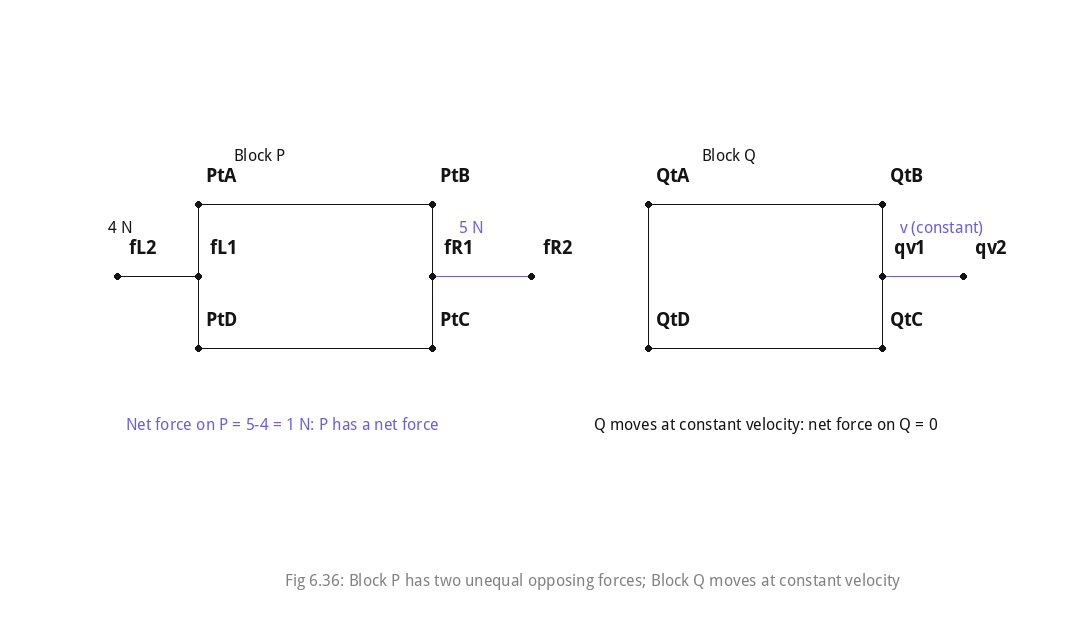
3. Two blocks P and Q on a smooth horizontal surface are shown in Fig. 6.36(a) and Fig. 6.36(b). Two forces of magnitudes 4 N and 5 N are acting in opposite directions on block P, while block Q is moving with a constant velocity. Which of the following statement is correct?
(i) P experiences a net force and Q does not experience a net force.
(ii) P does not experience a net force and Q experiences a net force.
(iii) Both P and Q experience a net force.
(iv) Neither P nor Q experiences a net force.
The correct option is (i). For block P, two opposite forces of 5 N and 4 N act on it, giving a net force of 5 N − 4 N = 1 N, so P experiences a net force. Block Q moves with constant velocity on a smooth surface, so its acceleration is zero and, by Newton’s second law, the net force on Q is also zero.
4. While practising for the snake boat race (Vallam Kali in Kerala), 100 oarsmen are rowing a boat together. Out of these, 95 row backwards to propel the boat forward. But by mistake, 5 oarsmen row in the opposite direction. If each oarsman applies a horizontal force of 200 N, what is the net force on the snake boat? (Ignore drag forces, air friction, etc.)
Forward-driving force = 95 × 200 N = 19,000 N. Opposing force = 5 × 200 N = 1,000 N. Net force = 19,000 N − 1,000 N = 18,000 N, directed forward. The net force on the snake boat is 18,000 N in the forward direction.
5. When a net force acts on an object, we observe that the object accelerates:
(i) opposite to the direction of force, with acceleration proportional to the force acting on the object.
(ii) opposite to the direction of force, with acceleration proportional to the mass of the object.
(iii) in the direction of force, with acceleration inversely proportional to the force acting on the object.
(iv) in the direction of force, with acceleration proportional to the force acting on the object.
The correct option is (iv). By Newton’s second law of motion, the acceleration produced in an object acts in the direction of the net force and is directly proportional to the magnitude of that force (and inversely proportional to the object’s mass).
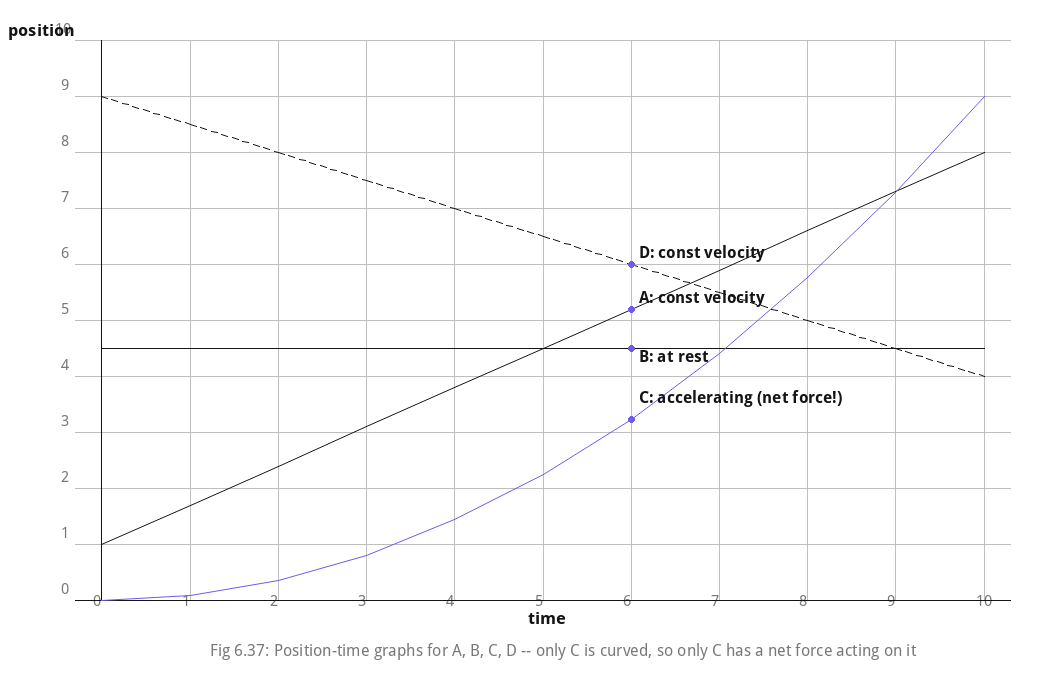
6. The position-time graph for four objects A, B, C and D moving along a straight line are given in Fig. 6.37. A net force acts on: (i) Object A (ii) Object B (iii) Object C (iv) Object D
The correct option is (iii) Object C. In a position-time graph, a straight sloped line means the object covers equal distances in equal time intervals — that is, constant velocity, zero acceleration and hence zero net force. A horizontal straight line means the object is at rest (also zero net force). Only a curved line means the velocity is continuously changing, i.e., the object is accelerating, so a net force must be acting. Object A (straight, sloped) and Object D (straight, sloped in the other direction) move with constant velocity, and Object B (horizontal line) stays at rest — none of these has a net force acting on it. Object C alone shows a curved position-time graph, so it alone has a net force acting on it.
7. A sailor jumps out from a small boat to the shore (Fig. 6.38). As the sailor jumps forward, will the boat move? If yes, in which direction and why?
Yes, the boat will move, and it moves backward (away from the shore). When the sailor pushes against the boat with their feet to jump forward, by Newton’s third law of motion the boat exerts an equal and opposite reaction force on the sailor — and simultaneously, the sailor’s push exerts an equal and opposite force on the boat, driving it backward.
8. During a high jump event, a landing mat or sand bed is placed for the athlete to fall upon (Fig. 6.39). Explain the reason behind it.
The mat or sand bed increases the time taken for the athlete’s momentum to become zero on landing. By Newton’s second law, force is the rate of change of momentum (F = Δp/Δt); for the same change in momentum, a longer stopping time produces a much smaller force. Spreading the impact over more time therefore reduces the force the athlete’s body experiences, lowering the risk of injury.
9. A hand cart loaded with vegetables collides with an identical but empty hand cart. During the collision:
(i) the loaded cart exerts a force of larger magnitude on the empty cart.
(ii) the empty cart exerts a force of larger magnitude on the loaded cart.
(iii) neither cart exerts a force on the other.
(iv) the loaded cart and the empty cart both exert an equal magnitude of force on each other.
The correct option is (iv). By Newton’s third law of motion, the two carts exert equal and opposite forces on each other regardless of their masses — mass difference affects how much each cart accelerates (the lighter, empty cart accelerates more), not the magnitude of the mutual force.
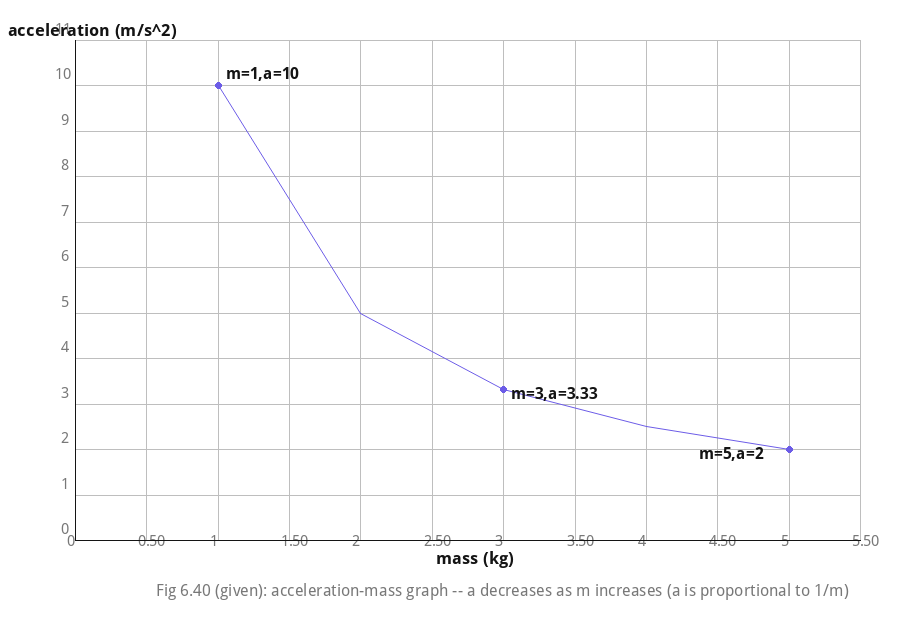
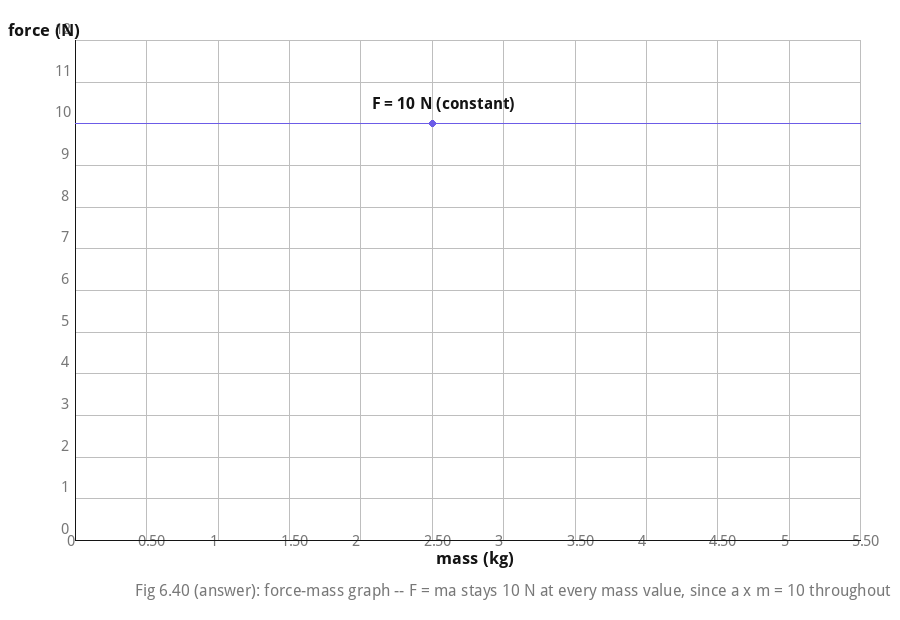
10. The acceleration-mass graph for the acceleration produced by a force on objects of different masses is plotted in Fig. 6.40. Plot the force-mass graph for this case.
From the acceleration-mass graph, acceleration decreases as mass increases in the pattern a = 10, 5, 3.33, 2.5, 2 m/s² for m = 1, 2, 3, 4, 5 kg, which is exactly the relation a ∝ 1/m expected when force is constant. Using F = ma at each point gives F = 1 × 10 = 10 N, 2 × 5 = 10 N, 3 × 3.33 ≈ 10 N, 4 × 2.5 = 10 N, and 5 × 2 = 10 N — the force is the same (10 N) at every mass value. So the force-mass graph is a straight horizontal line parallel to the mass axis, at F = 10 N, showing that the applied force does not change with mass.
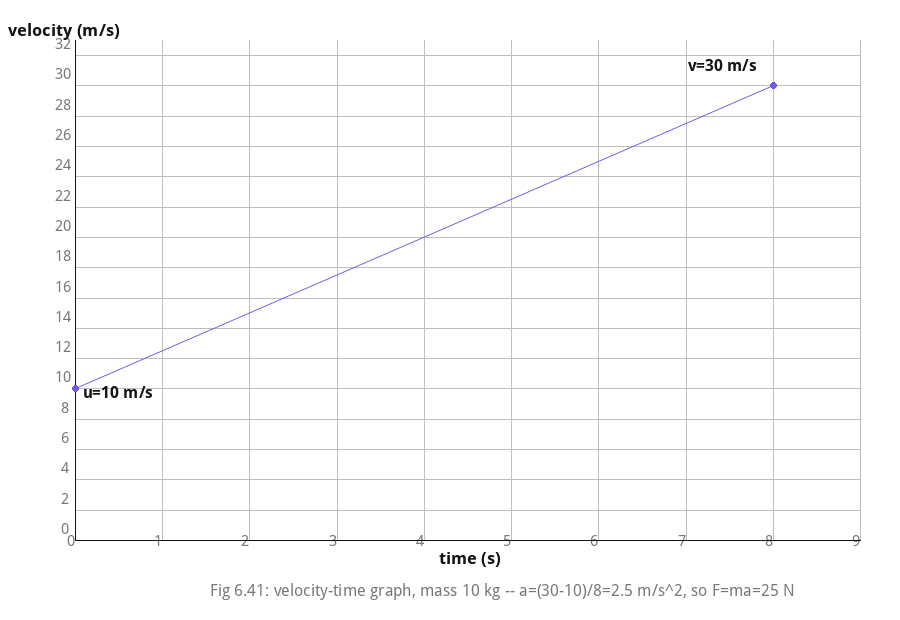
11. The velocity-time graph of an object of mass 10 kg moving along a straight line is shown in Fig. 6.41. Calculate the force acting on the object by using the graph.
From the graph: initial velocity u = 10 m/s, final velocity v = 30 m/s, time t = 8 s.
Acceleration, a = (v − u)/t = (30 − 10)/8 = 20/8 = 2.5 m/s².
Force, F = ma = 10 × 2.5 = 25 N.
The force acting on the object is 25 N.
12. A bullet of mass 50 g moving with a speed of 100 m/s enters a heavy stationary wooden block and stops after penetrating a distance of 50 cm. Estimate the stopping force acting on the bullet (assume that the bullet undergoes constant acceleration within the block).
Mass, m = 50 g = 0.05 kg; initial velocity, u = 100 m/s; final velocity, v = 0; distance, s = 50 cm = 0.5 m.
Using v² = u² + 2as: 0 = (100)² + 2a(0.5) ⇒ 0 = 10,000 + a ⇒ a = −10,000 m/s².
Force, F = ma = 0.05 × (−10,000) = −500 N.
The magnitude of the stopping force is 500 N, acting opposite to the bullet’s direction of motion. (Note: some online sources garble this step as “0² = 100² + 2 × a × 10.5” — the correct substitution uses s = 0.5 m, giving a = −10,000 m/s² and F = −500 N as shown above.)
13. An ace footballer converted a penalty shot by kicking the football with a speed of 108 km h⁻¹. The estimated force they imparted was 800 N. The mass of the football was 0.4 kg. Calculate the time of contact between their foot and the ball.
Speed, v = 108 km/h = 108 × (5/18) = 30 m/s; initial velocity, u = 0; force, F = 800 N; mass, m = 0.4 kg.
Acceleration, a = F/m = 800/0.4 = 2,000 m/s².
Using v = u + at: 30 = 0 + 2,000t ⇒ t = 30/2,000 = 0.015 s.
The time of contact between the foot and the ball is 0.015 s.
14. An object of mass 2 kg moving with a constant velocity of 10 m s⁻¹ encounters a rough patch where the force of friction on the object is 7 N. At the same time, an additional constant force of 3 N opposing the motion is applied on the object. After entering the rough patch, how much distance does the object travel before coming to rest?
Mass, m = 2 kg; initial velocity, u = 10 m/s; final velocity, v = 0.
Total opposing force = 7 N + 3 N = 10 N.
Acceleration (retardation), a = F/m = 10/2 = 5 m/s², so a = −5 m/s² (opposing motion).
Using v² = u² + 2as: 0 = (10)² + 2(−5)s ⇒ 0 = 100 − 10s ⇒ s = 10 m.
The object travels 10 m before coming to rest.
15. A tractor pulls a harrow (a ploughing tool) of mass m₁ with a net force F, resulting in an acceleration of a₁. The same tractor pulls a trolley of mass m₂ with a force F producing an acceleration of a₂. If the tractor now pulls the trolley with the harrow placed on it (with the same force F), then obtain an expression for the resulting acceleration in terms of a₁ and a₂. Ignore friction.
From F = m₁a₁, m₁ = F/a₁. From F = m₂a₂, m₂ = F/a₂.
When the harrow is placed on the trolley, the combined mass is m₁ + m₂, and the same force F now produces acceleration a:
F = (m₁ + m₂)a = (F/a₁ + F/a₂)a ⇒ 1 = a(1/a₁ + 1/a₂) ⇒ a = 1/(1/a₁ + 1/a₂).
Simplifying, a = a₁a₂/(a₁ + a₂). This is the resulting acceleration — verified independently by substituting back into F = (m₁+m₂)a, which holds true.
16. When the pole of a bar magnet is brought close to a magnetic compass, the bar magnet and the compass needle (which is also a magnet) exert a magnetic force on each other. As per Newton’s third law of motion, both the forces are equal in magnitude and opposite in direction. However, the compass needle moves, whereas the bar magnet does not move (Fig. 6.42). Explain why.
The magnetic forces the bar magnet and compass needle exert on each other are indeed equal and opposite, as required by Newton’s third law. But the resulting motion depends on mass, since acceleration = force/mass (Newton’s second law). The compass needle has a very small mass, so even this small magnetic force produces a noticeable acceleration and visible movement. The bar magnet has a much larger mass (and is usually held or rests on a surface), so the same-magnitude force produces a negligible acceleration in it. Equal forces do not imply equal motion when the masses of the two objects are very different.
In-Text Questions (Think It Over, Pause and Ponder, Think as a Scientist, Threads of Curiosity, and Let Us… Activities)
Think It Over (Page 94): Why does a canoe move forward when the canoeist pushes water backwards with their paddle, and why does it move faster when they push harder?
The canoe moves forward because, by Newton’s third law of motion, when the canoeist pushes water backward with the paddle, the water simultaneously pushes the canoe forward with an equal and opposite reaction force. Pushing harder increases the magnitude of this reaction force, producing greater acceleration and a faster canoe.
Think It Over (Page 94): Suppose the same canoeist uses the same paddle force in two different canoes, one empty and one carrying another passenger. In which case will the canoe move faster?
The empty canoe will move faster. For the same applied (reaction) force, acceleration is inversely proportional to mass (Newton’s second law), so the lighter, empty canoe accelerates more than the heavier canoe carrying an extra passenger.
Think It Over (Page 94–95): Is there an underlying cause for a change in position and velocity of an object? What is the nature of this cause? Do all motions require a cause?
Yes, there is an underlying cause — force. Force is a push or a pull that can change an object’s speed, direction, or state of rest. However, not every motion requires a continuing cause: an object already moving with constant velocity keeps moving without any net force acting on it (Newton’s first law); a cause (net force) is required only to change the existing state of motion.
Think It Over (Page 95): How can we measure the magnitude of a force? Do you remember using a spring balance earlier to measure the weight of objects, and that the weight of an object is the gravitational force with which the Earth pulls the object?
The magnitude of a force can be measured with a spring balance, which shows how far its spring stretches under an applied force — a larger force produces a greater extension. The weight of an object, which is the gravitational force with which the Earth pulls it, is one common force that can be read off a spring balance calibrated in newtons.
Think It Over (Page 95): What is the effect of forces when more than one force is acting on an object at rest or in motion?
When more than one force acts on an object, it is their resultant, or net force, that decides the effect on motion. If the individual forces are balanced (their vector sum is zero), there is no change in the object’s state of rest or motion. If the forces are unbalanced (net force is not zero), the object accelerates — it speeds up, slows down, or changes direction, in the direction of the net force.
Pause and Ponder (Page 97): A weightlifter lifts a barbell (Fig. 6.8). List two forces that are acting on the barbell. Are these forces balanced if the weightlifter keeps the barbell steady?
Two forces act on the barbell: the upward force applied by the weightlifter’s arms, and the downward gravitational force (the barbell’s weight). When the weightlifter holds the barbell steady (at rest or moving with constant velocity), these two forces are balanced — equal in magnitude and opposite in direction — so the net force is zero.
Pause and Ponder (Page 97): Two players, R and S, are participating in an arm-wrestling match (Fig. 6.9). At the instant when the arms tilt to the front direction (out of the page towards you), are the forces exerted by the players balanced? If not, which player exerted the larger force?
No, the forces are not balanced at that instant — if they were, the arms would remain stationary. Since the arms tilt toward player S’s side (out of the page, toward the viewer, on S’s side of the contest), player S is exerting the larger force, producing a net force and motion in that direction.
Pause and Ponder (Page 99): If the velocity of the block is neither increasing nor decreasing, what can you say about the net force acting on the block? Does the reading of the spring balance indicate the magnitude of the force of friction acting on the wooden block?
If the velocity is neither increasing nor decreasing, the block is moving with constant velocity, so its acceleration is zero and, by Newton’s second law, the net force on it is zero — the applied pulling force and the frictional force are balanced. In this situation, yes, the spring balance reading does indicate the magnitude of the force of friction, because the applied force needed to maintain constant velocity exactly equals the opposing friction.
Pause and Ponder (Page 99): Are the readings different for different surfaces? Is the reading smallest for the surface on which the stack of coins travelled the largest distance? Is the reading largest for which the distance travelled was the smallest?
Yes, the spring balance readings differ from surface to surface because friction depends on the nature of the two surfaces in contact. The reading is smallest for the smoothest surface (where friction is least and the coins travel the farthest), and it is largest for the roughest surface (where friction is greatest and the coins travel the shortest distance).
Pause and Ponder (Page 101): An object is moving with a constant velocity. Is there a net force acting upon it?
No. An object moving with constant velocity has zero acceleration, so by Newton’s second law the net force acting on it is zero — any forces present (such as an applied force and friction) must be balanced.
Pause and Ponder (Page 101): Suppose no net force is acting on an object. Which of the following situations are possible? (i) Object remains at rest if at rest. (ii) Object keeps moving with a constant velocity if already moving. (iii) Object is moving with a constant acceleration.
Situations (i) and (ii) are possible: with zero net force, an object at rest stays at rest, and an object already moving continues at the same constant velocity (Newton’s first law). Situation (iii) is not possible, because any non-zero acceleration, constant or not, requires a non-zero net force (F = ma); zero net force always means zero acceleration.
Pause and Ponder (Page 101): In the real world, it is difficult to find a situation where no forces are acting on an object. But by applying additional forces, a condition can be achieved where the net force on the object is zero. Explain with the help of an example.
In practice, forces like friction and gravity are almost always present, so a genuinely force-free object is rare. However, applying an extra force equal and opposite to the existing ones makes the net force zero. For example, when a person pushes a heavy box across a floor with a force exactly equal to the frictional force resisting it, the box moves at constant velocity — the applied force balances friction, so the net force on the box is zero even though real forces are acting on it.
Pause and Ponder (Page 102): What is the relationship between the net force acting on an object and its acceleration?
The net force acting on an object is directly proportional to the product of its mass and the acceleration it produces: F = ma. This is Newton’s second law of motion — acceleration is directly proportional to net force and inversely proportional to mass, and it acts in the same direction as the net force.
Pause and Ponder (Page 106): A toy car of mass 100 g is moving with a constant velocity of 0.5 m/s. What is the net force acting on the toy car?
Since the toy car moves with constant velocity, its acceleration is zero. By F = ma, the net force acting on it is 0.1 kg × 0 m/s² = 0 N.
Pause and Ponder (Page 106): Two children of different masses are sitting on identical swings. To impart identical initial acceleration, for which child would you require to apply a larger force? Explain why.
A larger force is required for the child with the greater mass. By Newton’s second law (F = ma), for the same acceleration, the required force is directly proportional to mass — a heavier child needs a proportionally larger push to achieve the same acceleration as a lighter child.
Pause and Ponder (Page 106): How are glass items packed for transportation using bubble wrap or hay protected from damage?
Bubble wrap or hay cushions the glass item and increases the time taken to stop it during a jolt or fall. By Newton’s second law expressed as F = Δp/Δt (force equals rate of change of momentum), for the same change in momentum, a longer stopping time results in a much smaller force. This reduced force is less likely to break the glass, which is why cushioning materials prevent damage during transport.
Pause and Ponder (Page 107): Why is it difficult to walk on wet polished floors or ice, and why is it risky to drive on roads covered with water or snow?
Wet, polished floors, ice, water, or snow drastically reduce the friction between two surfaces in contact — such as a shoe and the floor, or a tyre and the road. Since friction between our feet and the ground (or the tyres and the road) is what provides the forward push needed to walk or to steer and brake a vehicle safely, very low friction makes feet or wheels slip, making walking difficult and driving hazardous.
Pause and Ponder (Page 110): Why does a firefighter sometimes struggle when holding the pipe issuing water?
As water is forced out of the fire hose at high speed in the forward direction, by Newton’s third law of motion the water exerts an equal and opposite reactive (recoil) force on the hose and nozzle, pushing it backward. This strong backward recoil is what makes the pipe difficult for the firefighter to hold steady.
Pause and Ponder (Page 110): Suppose a spacecraft is moving in a region of space where the gravitational force acting upon it is negligible. Suggest how it can change its velocity.
Even where gravitational force is negligible, a spacecraft can change its velocity using its own engines. By expelling exhaust gas backward at high speed, the spacecraft experiences an equal and opposite reaction force (Newton’s third law), which pushes it forward, accelerating, decelerating, or changing its direction — this is exactly how rocket propulsion works in the vacuum of space, without needing anything external to push against.
Think as a Scientist (Page 100): Suppose you find an object and a horizontal floor having such smooth surfaces that the force of friction between them is zero. Imagine what will happen if you repeat steps 3 and 4 of Activity 6.1 with such an object and a horizontal floor. Will the velocity of the object decrease? Will the object ever come to rest, or continue moving forever?
If there really were zero friction between the object and the floor, the pushed object would move with a perfectly constant velocity: its speed would not decrease (there is no opposing force to slow it down), it would never come to rest on its own, and it would continue moving forever unless some other external force acted on it. This thought experiment shows that friction is the real-world reason moving objects gradually slow down and stop.
Threads of Curiosity (Page 104): How much force does 1 N feel like? If you hold a 100 g mass in your palm, the upward force your palm applies on the mass is around 1 N.
A force of 1 newton is approximately the force needed to support a 100 g mass against Earth’s gravity (since weight = mg = 0.1 kg × 9.8 m/s² ≈ 0.98 N ≈ 1 N). So if you hold a 100 g object — roughly a medium-sized apple — in your palm, the upward force your palm exerts to keep it from falling feels like about 1 N.
Activity 6.1 – Let Us Investigate (Page 98): A stack of coins is flicked with a rubber band across a wooden tabletop, a laminated tabletop, and a polished floor. What is observed about the distance the coins travel and their velocity, and what does this show about friction?
The coins travel the shortest distance and stop soonest on the rough wooden tabletop, travel farther on the smoother laminated tabletop, and travel farthest of all on the polished marble or tile floor. In every case, once the coins lose contact with the rubber band, their velocity gradually decreases until they stop. This shows that motion is always opposed by friction, that rougher surfaces produce more friction (stopping objects sooner), and that smoother surfaces produce less friction (letting objects travel farther) — confirming that the force of friction differs from surface to surface.
Activity 6.2 – Let Us Measure (Page 99): A spring balance is used to pull a wooden block at constant velocity across different surfaces. What do the spring balance readings show about friction on different surfaces?
The spring balance reading, when the block moves at constant velocity, gives the magnitude of the force of friction acting between the block and the surface. This reading is highest for rough surfaces (like an untreated wooden table), lower for smoother surfaces (like a laminated top), and lowest for very smooth surfaces (like polished marble or tile). This confirms that friction is greater on rougher surfaces and less on smoother ones, and that lower friction allows an object to be moved more easily and travel farther.
Activity 6.3 – Let Us Experiment (Page 102–103): A cart is pulled by a thread over a pulley, with a cup of increasing mass hanging at the other end to increase the pulling force. How does the cart’s acceleration change as the pulling force increases, for a fixed cart mass?
As the mass in the hanging cup (and hence the pulling force) is increased, the cart covers the same distance in less time, showing that its acceleration has increased. This demonstrates that for an object of fixed mass, acceleration increases as the net applied force increases — the first part of Newton’s second law of motion (a ∝ F when m is constant).
Activity 6.4 – Let Us Experiment (Page 103): The mass of the cart itself is now increased (by loading it with objects) while the pulling force is kept constant. How does the cart’s acceleration change?
When the cart’s mass is increased while the applied force is kept the same, the cart takes more time to cover the same distance, showing that its acceleration has decreased. This demonstrates that for a constant applied force, acceleration decreases as mass increases — that is, acceleration is inversely proportional to mass (a ∝ 1/m when F is constant), the second part of Newton’s second law of motion.
Activity 6.5 – Let Us Explore (Page 107): A student sitting on a rolling chair pushes and pulls a table in front of her. What happens to the chair each time, and what does this show?
When the student pushes the table forward, the chair she is sitting on rolls backward; when she pulls the table towards herself, the chair rolls forward (towards the table). This shows that whenever an object exerts a force on another object, the second object exerts an equal and opposite force back on the first — confirming Newton’s third law of motion, “for every action, there is an equal and opposite reaction.”
Activity 6.6 – Let Us Verify (Page 108): Two spring balances are hooked together and pulled apart in opposite directions with varying force. What do their readings show?
Both spring balances always show the same reading, no matter how much force is used to pull them apart. This confirms that the action and reaction forces the two balances exert on each other are always equal in magnitude, verifying Newton’s third law of motion.
Activity 6.7 – Let Us Understand (Page 109): An inflated balloon, held closed with a straw and taut thread through nails on two walls, is released. What happens to the balloon, and why?
When the neck of the balloon is released, air rushes out rapidly in one direction, and the balloon itself moves rapidly along the thread in the opposite direction. This happens because the stretched balloon skin pushes the escaping air molecules out (action), and by Newton’s third law, the escaping air simultaneously pushes back on the balloon with an equal and opposite force (reaction), propelling it forward — the same principle that powers jet and rocket engines.
Why This Chapter Matters
How Forces Affect Motion turns the purely descriptive ideas of position, distance, speed and acceleration from the earlier chapter on motion into an explanation of why objects move the way they do, introducing force, friction, inertia and Newton’s three laws as the cause-and-effect toolkit of classical mechanics. The system-of-objects approach used here — treating connected bodies like a tractor-and-trolley or a bullet-and-block as a single mass under one net force — is the same reasoning students will extend into momentum conservation, work and energy, and gravitation later in this book, and into more advanced dynamics, circular motion and rotational mechanics in Class 10, 11 and 12 Physics. A solid grip on balanced versus unbalanced forces and F = ma also underpins everyday safety concepts (seatbelts, airbags, landing mats) and numerical problem-solving skills that are tested heavily in board exams and competitive entrance exams alike.
Extra Questions | Revision Notes | Formulas Handbook
Chapter Quiz — Test Your Understanding
Class 9 Science Chapter 6 – Notes and Extra Questions
Along with these NCERT Solutions, students can also use the Class 9 Science Chapter 6 Extra Questions and Class 9 Science Chapter 6 Revision Notes for quick revision and extra practice.
- Chapter 1: Entering the World of Secondary Science – Free PDF Download
- Chapter 2: Cell: The Building Block of Life – Free PDF Download
- Chapter 3: Tissues in Action – Free PDF Download
- Chapter 4: Describing Motion Around Us – Free PDF Download
- Chapter 5: Exploring Mixtures and their Separation – Free PDF Download
- Chapter 7: Work, Energy and Simple Machines – Free PDF Download
- Chapter 8: Journey Inside the Atom – Free PDF Download
- Chapter 9: Atomic Foundations of Matter – Free PDF Download
- Chapter 10: Sound Waves: Characteristics and Applications – Free PDF Download
- Chapter 11: Reproduction: How Life Continues – Free PDF Download
- Chapter 12: Patterns in Life: Diversity and Classification – Free PDF Download
- Chapter 13: Earth as a System: Energy, Matter and Life – Free PDF Download
Frequently Asked Questions
What is the difference between balanced and unbalanced forces in Chapter 6 of Class 9 Science?
Balanced forces are equal in magnitude and opposite in direction, so their net (resultant) force is zero, and they produce no change in an object’s speed or direction — the object either stays at rest or keeps moving at constant velocity. Unbalanced forces have a non-zero resultant, which causes the object to accelerate, changing its speed, direction, or both, as described by Newton’s second law, F = ma.
How many numerical problems are there in the Chapter 6 “Revise, Reflect, Refine” exercise, and which formulas do they use most?
Of the 16 questions in the exercise, roughly half involve numerical calculation (Q4, Q10, Q11, Q12, Q13, Q14 and Q15), and they mainly use Newton’s second law (F = ma), the equations of motion (v = u + at and v² = u² + 2as), and, for Q15, combining two objects’ masses into one system under a single applied force.
Why does pulling your hand back while catching a fast ball reduce pain, according to this chapter?
Catching a ball brings its momentum to zero. Newton’s second law shows that force equals the rate of change of momentum; by pulling the hand back, the time taken to stop the ball is increased, and for the same change in momentum, a longer stopping time means a smaller force on the hand — the same reasoning used in the chapter to explain landing mats, airbags and bubble-wrap packaging.
What is inertia, and how is it related to Newton’s first law of motion in this chapter?
Inertia is the natural tendency of an object to resist any change in its state of rest or of uniform motion in a straight line. Newton’s first law of motion — sometimes called the law of inertia — states this precisely: an object continues in its state of rest or of uniform motion unless acted upon by a net (unbalanced) external force. A more massive object has greater inertia and therefore needs a larger force to produce the same change in its motion.
Does Newton’s third law mean action and reaction forces cancel each other out?
No. Action and reaction forces are equal in magnitude and opposite in direction, but they always act on two different objects, not on the same object, so they never cancel each other. For example, when a sailor jumps forward off a boat, the reaction force acts on the boat (pushing it backward), while the action force acts on the sailor (pushing them forward) — two separate objects, each experiencing one of the pair of forces.
Recommended: Buy the Printed NCERT Class 9 Science Book
Contains Amazon affiliate links.
If you’d like a printed copy alongside the PDF, here’s a verified option:
3.8 out of 5 stars (931 ratings) · Rs. 187
Price and availability may change on Amazon. As an Amazon Associate, ncertbooks.org earns from qualifying purchases.


