
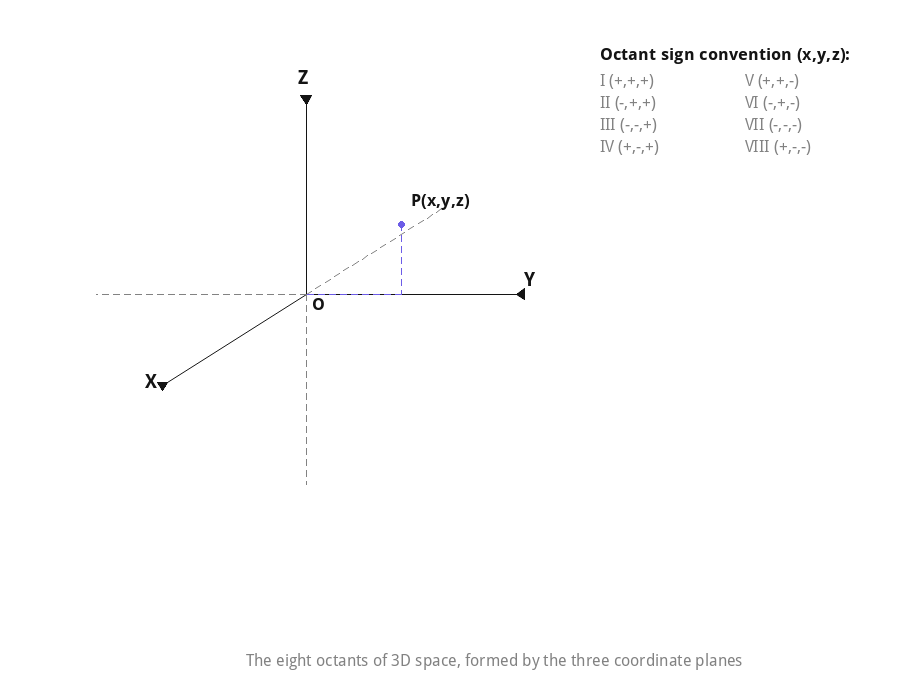
Three-dimensional coordinate geometry extends the familiar x-y plane with a third axis, splitting space into eight octants instead of four quadrants. Chapter 11 of Class 11 Maths covers how a point is located in this system and how the distance and section formulas adapt to it.
Last Updated: September 23, 2026
3D Coordinate System
- 3 mutually perpendicular axes (x,y,z); origin (0,0,0).
- 8 octants (vs 4 quadrants in 2D).
- Point = ordered triple (x,y,z).
Distance Formula
- d = √[(x2−x1)²+(y2−y1)²+(z2−z1)²].
Section Formula
- Ratio m:n: [(mx2+nx1)/(m+n), (my2+ny1)/(m+n), (mz2+nz1)/(m+n)].
One-Line Summary
3D coordinate geometry extends 2D concepts with a third (z) axis, dividing space into 8 octants, using natural extensions of the distance and section formulas.
Quick visual: a worked diagram from the full Solutions page, for reference.
- Chapter 1: Sets - Quick Revision Notes
- Chapter 2: Relations and Functions – Revision Notes
- Chapter 3: Trigonometric Functions – Revision Notes
- Chapter 4: Complex Numbers and Quadratic Equations – Revision Notes
- Chapter 5: Linear Inequalities – Revision Notes
- Chapter 6: Permutations and Combinations – Revision Notes
- Chapter 7: Binomial Theorem – Revision Notes
- Chapter 8: Sequences and Series – Revision Notes
- Chapter 9: Straight Lines – Revision Notes
- Chapter 10: Conic Sections – Revision Notes
- Chapter 12: Limits and Derivatives – Revision Notes
- Chapter 13: Statistics – Revision Notes
- Chapter 14: Probability – Revision Notes
Frequently Asked Questions
How is a point located in three-dimensional space?
A point in 3D space is located using three coordinates x, y and z, representing its distances from three mutually perpendicular coordinate planes, extending the two-coordinate system used in plane geometry.
What is the distance formula in three dimensions, and how does it relate to the 2D distance formula?
The 3D distance formula is the square root of the sum of squares of differences in the x, y and z coordinates. It is a direct extension of the 2D distance formula with an added z-term.
Chapter Quiz — Test Your Understanding
Class 11 Maths Chapter 11 – Solutions and Important Questions
Need full answers or more practice? See the Class 11 Maths Chapter 11 Solutions and Class 11 Maths Chapter 11 Extra Questions.
See also: Chapter 2 | Chapter 3 | Chapter 4 | Chapter 5 | Chapter 6 | Chapter 7 | Chapter 8 | Chapter 9 | Chapter 10 | Chapter 11
Practice more: Chapter 2 | Chapter 3 | Chapter 4 | Chapter 5 | Chapter 6 | Chapter 7 | Chapter 8 | Chapter 9 | Chapter 10 | Chapter 11
Quick revision: Chapter 2 | Chapter 3 | Chapter 4 | Chapter 5 | Chapter 6 | Chapter 7 | Chapter 8 | Chapter 9 | Chapter 10
Recommended: Buy the Printed NCERT Class 11 Maths Book
Contains Amazon affiliate links.
If you’d like a printed copy alongside the PDF, here’s a verified option:
4.2 out of 5 stars (953 ratings) · Rs. 170
Price and availability may change on Amazon. As an Amazon Associate, ncertbooks.org earns from qualifying purchases.


