
Probability in Chapter 14 of Class 11 Maths is built on a simple ratio: favourable outcomes divided by the total outcomes in the sample space. This page runs through the terminology, event types, and the addition rule used when combining two events.
Last Updated: September 23, 2026
Key Terms
- Random experiment; Sample space (S); Event = subset of S.
Event Types
- Impossible (∅): P=0. Sure (S): P=1.
- Complement: P(A’)=1−P(A).
- Mutually exclusive: no overlap.
Probability Formula
- P(A) = n(A)/n(S); 0≤P(A)≤1.
Addition Rule
- P(A∪B) = P(A)+P(B)−P(A∩B).
- Mutually exclusive: P(A∪B)=P(A)+P(B).
One-Line Summary
Theoretical probability is calculated as favourable outcomes over total outcomes in the sample space, with the addition rule handling combined events by subtracting any overlap to avoid double-counting.
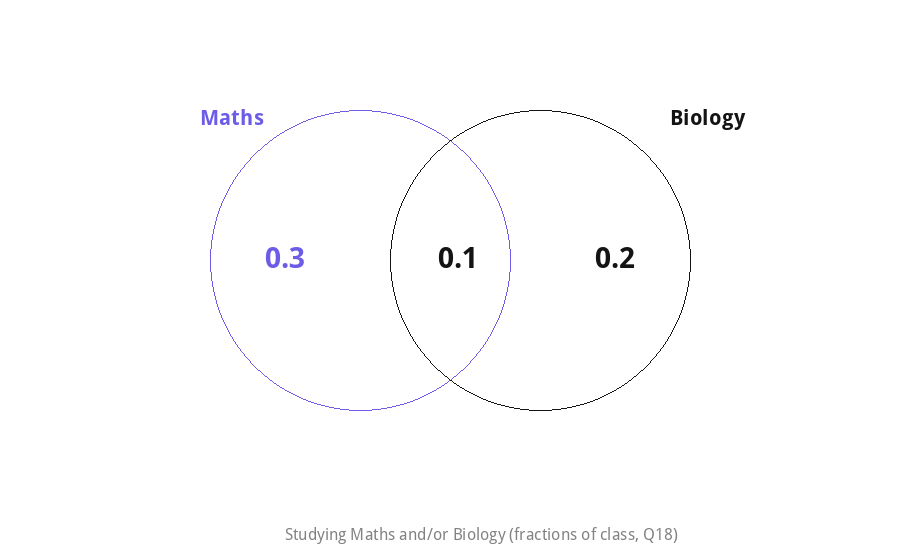
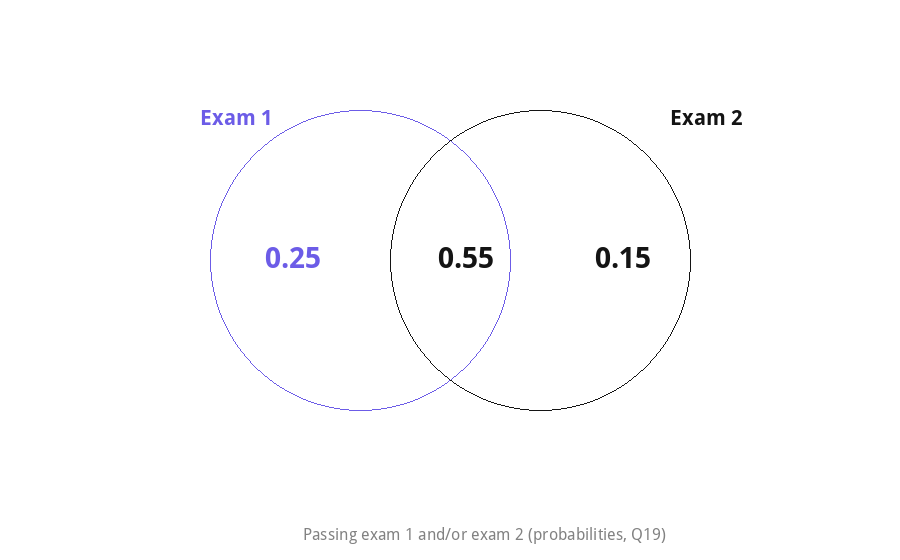
Quick visual: a worked diagram from the full Solutions page, for reference.
- Chapter 1: Sets - Quick Revision Notes
- Chapter 2: Relations and Functions – Revision Notes
- Chapter 3: Trigonometric Functions – Revision Notes
- Chapter 4: Complex Numbers and Quadratic Equations – Revision Notes
- Chapter 5: Linear Inequalities – Revision Notes
- Chapter 6: Permutations and Combinations – Revision Notes
- Chapter 7: Binomial Theorem – Revision Notes
- Chapter 8: Sequences and Series – Revision Notes
- Chapter 9: Straight Lines – Revision Notes
- Chapter 10: Conic Sections – Revision Notes
- Chapter 11: Introduction to Three Dimensional Geometry – Revision Notes
- Chapter 12: Limits and Derivatives – Revision Notes
- Chapter 13: Statistics – Revision Notes
Frequently Asked Questions
What is the difference between mutually exclusive and independent events in probability?
Mutually exclusive events cannot occur at the same time, like getting a 2 and a 5 on a single die roll, while independent events are ones where the occurrence of one does not affect the probability of the other, like flipping a coin twice.
How is the probability of an event calculated using the axiomatic approach introduced in this chapter?
Probability is assigned to each outcome of a sample space as a number between 0 and 1 such that the probabilities of all outcomes sum to 1, and the probability of an event is the sum of probabilities of its favourable outcomes.
Chapter Quiz — Test Your Understanding
Class 11 Maths Chapter 14 – Solutions and Important Questions
Need full answers or more practice? See the Class 11 Maths Chapter 14 Solutions and Class 11 Maths Chapter 14 Extra Questions.
See also: Chapter 2 | Chapter 3 | Chapter 4 | Chapter 5 | Chapter 6 | Chapter 7 | Chapter 8 | Chapter 9 | Chapter 10 | Chapter 11 | Chapter 12 | Chapter 13 | Chapter 14
Practice more: Chapter 2 | Chapter 3 | Chapter 4 | Chapter 5 | Chapter 6 | Chapter 7 | Chapter 8 | Chapter 9 | Chapter 10 | Chapter 11 | Chapter 12 | Chapter 13 | Chapter 14
Quick revision: Chapter 2 | Chapter 3 | Chapter 4 | Chapter 5 | Chapter 6 | Chapter 7 | Chapter 8 | Chapter 9 | Chapter 10 | Chapter 11 | Chapter 12 | Chapter 13
Recommended: Buy the Printed NCERT Class 11 Maths Book
Contains Amazon affiliate links.
If you’d like a printed copy alongside the PDF, here’s a verified option:
4.2 out of 5 stars (953 ratings) · Rs. 170
Price and availability may change on Amazon. As an Amazon Associate, ncertbooks.org earns from qualifying purchases.


