Range, mean deviation, variance, and standard deviation all measure the same thing in different ways: how spread out a set of numbers is. These Class 11 Maths Chapter 13 questions calculate each of these measures for small data sets.
Last Updated: September 23, 2026
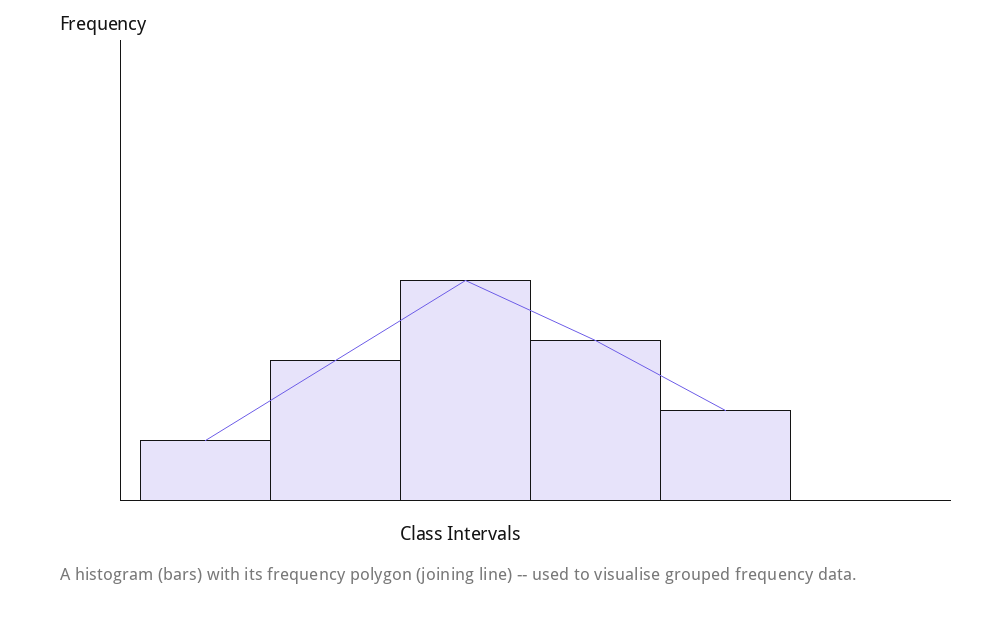 Reference figure: a histogram of grouped data, illustrating how frequency-distribution data used throughout this chapter is visualised.
Very Short Answer Questions (1 mark)
Q1. Find the range of the data: 3, 7, 2, 9, 5.
Ans: 9−2 = 7.
Q2. What is the relationship between variance and standard deviation?
Ans: Standard deviation = √(variance).
Q3. Can standard deviation be negative?
Ans: No, it is always ≥ 0 (it’s a square root of a sum of squares).
Q4. What does a standard deviation of 0 indicate?
Ans: All data values are identical (equal to the mean).
Q5. What measure uses absolute differences from the mean?
Ans: Mean deviation.
Short Answer Questions (2–3 marks)
Q6. Find the mean and range of the data set: 4, 8, 6, 10, 2.
Ans: Mean = (4+8+6+10+2)/5 = 30/5 = 6. Range = 10−2 = 8.
Q7. Two data sets have the same mean, but Set A has standard deviation 2 and Set B has standard deviation 8. Which set has more consistent (less spread out) data, and why?
Ans: Set A has more consistent data, since a smaller standard deviation (2, compared to 8) indicates the data values are, on average, closer to the mean, meaning less variability.
Q8. Find the variance of the data set 2, 4, 6 (mean = 4), showing your working.
Ans: Deviations from mean: (2−4)=−2, (4−4)=0, (6−4)=2. Squared: 4, 0, 4. Variance = (4+0+4)/3 = 8/3 ≈ 2.67.
Higher-Order Thinking / Application Questions
Q9. Two cricket players have the same batting average (mean) of 40 runs over 5 matches, but Player A’s standard deviation is 5, while Player B’s is 20. Explain what this tells a team selector about each player’s reliability, beyond just their average.
Ans: Although both players average 40 runs, Player A’s low standard deviation (5) indicates consistent scoring close to 40 in most matches, making them a reliable, predictable performer. Player B’s high standard deviation (20) indicates highly variable scores — possibly some very high and some very low scores — making them less predictable, even though their average performance is the same. A selector wanting consistency would prefer Player A, despite equal averages.
Q10. Explain why variance uses squared deviations rather than simply summing the raw (signed) deviations from the mean.
Ans: If raw (signed) deviations were summed directly, the positive and negative deviations would cancel each other out, always summing to zero (by the definition of the mean) — providing no useful information about spread. Squaring the deviations makes all values positive before summing, so that both above-mean and below-mean spread contributes meaningfully to the total measure of dispersion, rather than cancelling out.
- Chapter 1: Sets - Important HOTS & Extra Questions with Solutions
- Chapter 2: Relations and Functions – Extra Questions with Answers
- Chapter 3: Trigonometric Functions – Extra Questions with Answers
- Chapter 4: Complex Numbers and Quadratic Equations – Extra Questions with Answers
- Chapter 5: Linear Inequalities – Extra Questions with Answers
- Chapter 6: Permutations and Combinations – Extra Questions with Answers
- Chapter 7: Binomial Theorem – Extra Questions with Answers
- Chapter 8: Sequences and Series – Extra Questions with Answers
- Chapter 9: Straight Lines – Extra Questions with Answers
- Chapter 10: Conic Sections – Extra Questions with Answers
- Chapter 11: Introduction to Three Dimensional Geometry – Extra Questions with Answers
- Chapter 12: Limits and Derivatives – Extra Questions with Answers
- Chapter 14: Probability – Extra Questions with Answers
Frequently Asked Questions
How would you find the mean deviation about the mean for the data 4, 7, 8, 9, 10, 12, 13, 17?
First find the mean, which is 10, then average the absolute deviations from it, giving a mean deviation of 3.
If a dataset has variance 16, what is its standard deviation and how does it change if every value is doubled?
Standard deviation is the square root of variance, so 4; if every value is doubled, the standard deviation also doubles to 8.
Chapter Quiz — Test Your Understanding
Class 11 Maths Chapter 13 – Solutions and Notes
For complete step-by-step answers and a quick summary, check the Class 11 Maths Chapter 13 Solutions and Class 11 Maths Chapter 13 Revision Notes.
See also: Chapter 2 | Chapter 3 | Chapter 4 | Chapter 5 | Chapter 6 | Chapter 7 | Chapter 8 | Chapter 9 | Chapter 10 | Chapter 11 | Chapter 12 | Chapter 13
Practice more: Chapter 2 | Chapter 3 | Chapter 4 | Chapter 5 | Chapter 6 | Chapter 7 | Chapter 8 | Chapter 9 | Chapter 10 | Chapter 11 | Chapter 12
Quick revision: Chapter 2 | Chapter 3 | Chapter 4 | Chapter 5 | Chapter 6 | Chapter 7 | Chapter 8 | Chapter 9 | Chapter 10 | Chapter 11 | Chapter 12
Recommended: Buy the Printed NCERT Class 11 Maths Book
Contains Amazon affiliate links.
If you’d like a printed copy alongside the PDF, here’s a verified option:
4.2 out of 5 stars (953 ratings) · Rs. 170
Price and availability may change on Amazon. As an Amazon Associate, ncertbooks.org earns from qualifying purchases.