
Determinants underpin whether a matrix can be inverted, and these questions work through calculating |A|, recognising singular matrices, and finding inverses via the adjoint.
Last Updated: September 23, 2026
How to Approach the HOTS Questions in This Chapter
HOTS questions here often ask you to prove a determinant identity using row/column operations rather than direct expansion, or combine determinants with solving a system of equations via Cramer’s rule — practice simplifying a determinant using properties before expanding, since direct expansion of a complex determinant is usually much slower.
Very Short Answer Questions (1 mark)
Q1. Find |A| for A=[[2,3],[1,4]].
Ans: |A|=2(4)−3(1)=8−3=5.
Q2. What does it mean for a matrix to be singular?
Ans: Its determinant equals zero, so it has no inverse.
Q3. What is the formula for the inverse of a matrix using adjoint?
Ans: A⁻¹=adj(A)/|A|, provided |A|≠0.
Q4. If |A|=0 for a 3×3 matrix in AX=B, can we conclude there is no solution?
Ans: No, it could have no solution or infinitely many; further check via (adj A)B is needed.
Q5. State one property relating |A| and |A’|.
Ans: |A’|=|A| (determinant is unchanged by transpose).
Short Answer Questions (2–3 marks)
Q6. Find the cofactor A12 of the matrix [[1,2,3],[4,5,6],[7,8,9]].
Ans: Delete row1,col2: [[4,6],[7,9]], minor=4(9)−6(7)=36−42=−6. Cofactor A12=(−1)1+2(−6)=6.
Q7. Using determinants, find the area of a triangle with vertices (0,0), (4,0), (0,3).
Ans: Area=½|0(0−3)+4(3−0)+0(0−0)|=½|12|=6 sq units.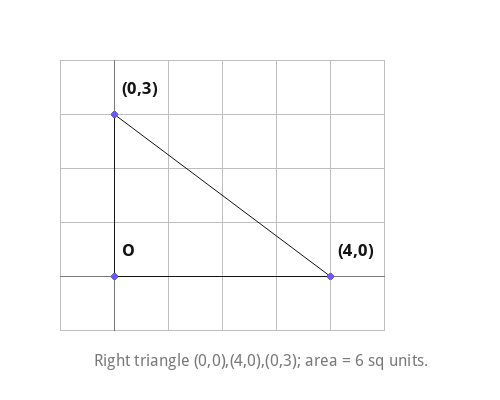
Q8. If |A|=5 and A is 3×3, find |adj(A)|.
Ans: |adj(A)|=|A|n−1=52=25.
Higher-Order Thinking / Application Questions
Q9. Solve the system 2x+3y=5 and x−2y=−3 using the matrix method, showing all steps including the inverse calculation.
Ans: Write as AX=B where A=[[2,3],[1,−2]], X=[[x],[y]], B=[[5],[−3]]. First, |A|=2(−2)−3(1)=−4−3=−7, which is non-zero, so A is invertible and a unique solution exists. Find adj(A): cofactors are A11=−2, A12=−1, A21=−3, A22=2, so the cofactor matrix is [[−2,−1],[−3,2]], and adj(A) (transpose of cofactor matrix)=[[−2,−3],[−1,2]]. Then A⁻¹=adj(A)/|A|=(1/−7)[[−2,−3],[−1,2]]=[[2/7,3/7],[1/7,−2/7]]. Now X=A⁻¹B=[[2/7,3/7],[1/7,−2/7]]×[[5],[−3]]=[[(2/7)(5)+(3/7)(−3)],[(1/7)(5)+(−2/7)(−3)]]=[[(10−9)/7],[(5+6)/7]]=[[1/7],[11/7]]. So x=1/7, y=11/7. Verification: 2(1/7)+3(11/7)=2/7+33/7=35/7=5 ✓; (1/7)−2(11/7)=1/7−22/7=−21/7=−3 ✓.
Q10. Explain, with reasoning, why a system of linear equations AX=B has a unique solution when |A|≠0, but may have no solution or infinitely many solutions when |A|=0.
Ans: When |A|≠0, matrix A is invertible, meaning A⁻¹ exists uniquely (since A⁻¹=adj(A)/|A| is a well-defined single matrix). We can then multiply both sides of AX=B on the left by A⁻¹ to get A⁻¹AX=A⁻¹B, i.e., IX=A⁻¹B, i.e., X=A⁻¹B. Since A⁻¹ is unique, this gives exactly one value of X — a unique solution. However, when |A|=0, A has no inverse, so we cannot isolate X this way at all. Geometrically, |A|=0 means the equations represented by the rows of A are linearly dependent (e.g., two planes/lines that are parallel or coincide rather than intersecting at a single point). If the equations are consistent (compatible), i.e. (adj A)B=0 (a zero matrix), the system reduces to fewer independent equations than unknowns, giving infinitely many solutions (like two coincident lines). If the equations are inconsistent, i.e. (adj A)B≠0, the equations contradict each other (like two parallel, non-intersecting lines), giving no solution at all. This is why checking (adj A)B is the standard test to distinguish between these two |A|=0 cases.
- Chapter 1: Extra Questions (HOTS) - Relations and Functions
- Chapter 2: Inverse Trigonometric Functions – Extra Questions with Answers
- Chapter 3: Matrices – Extra Questions with Answers
- Chapter 5: Continuity and Differentiability – Extra Questions with Answers
- Chapter 6: Applications of Derivatives – Extra Questions with Answers
- Chapter 7: Integrals – Extra Questions with Answers
- Chapter 8: Applications of Integrals – Extra Questions with Answers
- Chapter 9: Differential Equations – Extra Questions with Answers
- Chapter 10: Vectors – Extra Questions with Answers
- Chapter 11: Three-Dimensional Geometry – Extra Questions with Answers
- Chapter 12: Linear Programming – Extra Questions with Answers
- Chapter 13: Probability – Extra Questions with Answers
Frequently Asked Questions
How would you use determinants to check whether a system of two linear equations has a unique solution?
Calculate the determinant of the coefficient matrix; if it is non zero, the system has a unique solution by Cramer rule.
How would you find the area of a triangle with vertices (1,2), (3,4) and (5,0) using determinants?
Using the determinant formula for area, Area = half times the absolute value of the determinant formed by the coordinates, which gives 6 square units.
Chapter Quiz — Test Your Understanding
Class 12 Mathematics Chapter 4 – Solutions and Notes
For complete step-by-step answers and a quick summary, check the Class 12 Mathematics Chapter 4 Solutions and Class 12 Mathematics Chapter 4 Revision Notes.
See also: Chapter 1 | Chapter 2 | Chapter 3 | Chapter 4
Recommended: Buy the Printed NCERT Class 12 Maths Book
Contains Amazon affiliate links.
If you’d like a printed copy alongside the PDF, here’s a verified option:
4.3 out of 5 stars (899 ratings) · Rs. 94
Price and availability may change on Amazon. As an Amazon Associate, ncertbooks.org earns from qualifying purchases.



Pingback: Class 12 Maths Chapter 6 Applications of Derivatives Solutions (2026-27)
Pingback: Class 12 Maths Chapter 7 Integrals Solutions (2026-27)
Pingback: Class 12 Maths Chapter 6 Applications of Derivatives Extra Questions (2026-27)