
These practice questions probe the boundary between continuity and differentiability, including classic cases like |x| at x=0, where a function is continuous but not differentiable.
Last Updated: September 23, 2026
How to Approach the HOTS Questions in This Chapter
HOTS questions here often ask you to prove differentiability (or its absence) at a specific point using first principles, or combine logarithmic and implicit differentiation in one problem — practice first-principles differentiation directly, not just formula application, since HOTS questions frequently return to that definition.
Very Short Answer Questions (1 mark)
Q1. State the condition for continuity of f at x=a.
Ans: limx→af(x)=f(a).
Q2. Is |x| differentiable at x=0?
Ans: No, the left and right derivatives differ (−1 and 1).
Q3. What is d/dx(ex)?
Ans: ex.
Q4. What is d/dx(log x)?
Ans: 1/x.
Q5. State the chain rule for y=f(g(x)).
Ans: dy/dx=f'(g(x))·g'(x).
Short Answer Questions (2–3 marks)
Q6. Differentiate y=sin(x²) with respect to x.
Ans: Using chain rule, dy/dx=cos(x²)·2x=2x cos(x²).
Q7. Find dy/dx if x²+y²=25 (implicit differentiation).
Ans: Differentiating both sides: 2x+2y(dy/dx)=0, so dy/dx=−x/y.
Q8. Differentiate y=xx using logarithmic differentiation.
Ans: Take log: log y=x log x. Differentiate: (1/y)(dy/dx)=log x+1, so dy/dx=y(log x+1)=xx(log x+1).
Higher-Order Thinking / Application Questions
Q9. Examine the continuity and differentiability of f(x)=|x−1| at x=1, showing all reasoning using left-hand and right-hand limits and derivatives.
Ans: For continuity at x=1: LHL=limx→1⁻|x−1|=limh→0|(1−h)−1|=limh→0h=0. RHL=limx→1⁺|x−1|=limh→0|(1+h)−1|=limh→0h=0. f(1)=|1−1|=0. Since LHL=RHL=f(1)=0, f is continuous at x=1. For differentiability: LHD=limh→0[f(1−h)−f(1)]/(−h)=limh→0[h−0]/(−h)=−1. RHD=limh→0[f(1+h)−f(1)]/h=limh→0[h−0]/h=1. Since LHD=−1≠RHD=1, f is NOT differentiable at x=1, despite being continuous there — this is a classic example demonstrating that continuity does not guarantee differentiability, because the graph has a sharp corner (kink) at x=1 even though there is no break or jump.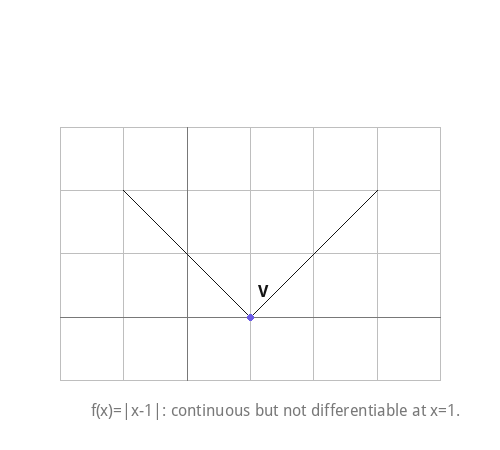
Q10. State Rolle’s Theorem and verify it for f(x)=x²−4x+3 on the interval [1,3], finding the value of c explicitly.
Ans: Rolle’s Theorem states that if f is continuous on [a,b], differentiable on (a,b), and f(a)=f(b), then there exists at least one c∈(a,b) such that f'(c)=0. Here f(x)=x²−4x+3 is a polynomial, so it is continuous on [1,3] and differentiable on (1,3), satisfying the first two conditions. Check f(1)=1−4+3=0 and f(3)=9−12+3=0, so f(1)=f(3)=0, satisfying the third condition. By Rolle’s Theorem, there must exist c∈(1,3) with f'(c)=0. Now f'(x)=2x−4, so setting f'(c)=0 gives 2c−4=0, i.e., c=2. Since 2∈(1,3), this confirms Rolle’s Theorem holds, and geometrically it means the tangent to the parabola is horizontal at x=2, which is the vertex of the parabola exactly midway between the two roots x=1 and x=3.![Rolle Thm: x^2-4x+3 on [1,3]; horizontal tangent at c=2.](https://ncertbooks.org/wp-content/uploads/2026/09/ncb-diagram-4294-exq-q10.png)
- Chapter 1: Extra Questions (HOTS) - Relations and Functions
- Chapter 2: Inverse Trigonometric Functions – Extra Questions with Answers
- Chapter 3: Matrices – Extra Questions with Answers
- Chapter 4: Determinants – Extra Questions with Answers
- Chapter 6: Applications of Derivatives – Extra Questions with Answers
- Chapter 7: Integrals – Extra Questions with Answers
- Chapter 8: Applications of Integrals – Extra Questions with Answers
- Chapter 9: Differential Equations – Extra Questions with Answers
- Chapter 10: Vectors – Extra Questions with Answers
- Chapter 11: Three-Dimensional Geometry – Extra Questions with Answers
- Chapter 12: Linear Programming – Extra Questions with Answers
- Chapter 13: Probability – Extra Questions with Answers
Frequently Asked Questions
How would you check if the function f(x) = absolute value of x is differentiable at x=0?
The left hand derivative is -1 and the right hand derivative is +1 at x=0, and since they are not equal, the function is not differentiable at that point.
How would you find the derivative of y = sin(x squared) using the chain rule?
Using the chain rule, dy over dx = cos(x squared) times 2x, giving 2x cos(x squared).
Chapter Quiz — Test Your Understanding
Class 12 Mathematics Chapter 5 – Solutions and Notes
For complete step-by-step answers and a quick summary, check the Class 12 Mathematics Chapter 5 Solutions and Class 12 Mathematics Chapter 5 Revision Notes.
See also: Chapter 1 | Chapter 2 | Chapter 3 | Chapter 4 | Chapter 5
Practice more: Chapter 1 | Chapter 2 | Chapter 3 | Chapter 4
Quick revision: Chapter 1 | Chapter 2 | Chapter 3 | Chapter 4
Recommended: Buy the Printed NCERT Class 12 Maths Book
Contains Amazon affiliate links.
If you’d like a printed copy alongside the PDF, here’s a verified option:
4.3 out of 5 stars (899 ratings) · Rs. 94
Price and availability may change on Amazon. As an Amazon Associate, ncertbooks.org earns from qualifying purchases.



Pingback: Class 12 Maths Chapter 10 Vectors Revision Notes (2026-27)
Pingback: Class 12 Maths Chapter 5 Continuity and Differentiability Revision Notes (2026-27)