
Linear Programming sets up a linear objective function subject to constraints, and this chapter explains the corner point method used to find where that function is maximised or minimised.
Last Updated: September 23, 2026
Key Concepts
- Objective function: Z=ax+by (maximize/minimize).
- Constraints: linear inequalities + non-negativity (x,y≥0).
- Feasible region: common region satisfying all constraints.
Corner Point Method
- Optimal Z occurs at a vertex of the feasible region.
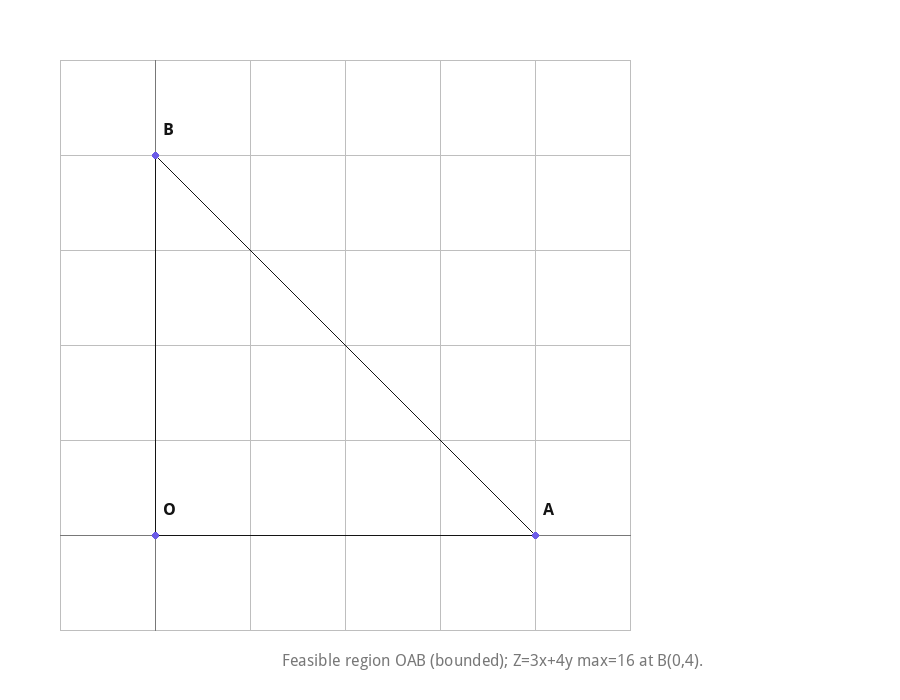
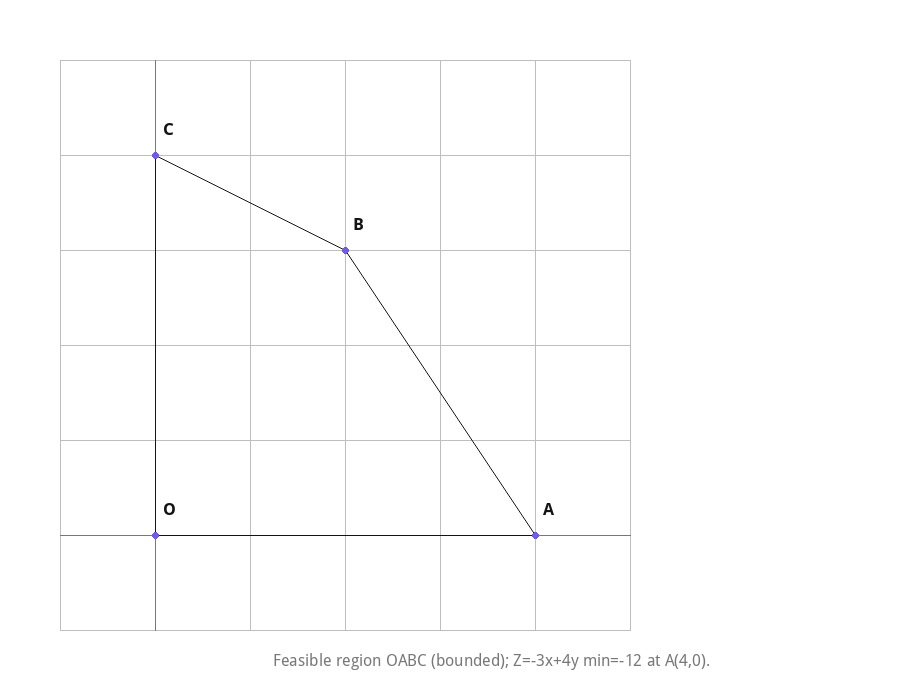
- Evaluate Z at each corner point; pick max/min.
- Unbounded region: check if max actually exists.
- Equal Z at two adjacent corners ⇒ entire edge is optimal (multiple solutions).
One-Line Summary
Linear Programming optimizes a linear objective function over a feasible region defined by linear constraints, with the optimum always occurring at a corner point (vertex) of the region.
Quick visual: a worked diagram from the full Solutions page, for reference.
- Chapter 1: Revision Notes - Relations and Functions
- Chapter 2: Inverse Trigonometric Functions – Revision Notes
- Chapter 3: Matrices – Revision Notes
- Chapter 4: Determinants – Revision Notes
- Chapter 5: Continuity and Differentiability – Revision Notes
- Chapter 6: Applications of Derivatives – Revision Notes
- Chapter 7: Integrals – Revision Notes
- Chapter 8: Applications of Integrals – Revision Notes
- Chapter 9: Differential Equations – Revision Notes
- Chapter 10: Vectors – Revision Notes
- Chapter 11: Three-Dimensional Geometry – Revision Notes
- Chapter 13: Probability – Revision Notes
Frequently Asked Questions
What is the goal of a linear programming problem?
A linear programming problem aims to find the maximum or minimum value of a linear objective function, subject to a set of linear constraints, representing real-world limitations such as resources, cost, or time.
What is the significance of the feasible region and its corner points?
The feasible region is the set of all points satisfying every constraint simultaneously, and the Corner Point Theorem states that the optimal value of the objective function always occurs at one of the corner points of this region.
Chapter Quiz — Test Your Understanding
Class 12 Mathematics Chapter 12 – Solutions and Important Questions
Need full answers or more practice? See the Class 12 Mathematics Chapter 12 Solutions and Class 12 Mathematics Chapter 12 Extra Questions.
See also: Chapter 1 | Chapter 2 | Chapter 3 | Chapter 4 | Chapter 5 | Chapter 6 | Chapter 7 | Chapter 8 | Chapter 9 | Chapter 10 | Chapter 11 | Chapter 12
Practice more: Chapter 1 | Chapter 2 | Chapter 3 | Chapter 4 | Chapter 5 | Chapter 6 | Chapter 7 | Chapter 8 | Chapter 9 | Chapter 10 | Chapter 11 | Chapter 12
Quick revision: Chapter 1 | Chapter 2 | Chapter 3 | Chapter 4 | Chapter 5 | Chapter 6 | Chapter 7 | Chapter 8 | Chapter 9 | Chapter 10 | Chapter 11
Recommended: Buy the Printed NCERT Class 12 Maths Book
Contains Amazon affiliate links.
If you’d like a printed copy alongside the PDF, here’s a verified option:
4.3 out of 5 stars (899 ratings) · Rs. 94
Price and availability may change on Amazon. As an Amazon Associate, ncertbooks.org earns from qualifying purchases.


