
This set of Probability questions moves from conditional probability and independence through to the binomial distribution and the variance of a random variable.
Last Updated: September 23, 2026
Very Short Answer Questions (1 mark)
Q1. Write the formula for P(A|B).
Ans: P(A∩B)/P(B), P(B)>0.
Q2. What is the condition for independence of A and B?
Ans: P(A∩B)=P(A)P(B).
Q3. Write the binomial probability formula for r successes in n trials.
Ans: P(X=r)=nCrprqn−r.
Q4. What is the sum of all probabilities in a probability distribution?
Ans: 1.
Q5. Write the formula for variance of a random variable X.
Ans: Var(X)=E(X²)−[E(X)]².
Short Answer Questions (2–3 marks)
Q6. If P(A)=0.4, P(B)=0.5, P(A∩B)=0.2, find P(A|B).
Ans: P(A|B)=P(A∩B)/P(B)=0.2/0.5=0.4.
Q7. A fair coin is tossed 3 times. Find the probability of getting exactly 2 heads.
Ans: n=3, p=q=1/2, r=2. P(X=2)=3C2(1/2)²(1/2)⁹¹=3(1/4)(1/2)=3/8.
Q8. Check if events A,B with P(A)=0.3, P(B)=0.4, P(A∩B)=0.12 are independent.
Ans: P(A)P(B)=0.3×0.4=0.12=P(A∩B). Yes, they are independent.
Higher-Order Thinking / Application Questions
Q9. A bag contains 5 red and 3 black balls. Two balls are drawn one after another without replacement. Find the probability that the second ball is red, given the first ball drawn was black, and also find the overall probability that both balls are red.
Ans: Total balls=8 (5 red, 3 black). Given the first ball is black (3 black balls, so P(first black)=3/8), after removing one black ball, 7 balls remain: 5 red, 2 black. So P(second is red | first is black)=5/7. For the second part, probability that both balls are red: P(first red)=5/8. Given first is red, 7 balls remain: 4 red, 3 black, so P(second red | first red)=4/7. By the multiplication theorem, P(both red)=P(first red)×P(second red|first red)=(5/8)×(4/7)=20/56=5/14. This demonstrates conditional probability changing as balls are removed without replacement (sampling without replacement), unlike independent trials with replacement where probabilities would stay constant.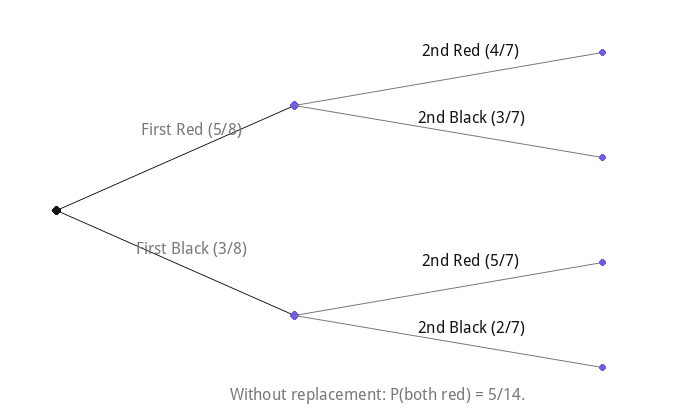
Q10. Three machines A, B, C produce 25%, 35%, and 40% of a factory’s total output respectively. Their defect rates are 5%, 4%, and 2% respectively. If a randomly selected item is found defective, find the probability it was produced by machine C, using Bayes theorem.
Ans: Let E₁,E₂,E₃ denote the item being from machines A, B, C respectively, with P(E₁)=0.25, P(E₂)=0.35, P(E₃)=0.40. Let D denote the event the item is defective, with P(D|E₁)=0.05, P(D|E₂)=0.04, P(D|E₃)=0.02. First find P(D) using the law of total probability: P(D)=P(E₁)P(D|E₁)+P(E₂)P(D|E₂)+P(E₃)P(D|E₃)=(0.25)(0.05)+(0.35)(0.04)+(0.40)(0.02)=0.0125+0.014+0.008=0.0345. Now apply Bayes theorem to find P(E₃|D): P(E₃|D)=[P(E₃)P(D|E₃)]/P(D)=(0.40)(0.02)/0.0345=0.008/0.0345≈0.2319, i.e., approximately 23.19%. This result is meaningful because even though machine C has the LOWEST individual defect rate (2%), it still contributes a non-trivial share of defective items overall since it produces the largest share of total output (40%) — illustrating how Bayes theorem correctly balances both the prior probability (production share) and the likelihood (defect rate) to give the true posterior probability.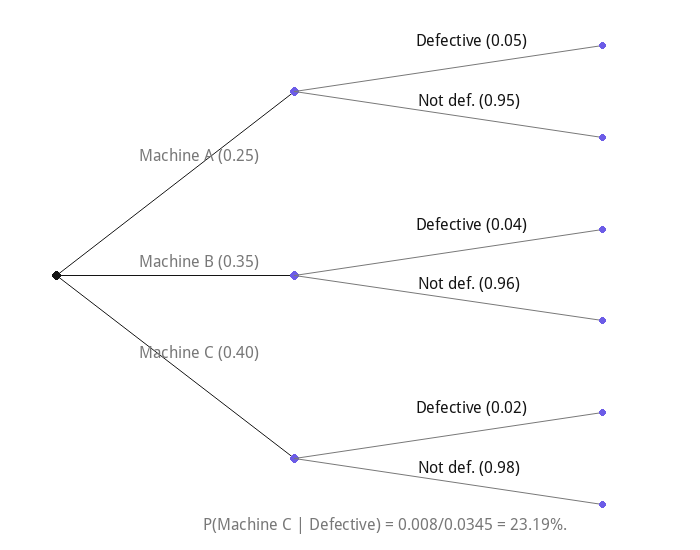
- Chapter 1: Extra Questions (HOTS) - Relations and Functions
- Chapter 2: Inverse Trigonometric Functions – Extra Questions with Answers
- Chapter 3: Matrices – Extra Questions with Answers
- Chapter 4: Determinants – Extra Questions with Answers
- Chapter 5: Continuity and Differentiability – Extra Questions with Answers
- Chapter 6: Applications of Derivatives – Extra Questions with Answers
- Chapter 7: Integrals – Extra Questions with Answers
- Chapter 8: Applications of Integrals – Extra Questions with Answers
- Chapter 9: Differential Equations – Extra Questions with Answers
- Chapter 10: Vectors – Extra Questions with Answers
- Chapter 11: Three-Dimensional Geometry – Extra Questions with Answers
- Chapter 12: Linear Programming – Extra Questions with Answers
Frequently Asked Questions
If a fair coin is tossed 3 times, how would you find the probability of getting exactly 2 heads?
Using the binomial probability formula, the probability is C(3,2) times (half) squared times (half) to the power 1 = 3 over 8.
How would you find the probability of drawing an ace from a well shuffled deck of 52 cards given that a face card was already removed?
Since removing a face card leaves 51 cards including all 4 aces, the probability of drawing an ace is 4 over 51.
Chapter Quiz — Test Your Understanding
Class 12 Mathematics Chapter 13 – Solutions and Notes
For complete step-by-step answers and a quick summary, check the Class 12 Mathematics Chapter 13 Solutions and Class 12 Mathematics Chapter 13 Revision Notes.
See also: Chapter 1 | Chapter 2 | Chapter 3 | Chapter 4 | Chapter 5 | Chapter 6 | Chapter 7 | Chapter 8 | Chapter 9 | Chapter 10 | Chapter 11 | Chapter 12 | Chapter 13
Practice more: Chapter 1 | Chapter 2 | Chapter 3 | Chapter 4 | Chapter 5 | Chapter 6 | Chapter 7 | Chapter 8 | Chapter 9 | Chapter 10 | Chapter 11 | Chapter 12
Quick revision: Chapter 1 | Chapter 2 | Chapter 3 | Chapter 4 | Chapter 5 | Chapter 6 | Chapter 7 | Chapter 8 | Chapter 9 | Chapter 10 | Chapter 11 | Chapter 12
Recommended: Buy the Printed NCERT Class 12 Maths Book
Contains Amazon affiliate links.
If you’d like a printed copy alongside the PDF, here’s a verified option:
4.3 out of 5 stars (899 ratings) · Rs. 94
Price and availability may change on Amazon. As an Amazon Associate, ncertbooks.org earns from qualifying purchases.


