
Probability in this chapter builds from conditional probability up to Bayes’ theorem and the binomial distribution, tying together how earlier events shape the likelihood of later ones.
Last Updated: September 23, 2026
Key Formulas
- Conditional: P(A|B)=P(A∩B)/P(B).
- Multiplication: P(A∩B)=P(A)P(B|A).
- Independence: P(A∩B)=P(A)P(B).
Bayes & Distributions
- Total probability: P(A)=ΣP(Ei)P(A|Ei).
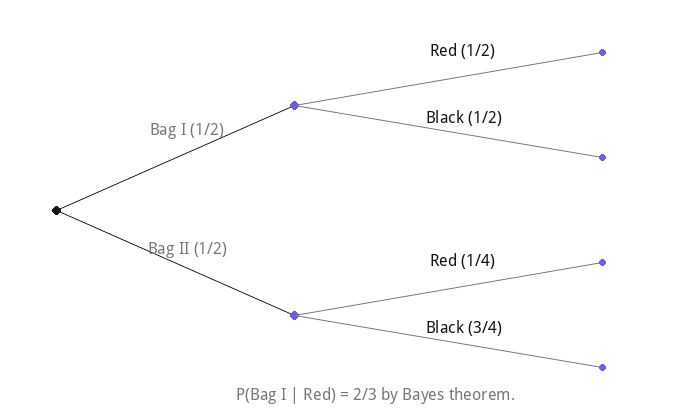
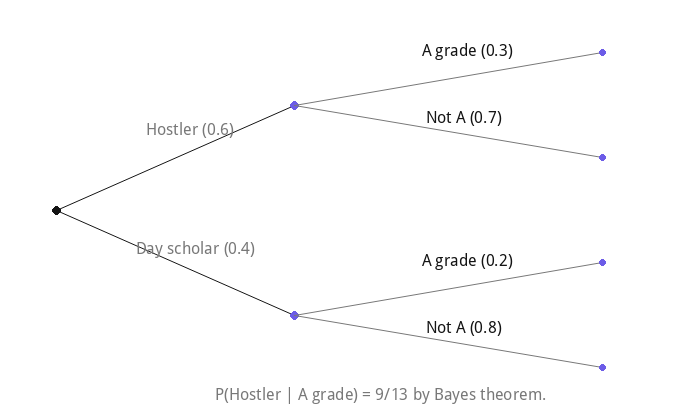
- Bayes theorem: P(Ei|A)=[P(Ei)P(A|Ei)]/ΣP(Ej)P(A|Ej).
- Binomial: P(X=r)=nCrprqn−r.
- Mean=Σxipi; Variance=E(X²)−[E(X)]².
One-Line Summary
Probability in Class 12 builds on conditional probability and independence to Bayes theorem for reversing conditioning, and to random variables/binomial distributions for modeling repeated trials.
Quick visual: a worked diagram from the full Solutions page, for reference.
- Chapter 1: Revision Notes - Relations and Functions
- Chapter 2: Inverse Trigonometric Functions – Revision Notes
- Chapter 3: Matrices – Revision Notes
- Chapter 4: Determinants – Revision Notes
- Chapter 5: Continuity and Differentiability – Revision Notes
- Chapter 6: Applications of Derivatives – Revision Notes
- Chapter 7: Integrals – Revision Notes
- Chapter 8: Applications of Integrals – Revision Notes
- Chapter 9: Differential Equations – Revision Notes
- Chapter 10: Vectors – Revision Notes
- Chapter 11: Three-Dimensional Geometry – Revision Notes
- Chapter 12: Linear Programming – Revision Notes
Frequently Asked Questions
What is conditional probability, and how is it different from ordinary probability?
Conditional probability is the probability of an event occurring given that another event has already occurred, which narrows the sample space to only the outcomes consistent with the given condition, unlike ordinary probability calculated over the full sample space.
What does Bayes Theorem help calculate?
Bayes Theorem helps calculate the probability of a cause given an observed effect, by reversing conditional probabilities using known prior probabilities, and it is widely used in situations involving multiple possible causes for an outcome.
Chapter Quiz — Test Your Understanding
Class 12 Mathematics Chapter 13 – Solutions and Important Questions
Need full answers or more practice? See the Class 12 Mathematics Chapter 13 Solutions and Class 12 Mathematics Chapter 13 Extra Questions.
See also: Chapter 1 | Chapter 2 | Chapter 3 | Chapter 4 | Chapter 5 | Chapter 6 | Chapter 7 | Chapter 8 | Chapter 9 | Chapter 10 | Chapter 11 | Chapter 12 | Chapter 13
Practice more: Chapter 1 | Chapter 2 | Chapter 3 | Chapter 4 | Chapter 5 | Chapter 6 | Chapter 7 | Chapter 8 | Chapter 9 | Chapter 10 | Chapter 11 | Chapter 12 | Chapter 13
Quick revision: Chapter 1 | Chapter 2 | Chapter 3 | Chapter 4 | Chapter 5 | Chapter 6 | Chapter 7 | Chapter 8 | Chapter 9 | Chapter 10 | Chapter 11 | Chapter 12
Recommended: Buy the Printed NCERT Class 12 Maths Book
Contains Amazon affiliate links.
If you’d like a printed copy alongside the PDF, here’s a verified option:
4.3 out of 5 stars (899 ratings) · Rs. 94
Price and availability may change on Amazon. As an Amazon Associate, ncertbooks.org earns from qualifying purchases.


