
Solving an inequality looks just like solving an equation, except the direction flips the moment you multiply or divide by a negative number, and these questions test exactly that.
Last Updated: September 23, 2026
Very Short Answer Questions (1 mark)
Q1. Solve for x: x + 3 > 7.
Ans: x > 4.
Q2. Solve for x: −2x < 8.
Ans: x > −4 (direction reversed since divided by negative).
Q3. Should the boundary line be solid or dashed for the inequality y < 2x+1?
Ans: Dashed (strict inequality, boundary excluded).
Q4. Is x = 5 included in the solution set of x ≥ 5?
Ans: Yes.
Q5. What symbol represents “at most”?
Ans: ≤.
Short Answer Questions (2–3 marks)
Q6. Solve the inequality 3x − 5 ≤ 2x + 1, showing all steps.
Ans: 3x − 2x ≤ 1 + 5, giving x ≤ 6.
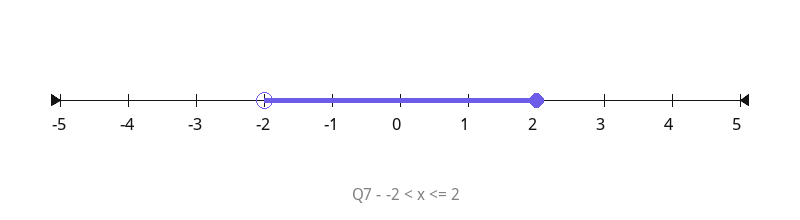
Q7. Solve and represent on a number line: −3 < 2x + 1 ≤ 5.
Ans: Subtract 1 throughout: −4 < 2x ≤ 4. Divide by 2: −2 < x ≤ 2. On the number line: open circle at −2, closed (filled) circle at 2, shaded between.
Q8. A test point method is used to shade the region for x + y ≤ 4. Using the origin (0,0) as the test point, determine which side of the line x+y=4 should be shaded.
Ans: Substituting (0,0): 0+0 = 0 ≤ 4, which is TRUE, so the origin satisfies the inequality, meaning the side of the line containing the origin should be shaded.
Higher-Order Thinking / Application Questions
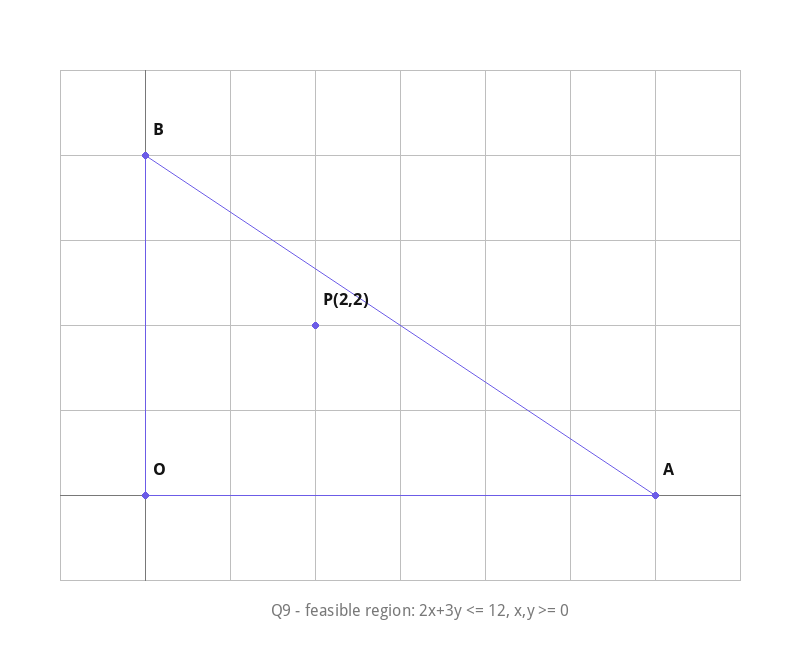
Q9. A factory produces two products, A and B. Constraints require 2x + 3y ≤ 12 (resource limit) and x, y ≥ 0 (non-negative production). Sketch (describe in words) the feasible region, and identify one point that satisfies all constraints.
Ans: The feasible region is a triangle bounded by the x-axis, y-axis, and the line 2x+3y=12 (with the region including the origin side, since (0,0) satisfies 2(0)+3(0)=0≤12). One valid point satisfying all constraints: (2,2), since 2(2)+3(2)=4+6=10≤12, and both x=2, y=2 are non-negative.
Q10. Explain, using an example, why the rule “reverse the inequality when multiplying/dividing by a negative” is necessary, rather than just an arbitrary rule to memorise.
Ans: Consider 2 < 3 (a true statement). Multiplying both sides by −1 without reversing would give −2 < −3, which is FALSE (−2 is actually greater than −3). Reversing the inequality gives −2 > −3, which is TRUE. This shows the rule isn’t arbitrary — it’s necessary to keep the inequality mathematically consistent, since multiplying by a negative number flips the relative order of numbers on the number line.
- Chapter 1: Sets - Important HOTS & Extra Questions with Solutions
- Chapter 2: Relations and Functions – Extra Questions with Answers
- Chapter 3: Trigonometric Functions – Extra Questions with Answers
- Chapter 4: Complex Numbers and Quadratic Equations – Extra Questions with Answers
- Chapter 6: Permutations and Combinations – Extra Questions with Answers
- Chapter 7: Binomial Theorem – Extra Questions with Answers
- Chapter 8: Sequences and Series – Extra Questions with Answers
- Chapter 9: Straight Lines – Extra Questions with Answers
- Chapter 10: Conic Sections – Extra Questions with Answers
- Chapter 11: Introduction to Three Dimensional Geometry – Extra Questions with Answers
- Chapter 12: Limits and Derivatives – Extra Questions with Answers
- Chapter 13: Statistics – Extra Questions with Answers
- Chapter 14: Probability – Extra Questions with Answers
Frequently Asked Questions
A shopkeeper wants total cost to stay under Rs 5000 while buying items costing Rs 250 each, how many items can be bought at most?
Solve 250x is less than or equal to 5000, giving x is less than or equal to 20, so at most 20 items can be purchased.
How would you represent the solution of 3x minus 2 greater than 7 on a number line?
Solve to get x greater than 3, then represent it as an open circle at 3 with shading extending to the right on the number line.
Chapter Quiz — Test Your Understanding
Class 11 Maths Chapter 5 – Solutions and Notes
For complete step-by-step answers and a quick summary, check the Class 11 Maths Chapter 5 Solutions and Class 11 Maths Chapter 5 Revision Notes.
See also: Chapter 2 | Chapter 3 | Chapter 4 | Chapter 5
Recommended: Buy the Printed NCERT Class 11 Maths Book
Contains Amazon affiliate links.
If you’d like a printed copy alongside the PDF, here’s a verified option:
4.2 out of 5 stars (953 ratings) · Rs. 170
Price and availability may change on Amazon. As an Amazon Associate, ncertbooks.org earns from qualifying purchases.


