
Slice a cone at different angles and you get a circle, an ellipse, a parabola, or a hyperbola, the four conic sections. These Class 11 Maths Chapter 10 questions test the standard equations and defining properties of each curve.
Last Updated: September 23, 2026
Very Short Answer Questions (1 mark)
Q1. Write the equation of a circle with centre (2,3) and radius 5.
Ans: (x−2)²+(y−3)²=25.
Q2. What shape is formed when a plane cuts a cone parallel to its slant side?
Ans: A parabola.
Q3. How many foci does an ellipse have?
Ans: Two.
Q4. Write the standard equation of a parabola opening to the right, vertex at origin.
Ans: y²=4ax.
Q5. What is constant for points on a hyperbola relative to its foci?
Ans: The absolute difference of distances to the two foci.
Short Answer Questions (2–3 marks)
Q6. Find the centre and radius of the circle x²+y²−4x−6y+9=0 by completing the square.
Ans: (x²−4x) + (y²−6y) = −9. Completing the square: (x−2)²−4 + (y−3)²−9 = −9, so (x−2)²+(y−3)²=4. Centre = (2,3), radius = 2.
Q7. For the ellipse x²/25 + y²/9 = 1, find the values of a and b, and identify which axis is longer.
Ans: a²=25, so a=5; b²=9, so b=3. Since a>b, the major (longer) axis is along the x-axis.
Q8. Explain, in your own words, how a circle can be considered a special case of an ellipse.
Ans: A circle is an ellipse where both axes are equal in length (a=b), meaning the two foci coincide at a single central point. So a circle is the special case of an ellipse where a=b=r (the radius).
Higher-Order Thinking / Application Questions
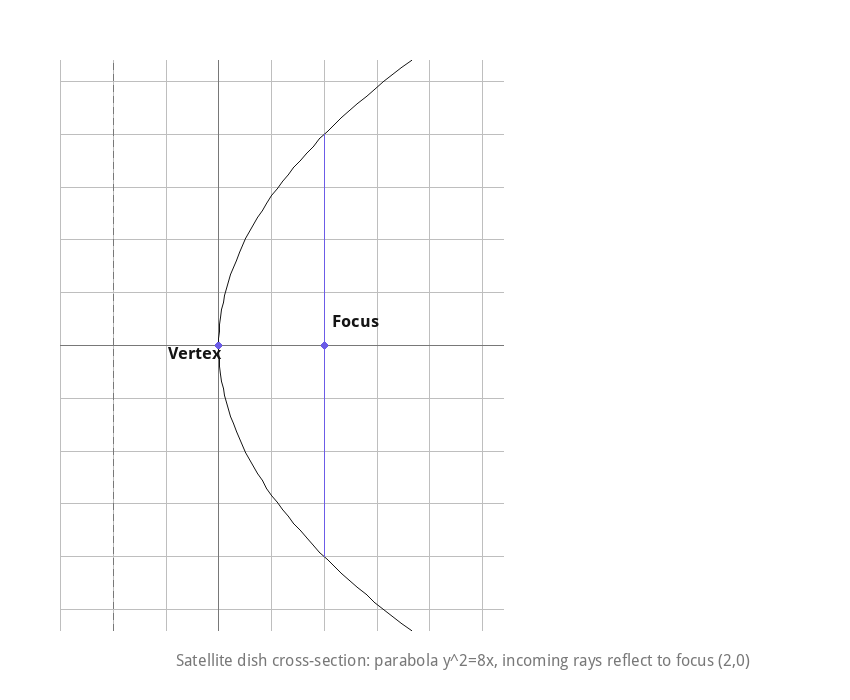
Q9. A satellite dish has a parabolic cross-section designed so that incoming signals reflect to a single focal point. If the equation of the parabola’s cross-section is y²=8x, find the coordinates of the focus, and explain why this focusing property makes parabolas useful for satellite dishes.
Ans: Comparing y²=8x with y²=4ax gives 4a=8, so a=2. The focus is at (a,0) = (2,0). This focusing property is useful because parallel incoming signals (like radio waves from a distant satellite) that strike the parabolic surface all reflect toward this single focal point, allowing the receiver placed there to collect all the concentrated signal, maximising reception strength.
Q10. Explain, using the defining property of an ellipse (constant sum of distances to two foci), why the “string and two pins” method can be used to draw a perfect ellipse by hand.
Ans: If a string of fixed length is looped around two pins (representing the foci) and a pencil is used to pull the string taut while tracing around them, the total length of string from the pencil to each pin remains constant throughout the tracing (since the string length itself doesn’t change). This is exactly the defining property of an ellipse — the sum of distances from any point on the curve to the two foci is constant — so tracing with this fixed total distance naturally produces a perfect ellipse.
- Chapter 1: Sets - Important HOTS & Extra Questions with Solutions
- Chapter 2: Relations and Functions – Extra Questions with Answers
- Chapter 3: Trigonometric Functions – Extra Questions with Answers
- Chapter 4: Complex Numbers and Quadratic Equations – Extra Questions with Answers
- Chapter 5: Linear Inequalities – Extra Questions with Answers
- Chapter 6: Permutations and Combinations – Extra Questions with Answers
- Chapter 7: Binomial Theorem – Extra Questions with Answers
- Chapter 8: Sequences and Series – Extra Questions with Answers
- Chapter 9: Straight Lines – Extra Questions with Answers
- Chapter 11: Introduction to Three Dimensional Geometry – Extra Questions with Answers
- Chapter 12: Limits and Derivatives – Extra Questions with Answers
- Chapter 13: Statistics – Extra Questions with Answers
- Chapter 14: Probability – Extra Questions with Answers
Frequently Asked Questions
How would you find the equation of a circle with center (2,-3) and radius 5?
Using the standard form (x minus h) squared plus (y minus k) squared = r squared, the equation is (x-2) squared + (y+3) squared = 25.
If the focus of a parabola is at (3,0) and the directrix is x=-3, what is its equation?
Since the vertex is at the origin and 4a = 12 with a = 3, the equation is y squared = 12x.
Chapter Quiz — Test Your Understanding
Class 11 Maths Chapter 10 – Solutions and Notes
For complete step-by-step answers and a quick summary, check the Class 11 Maths Chapter 10 Solutions and Class 11 Maths Chapter 10 Revision Notes.
See also: Chapter 2 | Chapter 3 | Chapter 4 | Chapter 5 | Chapter 6 | Chapter 7 | Chapter 8 | Chapter 9 | Chapter 10
Practice more: Chapter 2 | Chapter 3 | Chapter 4 | Chapter 5 | Chapter 6 | Chapter 7 | Chapter 8 | Chapter 9
Quick revision: Chapter 2 | Chapter 3 | Chapter 4 | Chapter 5 | Chapter 6 | Chapter 7 | Chapter 8 | Chapter 9
Recommended: Buy the Printed NCERT Class 11 Maths Book
Contains Amazon affiliate links.
If you’d like a printed copy alongside the PDF, here’s a verified option:
4.2 out of 5 stars (953 ratings) · Rs. 170
Price and availability may change on Amazon. As an Amazon Associate, ncertbooks.org earns from qualifying purchases.


