
Working out a probability starts with listing every possible outcome, the sample space, and then counting the ones that count as a success. These Class 11 Maths Chapter 14 questions cover sample spaces, complementary events, and mutually exclusive outcomes using dice and similar examples.
Last Updated: September 23, 2026
Very Short Answer Questions (1 mark)
Q1. Write the sample space when a die is rolled.
Ans: {1, 2, 3, 4, 5, 6}.
Q2. What is the probability of a sure event?
Ans: 1.
Q3. Find the probability of getting an even number when a die is rolled.
Ans: Favourable outcomes {2,4,6} = 3; P = 3/6 = 1/2.
Q4. If P(A) = 0.4, find P(A’), the complement.
Ans: 1−0.4 = 0.6.
Q5. Are the events “rolling an even number” and “rolling an odd number” on a die mutually exclusive?
Ans: Yes, they cannot happen simultaneously.
Short Answer Questions (2–3 marks)
Q6. A card is drawn from a standard deck of 52 cards. Find the probability that it is a king or a queen.
Ans: These are mutually exclusive events. P(king) = 4/52; P(queen) = 4/52. P(king or queen) = 4/52 + 4/52 = 8/52 = 2/13.
Q7. Two dice are rolled. Find the probability that the sum of the numbers is 7.
Ans: Total outcomes = 36. Favourable: (1,6),(2,5),(3,4),(4,3),(5,2),(6,1) = 6 outcomes. P = 6/36 = 1/6.
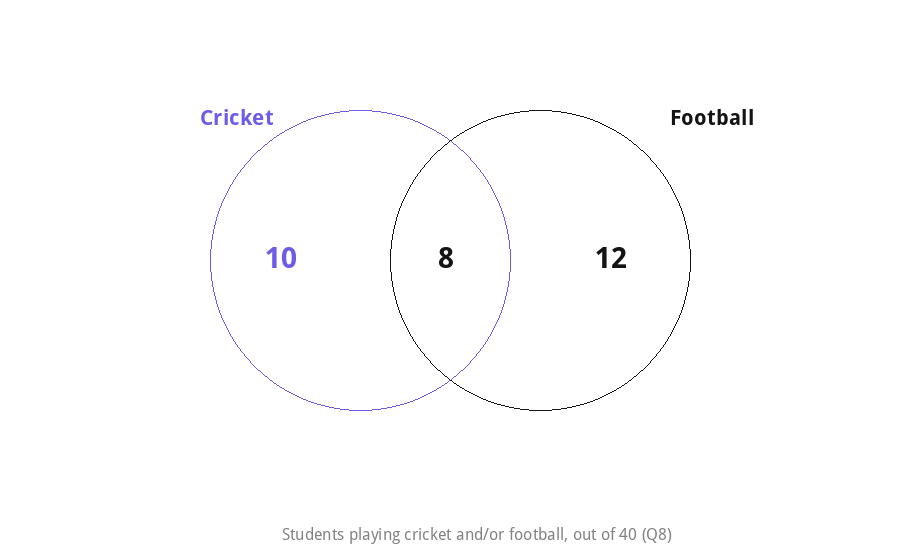
Q8. In a class of 40 students, 18 play cricket, 20 play football, and 8 play both. Find the probability that a randomly chosen student plays cricket or football, using the addition rule.
Ans: P(cricket) = 18/40, P(football) = 20/40, P(both) = 8/40. P(cricket or football) = 18/40 + 20/40 − 8/40 = 30/40 = 3/4.
Higher-Order Thinking / Application Questions
Q9. Explain why the formula P(A∪B) = P(A) + P(B) would overcount the probability if A and B are NOT mutually exclusive, using the class example above (cricket/football) as illustration.
Ans: If we simply added P(cricket)+P(football) = 18/40+20/40 = 38/40 without subtracting the overlap, we would be double-counting the 8 students who play both sports (they’d be counted once in the cricket group and again in the football group). Subtracting P(A∩B) = 8/40 removes this double-counting, correctly giving 30/40 as the true probability of playing at least one sport.
Q10. A single die is rolled once. Event A = “rolling a number greater than 4” and Event B = “rolling an even number.” Find P(A), P(B), P(A∩B), and P(A∪B), explaining each step.
Ans: A = {5,6}, so P(A) = 2/6 = 1/3. B = {2,4,6}, so P(B) = 3/6 = 1/2. A∩B (both greater than 4 AND even) = {6}, so P(A∩B) = 1/6. Using the addition rule: P(A∪B) = P(A)+P(B)−P(A∩B) = 1/3+1/2−1/6 = 2/6+3/6−1/6 = 4/6 = 2/3.
- Chapter 1: Sets - Important HOTS & Extra Questions with Solutions
- Chapter 2: Relations and Functions – Extra Questions with Answers
- Chapter 3: Trigonometric Functions – Extra Questions with Answers
- Chapter 4: Complex Numbers and Quadratic Equations – Extra Questions with Answers
- Chapter 5: Linear Inequalities – Extra Questions with Answers
- Chapter 6: Permutations and Combinations – Extra Questions with Answers
- Chapter 7: Binomial Theorem – Extra Questions with Answers
- Chapter 8: Sequences and Series – Extra Questions with Answers
- Chapter 9: Straight Lines – Extra Questions with Answers
- Chapter 10: Conic Sections – Extra Questions with Answers
- Chapter 11: Introduction to Three Dimensional Geometry – Extra Questions with Answers
- Chapter 12: Limits and Derivatives – Extra Questions with Answers
- Chapter 13: Statistics – Extra Questions with Answers
Frequently Asked Questions
If two dice are rolled, what is the probability of getting a sum of 8?
There are 5 favorable outcomes out of 36 total outcomes, so the probability is 5 over 36.
A bag has 4 red and 6 black balls, what is the probability of drawing one ball that is red?
There are 4 favorable outcomes out of 10 total balls, so the probability is 4 over 10, which simplifies to 2 over 5.
Chapter Quiz — Test Your Understanding
Class 11 Maths Chapter 14 – Solutions and Notes
For complete step-by-step answers and a quick summary, check the Class 11 Maths Chapter 14 Solutions and Class 11 Maths Chapter 14 Revision Notes.
See also: Chapter 2 | Chapter 3 | Chapter 4 | Chapter 5 | Chapter 6 | Chapter 7 | Chapter 8 | Chapter 9 | Chapter 10 | Chapter 11 | Chapter 12 | Chapter 13 | Chapter 14
Practice more: Chapter 2 | Chapter 3 | Chapter 4 | Chapter 5 | Chapter 6 | Chapter 7 | Chapter 8 | Chapter 9 | Chapter 10 | Chapter 11 | Chapter 12 | Chapter 13
Quick revision: Chapter 2 | Chapter 3 | Chapter 4 | Chapter 5 | Chapter 6 | Chapter 7 | Chapter 8 | Chapter 9 | Chapter 10 | Chapter 11 | Chapter 12 | Chapter 13
Recommended: Buy the Printed NCERT Class 11 Maths Book
Contains Amazon affiliate links.
If you’d like a printed copy alongside the PDF, here’s a verified option:
4.2 out of 5 stars (953 ratings) · Rs. 170
Price and availability may change on Amazon. As an Amazon Associate, ncertbooks.org earns from qualifying purchases.


