
Describing Motion Around Us draws the line between distance and displacement, and between speed and velocity, before building up to the standard equations of motion, and this page lays out each distinction and formula.
Last Updated: September 23, 2026
Common Mistakes Students Make in Motion
- Treating distance and displacement as the same: displacement can be less than the distance travelled, or even zero for a round trip, while distance never decreases.
- Confusing speed and velocity: forgetting velocity is a vector (needs direction), while speed is scalar.
- Misreading motion graphs: reading the area under a velocity-time graph (which gives distance) as if it were the slope (which gives acceleration), or vice versa.
- Picking the wrong equation of motion: using v = u + at when the question actually asks for displacement (needing s = ut + ½at²), or vice versa.
Distance vs Displacement
- Distance: total path length, scalar, always positive.
- Displacement: shortest straight-line distance with direction, vector, can be zero.
Speed vs Velocity
- Speed = distance/time (scalar).
- Velocity = displacement/time (vector).
Acceleration
- Rate of change of velocity.
- Positive: speeding up; Negative (retardation): slowing down; Zero: uniform velocity.
Graphs
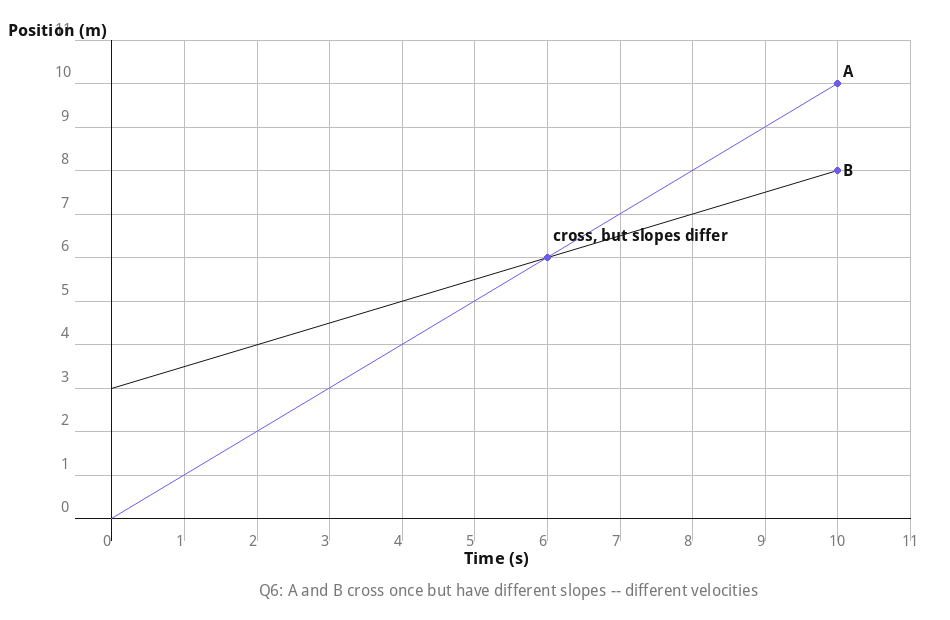
- Position-time graph slope = velocity.
- Velocity-time graph slope = acceleration; area under graph = displacement.
Equations of Motion
- v = u + at
- s = ut + ½at²
- v² = u² + 2as
Uniform Circular Motion
- Constant speed, continuously changing direction → accelerated motion, directed toward centre.
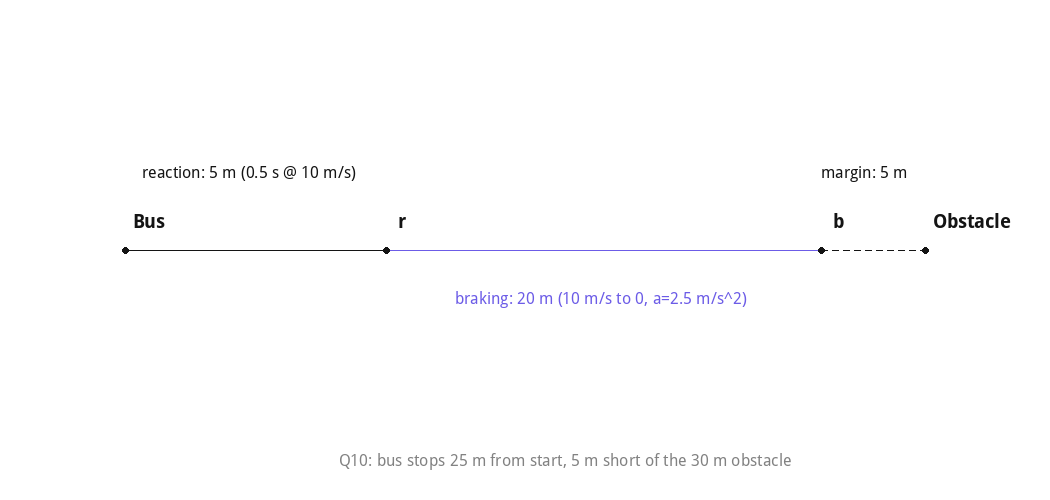
Quick visual: a worked diagram from the full Solutions page, for reference.
One-Line Summary
Motion is described using distance/displacement, speed/velocity, and acceleration, visualised through position-time and velocity-time graphs, and summarised in three equations of motion; even constant-speed circular motion counts as accelerated motion because direction keeps changing.
- Chapter 1: Entering the World of Secondary Science – Revision Notes
- Chapter 2: Cell: The Building Block of Life – Revision Notes
- Chapter 3: Tissues in Action – Revision Notes
- Chapter 5: Exploring Mixtures and their Separation – Revision Notes
- Chapter 6: How Forces Affect Motion – Revision Notes
- Chapter 7: Work, Energy and Simple Machines – Revision Notes
- Chapter 8: Journey Inside the Atom – Revision Notes
- Chapter 9: Atomic Foundations of Matter – Revision Notes
- Chapter 10: Sound Waves: Characteristics and Applications – Revision Notes
- Chapter 11: Reproduction: How Life Continues – Revision Notes
- Chapter 12: Patterns in Life: Diversity and Classification – Revision Notes
- Chapter 13: Earth as a System: Energy, Matter and Life – Revision Notes
Frequently Asked Questions
What is the difference between distance and displacement as covered in this chapter?
Distance is the total path length an object travels regardless of direction, while displacement is the shortest straight-line distance between the initial and final position along with direction, making displacement a vector quantity.
How is uniform motion different from non-uniform motion?
In uniform motion, an object covers equal distances in equal intervals of time, meaning its speed stays constant, while in non-uniform motion the speed changes over time, covering unequal distances in equal time intervals.
Chapter Quiz — Test Your Understanding
See also: Chapter 1 | Chapter 2 | Chapter 3 | Chapter 4
Practice more: Chapter 1 | Chapter 2 | Chapter 3 | Chapter 4
What to Revise First (and Last) in This Chapter
Prioritise the three equations of motion and exactly what each one outputs (velocity vs displacement), then graph interpretation (slope vs area) — together these cover most numerical and graph-based questions. Leave detailed derivations of the equations for an earlier, slower revision pass.
Recommended: Buy the Printed NCERT Class 9 Science Book
Contains Amazon affiliate links.
If you’d like a printed copy alongside the PDF, here’s a verified option:
3.8 out of 5 stars (931 ratings) · Rs. 187
Price and availability may change on Amazon. As an Amazon Associate, ncertbooks.org earns from qualifying purchases.


