
This chapter on circles starts from basic terms like radius and chord before building up to angle relationships — including why opposite angles in a cyclic quadrilateral always add up to 180 degrees.
Last Updated: September 23, 2026
Basic Terms
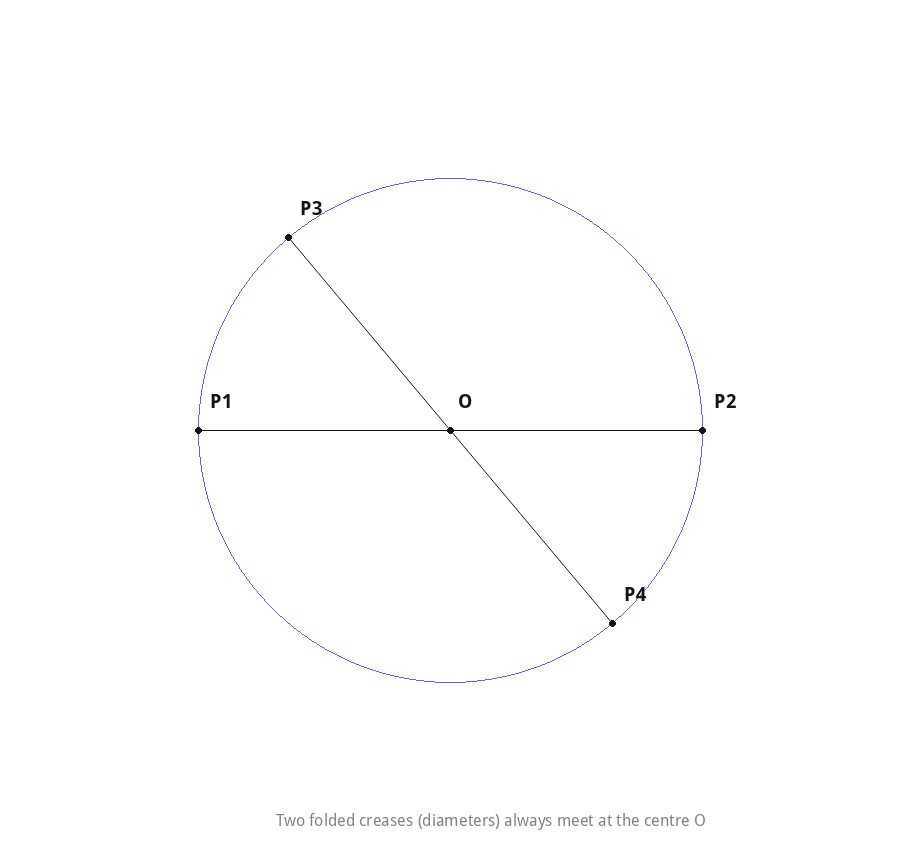
- Radius: centre to circle. Chord: joins 2 points on circle. Diameter: longest chord (through centre).
Chord Properties
- Equal chords → equal angles at centre.
- Perpendicular from centre bisects chord (and vice versa).
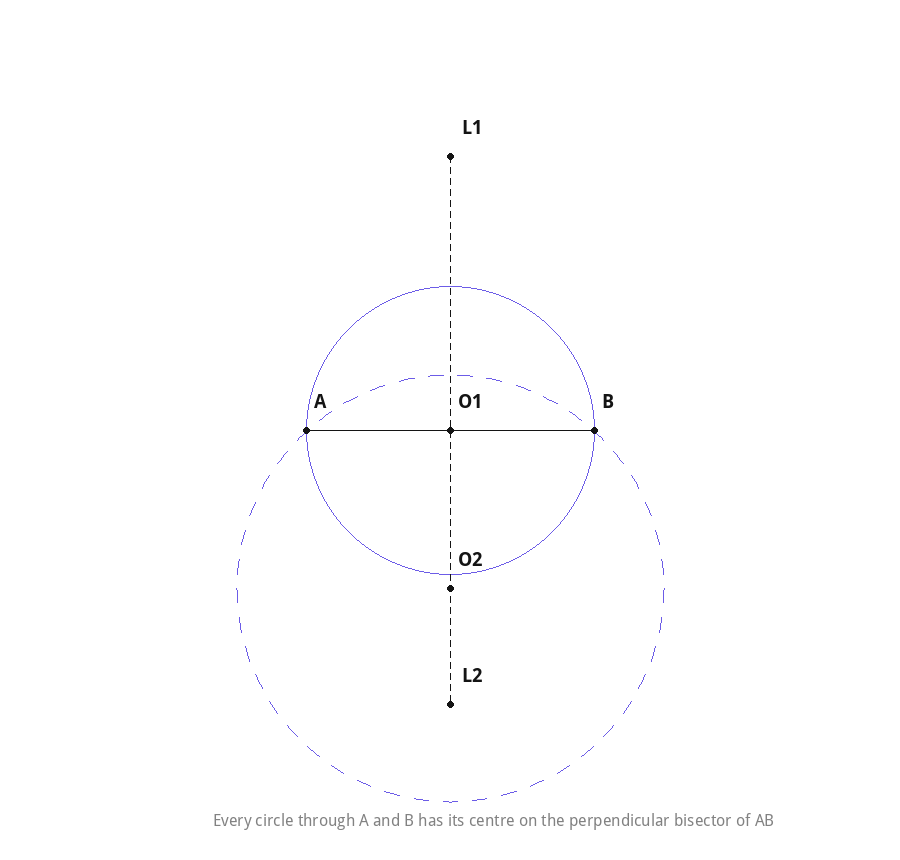
- Perpendicular bisector of any chord passes through centre.
Angles
- Angle at centre = 2 × angle at circumference (same arc).
- Angle in semicircle = 90°.
Circumcircle
- Circumcentre: intersection of perpendicular bisectors of triangle’s sides.
Cyclic Quadrilaterals
- Opposite angles supplementary (sum 180°).
- Exterior angle = opposite interior angle.
One-Line Summary
Circle geometry connects chords, arcs, and angles — equal chords give equal central angles, a diameter always subtends 90°, and cyclic quadrilaterals always have supplementary opposite angles.
Quick visual: a worked diagram from the full Solutions page, for reference.
- Chapter 1: Orienting Yourself: The Use of Coordinates – Revision Notes
- Chapter 2: Introduction to Linear Polynomials – Revision Notes
- Chapter 3: The World of Numbers – Revision Notes
- Chapter 4: Exploring Algebraic Identities – Revision Notes
- Chapter 6: Measuring Space: Perimeter and Area – Revision Notes
- Chapter 7: The Mathematics of Maybe: Introduction to Probability – Revision Notes
- Chapter 8: Predicting What Comes Next?: Exploring Sequences and Progressions – Revision Notes
Frequently Asked Questions
What information does a linear equation in two variables represent graphically?
A linear equation in two variables represents a straight line when plotted on a Cartesian plane, and every point on that line corresponds to an ordered pair of values that satisfies the equation.
How many solutions does a linear equation in two variables have?
A linear equation in two variables has infinitely many solutions, since for every value chosen for one variable, a corresponding value of the other variable can be found that satisfies the equation.
Chapter Quiz — Test Your Understanding
Class 9 Mathematics Chapter 5 – Solutions and Important Questions
Need full answers or more practice? See the Class 9 Mathematics Chapter 5 Solutions and Class 9 Mathematics Chapter 5 Extra Questions.
See also: Chapter 1 | Chapter 2 | Chapter 3 | Chapter 4 | Chapter 5
Practice more: Chapter 1 | Chapter 2 | Chapter 3 | Chapter 4 | Chapter 5
Quick revision: Chapter 1 | Chapter 2 | Chapter 3 | Chapter 4
Recommended: Buy the Printed NCERT Class 9 Maths Book
Contains Amazon affiliate links.
If you’d like a printed copy alongside the PDF, here’s a verified option:
4.0 out of 5 stars (1,313 ratings) · Rs. 106
Price and availability may change on Amazon. As an Amazon Associate, ncertbooks.org earns from qualifying purchases.


