
Chapter 2 of Class 11 Physics separates distance from displacement and speed from velocity before introducing the three kinematic equations that connect initial velocity, acceleration, and time. It also covers how slopes and areas on motion graphs represent velocity, acceleration, and displacement.
Last Updated: September 23, 2026
Key Terms
- Distance (scalar) vs Displacement (vector).
- Average speed = distance/time; Average velocity = displacement/time.
- Instantaneous velocity = dx/dt; Instantaneous acceleration = dv/dt.
Kinematic Equations
- v=u+at; x=ut+½at²; v²=u²+2ax.
Graphs
- Position-time slope = velocity.
- Velocity-time slope = acceleration; area = displacement.
Relative Velocity
- vAB = vA − vB.
One-Line Summary
Motion in a straight line is described using position, displacement, velocity, and acceleration (including instantaneous, calculus-based definitions), governed by three kinematic equations for uniform acceleration.
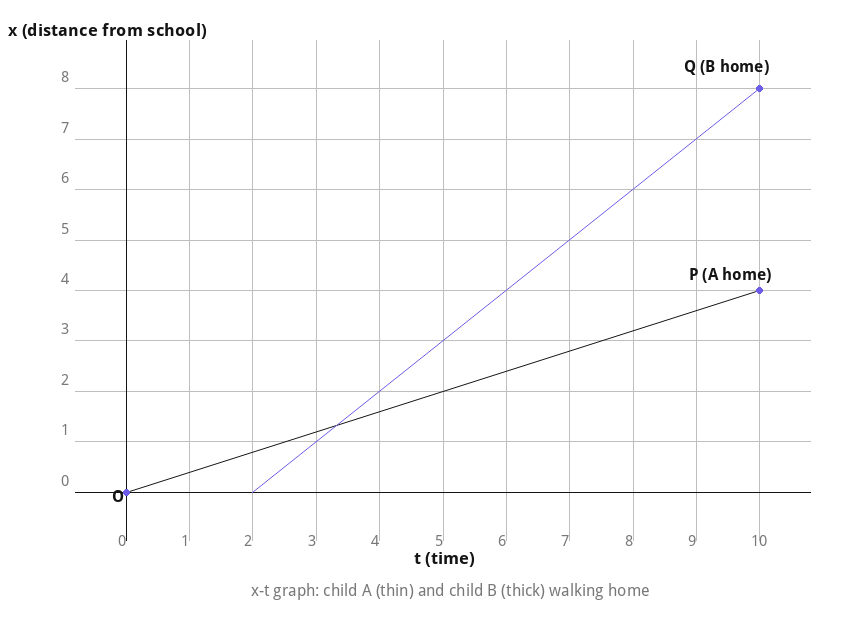
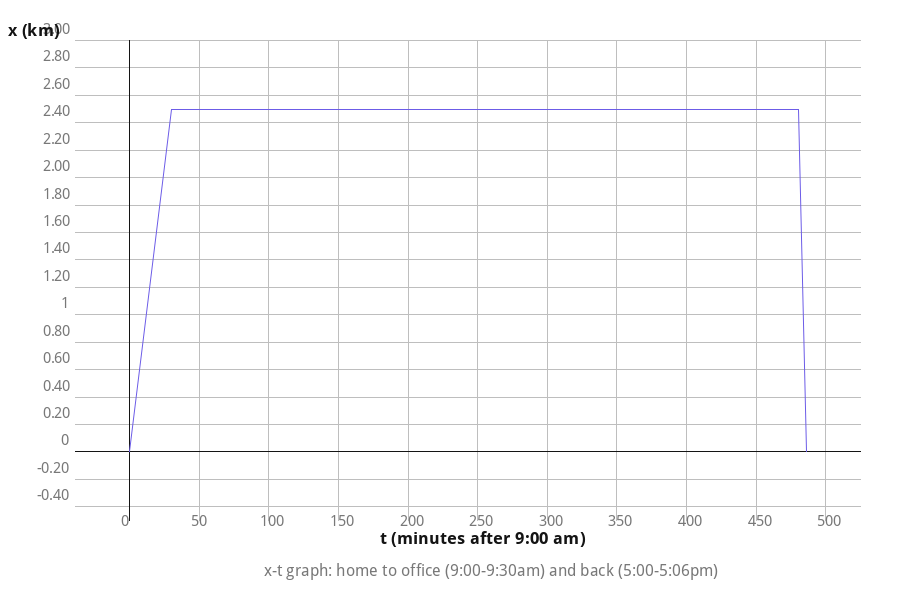
Quick visual: a worked diagram from the full Solutions page, for reference.
- Chapter 1: Units and Measurements - Quick Revision Notes
- Chapter 3: Motion in a Plane – Revision Notes
- Chapter 4: Laws of Motion – Revision Notes
- Chapter 5: Work, Energy and Power – Revision Notes
- Chapter 6: System of Particles and Rotational Motion – Revision Notes
- Chapter 7: Gravitation – Revision Notes
- Chapter 8: Mechanical Properties of Solids – Revision Notes
- Chapter 9: Mechanical Properties of Fluids – Revision Notes
- Chapter 10: Thermal Properties of Matter – Revision Notes
- Chapter 11: Thermodynamics – Revision Notes
- Chapter 12: Kinetic Theory – Revision Notes
- Chapter 13: Oscillations – Revision Notes
- Chapter 14: Waves – Revision Notes
Frequently Asked Questions
What is the difference between distance and displacement?
Distance is the total path length covered by an object regardless of direction, while displacement is the shortest straight-line distance from the initial to the final position along with direction, making displacement a vector quantity.
How do position-time and velocity-time graphs help analyse motion?
The slope of a position-time graph gives velocity at any instant, while the slope of a velocity-time graph gives acceleration, and the area under a velocity-time graph gives displacement.
Chapter Quiz — Test Your Understanding
Class 11 Physics Chapter 2 – Solutions and Important Questions
Need full answers or more practice? See the Class 11 Physics Chapter 2 Solutions and Class 11 Physics Chapter 2 Extra Questions.
Recommended: Buy the Printed NCERT Class 11 Physics Book Set
Contains Amazon affiliate links.
If you’d like a printed copy alongside the PDF, here’s a verified option:
Rs. 280
Price and availability may change on Amazon. As an Amazon Associate, ncertbooks.org earns from qualifying purchases.



Pingback: Class 11 Physics Chapter 11 Thermodynamics Extra Questions (2026-27)