
From a bar magnet’s magnetic moment to how diamagnetic, paramagnetic, and ferromagnetic materials respond differently to a field, Class 12 Physics Chapter 5 covers a lot of ground — these questions revisit the key formulas and definitions.
Last Updated: September 23, 2026
Very Short Answer Questions (1 mark)
Q1. Write the formula for magnetic moment of a bar magnet.
Ans: m=qm×2l.
Q2. What is the value of horizontal component of Earth’s field at the magnetic poles?
Ans: Zero (field is fully vertical there).
Q3. Name one diamagnetic material.
Ans: Bismuth (or copper, water).
Q4. What happens to paramagnetic susceptibility as temperature increases?
Ans: It decreases (Curie’s law, χ∝1/T).
Q5. Write the formula for potential energy of a magnetic dipole in a field.
Ans: U=−mB cosθ.
Short Answer Questions (2–3 marks)
Q6. A bar magnet has magnetic moment 5 A·m². Find the field on its axial line at 0.2m (take r>>l).
Ans: B=(μ₀/4π)(2m/r³)=10⁻⁷×2(5)/(0.2)³=10⁻⁷×10/0.008=1.25×10⁻⁶ T.
Q7. A dipole of moment 2 A·m² is placed in a field of 0.5T at 30°. Find the torque.
Ans: τ=mB sinθ=2(0.5)sin30°=1(0.5)=0.5 N·m.
Q8. Distinguish diamagnetic and ferromagnetic materials in terms of susceptibility.
Ans: Diamagnetic: small negative χ (independent of field, weakly repelled). Ferromagnetic: large positive χ (strongly attracted, retains magnetisation, exhibits hysteresis).
Higher-Order Thinking / Application Questions
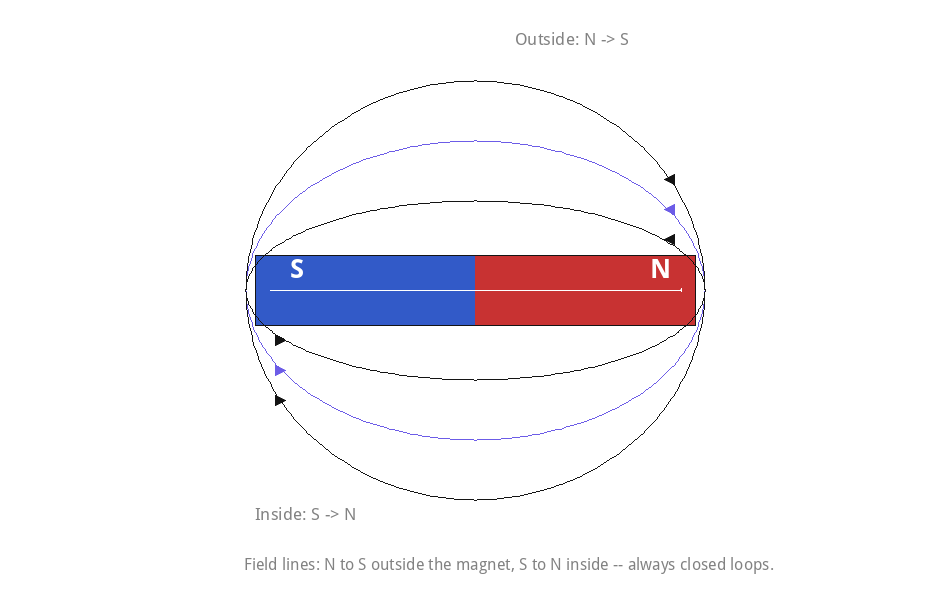
Q9. Explain why the magnetic field lines inside a bar magnet run from the south pole to the north pole, while outside they run from north to south, and relate this to why field lines form closed loops.
Ans: Magnetic field lines, by definition and by Gauss’s law for magnetism (∇·B=0, no magnetic monopoles), must always form closed loops — they can never simply begin or end at a pole the way electric field lines do at a charge. Outside the bar magnet, the field lines emerge from the north pole, curve around, and enter the south pole, matching what we observe with iron filings. Since these lines cannot simply terminate at the south pole (that would violate the closed-loop requirement), they must continue through the interior of the magnet, and by symmetry/continuity, this internal path runs from the south pole back to the north pole, completing the loop. This is exactly analogous to the field of a solenoid, which is why a bar magnet is treated as ‘equivalent’ to a solenoid: both produce this same closed-loop field pattern, with the equivalence becoming an especially good approximation for a uniformly magnetized bar.
Q10. A compass needle at a certain place shows a dip of 60° and the horizontal component of Earth’s field there is 0.3 Gauss. Find the total magnetic field of the Earth at that place, and explain what a dip of 90° would physically mean.
Ans: The horizontal component relates to the total field via BH=B cos(dip). Rearranging: B=BH/cos(dip)=0.3/cos(60°)=0.3/0.5=0.6 Gauss. This is the total magnitude of Earth’s magnetic field at that location. A dip of 90° would mean the magnetic field is pointing straight down (or up), entirely vertical, with zero horizontal component (BH=B cos90°=0) — this occurs at the magnetic poles, where a magnetic compass needle would try to point straight down into the Earth rather than showing any horizontal direction, making an ordinary compass useless for direction-finding there. This is exactly why the horizontal component (relevant for compass navigation) vanishes at the poles, consistent with the answer to Q2 above.
- Chapter 1: Electric Charges and Fields
- Chapter 2: Electrostatic Potential and Capacitance – Extra Questions with Answers
- Chapter 3: Current Electricity – Extra Questions with Answers
- Chapter 4: Moving Charges and Magnetism – Extra Questions with Answers
- Chapter 6: Electromagnetic Induction – Extra Questions with Answers
- Chapter 7: Alternating Current – Extra Questions with Answers
Frequently Asked Questions
How would you classify a material with a small positive magnetic susceptibility?
Such a material is classified as paramagnetic, since it is weakly attracted by an external magnetic field due to its small positive susceptibility.
How would you find the magnetic dipole moment of a bar magnet of pole strength 5 A m and length 0.2 m?
Magnetic dipole moment = pole strength times length = 5 times 0.2 = 1 A m squared.
Chapter Quiz — Test Your Understanding
Class 12 Physics Chapter 5 – Solutions and Notes
For complete step-by-step answers and a quick summary, check the Class 12 Physics Chapter 5 Solutions and Class 12 Physics Chapter 5 Revision Notes.
See also: Chapter 1 | Chapter 2 | Chapter 3 | Chapter 5
Recommended: Buy the Printed NCERT Class 12 Physics Book
Contains Amazon affiliate links.
If you’d like a printed copy alongside the PDF, here’s a verified option:
4.4 out of 5 stars (159 ratings) · Rs. 155
Price and availability may change on Amazon. As an Amazon Associate, ncertbooks.org earns from qualifying purchases.



Pingback: Class 12 Physics Chapter 5 Magnetism and Matter Solutions (2026-27)