
Chapter 7 of Class 11 Physics starts from Newton’s law of gravitation and builds up to Kepler’s three laws of planetary motion, the variation of g with height and depth, and escape velocity. It closes with the orbital mechanics behind geostationary satellites.
Last Updated: September 23, 2026
Newton’s Law
- F=Gm1m2/r²; G=6.67×10⁻¹¹ Nm²/kg².
Kepler’s Laws
- 1st: elliptical orbits.
- 2nd: equal areas in equal times.
- 3rd: T²∝r³.
g, Potential Energy, Escape Velocity
- g=GM/R²; decreases with height and depth.
- U=−GMm/r; ve=√(2gR).
Satellites
- vo=√(GM/r); geostationary period=24 h.
One-Line Summary
Gravitation describes the universal attractive force between masses, governing planetary orbits (Kepler’s laws), surface gravity, escape velocity, and satellite motion.
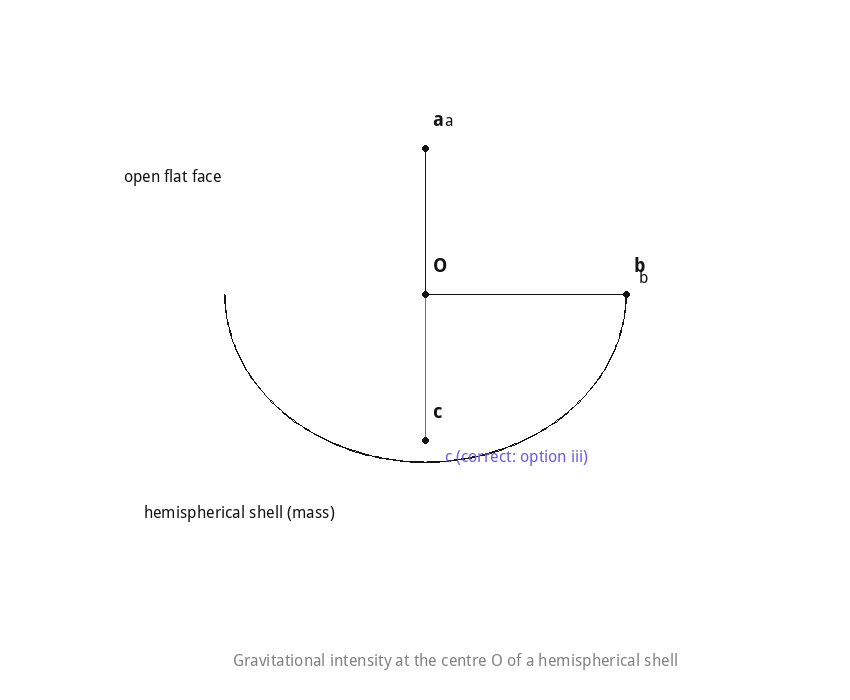
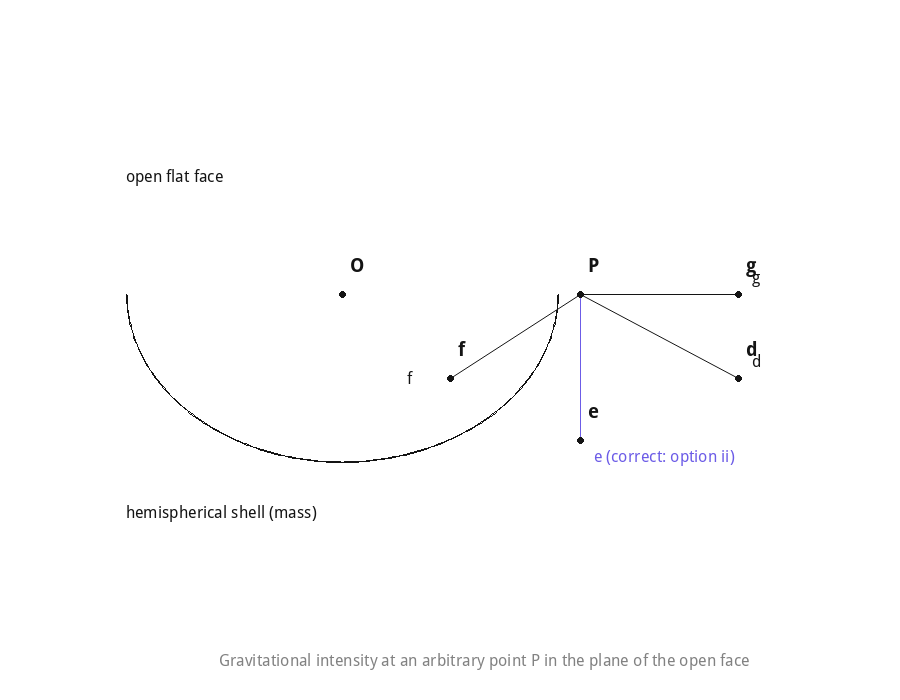
Quick visual: a worked diagram from the full Solutions page, for reference.
- Chapter 1: Units and Measurements - Quick Revision Notes
- Chapter 2: Motion in a Straight Line – Revision Notes
- Chapter 3: Motion in a Plane – Revision Notes
- Chapter 4: Laws of Motion – Revision Notes
- Chapter 5: Work, Energy and Power – Revision Notes
- Chapter 6: System of Particles and Rotational Motion – Revision Notes
- Chapter 8: Mechanical Properties of Solids – Revision Notes
- Chapter 9: Mechanical Properties of Fluids – Revision Notes
- Chapter 10: Thermal Properties of Matter – Revision Notes
- Chapter 11: Thermodynamics – Revision Notes
- Chapter 12: Kinetic Theory – Revision Notes
- Chapter 13: Oscillations – Revision Notes
- Chapter 14: Waves – Revision Notes
Frequently Asked Questions
How do the laws of planetary motion given by Kepler relate to the law of gravitation given by Newton?
Kepler described the motion of planets empirically through observation, while the law of gravitation later provided the underlying force explanation, showing the same gravitational force that makes an apple fall also keeps planets in orbit.
Why do astronauts in orbit appear weightless even though gravity is still acting on them?
Astronauts in orbit are in continuous free fall around the Earth. Gravity provides exactly the centripetal force needed to keep them in orbit, so they and their spacecraft fall together, creating the sensation of weightlessness.
Chapter Quiz — Test Your Understanding
Class 11 Physics Chapter 7 – Solutions and Important Questions
Need full answers or more practice? See the Class 11 Physics Chapter 7 Solutions and Class 11 Physics Chapter 7 Extra Questions.
See also: Chapter 1 | Chapter 2 | Chapter 3 | Chapter 4 | Chapter 5 | Chapter 6 | Chapter 7
Practice more: Chapter 1 | Chapter 2 | Chapter 3 | Chapter 4 | Chapter 5 | Chapter 6 | Chapter 7
Quick revision: Chapter 1 | Chapter 2 | Chapter 3 | Chapter 4 | Chapter 5 | Chapter 6
Recommended: Buy the Printed NCERT Class 11 Physics Book Set
Contains Amazon affiliate links.
If you’d like a printed copy alongside the PDF, here’s a verified option:
Rs. 280
Price and availability may change on Amazon. As an Amazon Associate, ncertbooks.org earns from qualifying purchases.


