
Push or pull on a solid hard enough and it deforms permanently once it passes its elastic limit, never fully returning to its original shape. These Class 11 Physics Chapter 8 questions cover stress, strain, Young’s modulus, and Poisson’s ratio.
Last Updated: September 23, 2026
Very Short Answer Questions (1 mark)
Q1. What is the SI unit of stress?
Ans: N/m² (pascal, Pa).
Q2. Is strain a dimensionless quantity?
Ans: Yes, strain has no units since it is a ratio of two lengths (or volumes).
Q3. Write the formula for Young’s modulus.
Ans: Y=(F/A)/(ΔL/L) = FL/(AΔL).
Q4. What happens to a wire beyond its elastic limit?
Ans: It undergoes permanent (plastic) deformation and does not return to its original shape when the load is removed.
Q5. Define Poisson’s ratio.
Ans: The ratio of lateral strain to longitudinal strain produced in a stretched wire or rod.
Short Answer Questions (2–3 marks)
Q6. A wire of length 2 m and cross-sectional area 1×10⁻⁶ m² stretches by 1 mm under a force of 100 N. Find the stress and strain.
Ans: Stress=F/A=100/(1×10−6)=10⁸ N/m². Strain=ΔL/L=0.001/2=5×10−4.
Q7. Using the values from Q6, calculate Young’s modulus of the wire’s material.
Ans: Y=Stress/Strain=10⁸/(5×10−4)=2×10¹¹ N/m².
Q8. A solid sphere of volume 1 m³ experiences a pressure increase of 2×10⁵ Pa, reducing its volume by 0.001 m³. Find the bulk modulus.
Ans: K=−ΔP/(ΔV/V)=2×10⁵/(0.001/1)=2×10⁸ Pa.
Higher-Order Thinking / Application Questions
Q9. Two wires of the same material have lengths in ratio 2:1 and diameters in ratio 1:2. If the same force is applied to both, find the ratio of their elongations, explaining the role of Young’s modulus.
Ans: Since ΔL=FL/(AY), and Y is the same material property for both wires, ΔL ∝ L/A ∝ L/d². Ratio of elongations = (L1/d1²)/(L2/d2²) = (2/1²)/(1/2²) = (2/1)/(1/4) = 8. So the elongation of the first wire is 8 times that of the second, because a longer, thinner wire stretches more for the same force under a fixed Young’s modulus.
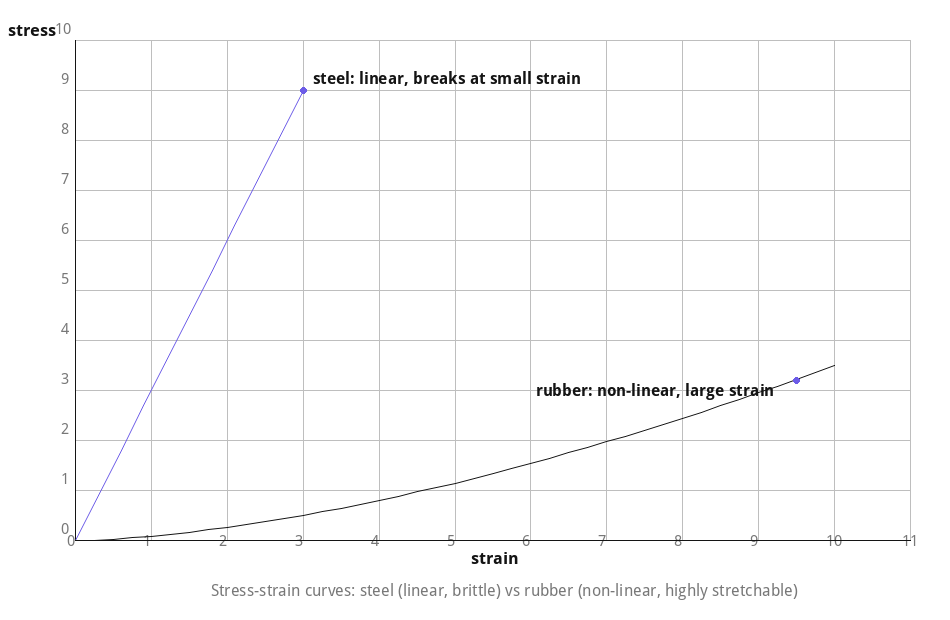
Q10. Explain, using the stress-strain graph, why a material like rubber can be stretched a lot without breaking but does not obey Hooke’s law over most of that range, while a material like steel obeys Hooke’s law over a much larger stress range but breaks at relatively small strain.
Ans: Steel has a stress-strain graph that is linear (obeying Hooke’s law, stress ∝ strain) over a wide range of stress before reaching its elastic limit and eventual fracture point, but the maximum strain it can sustain before breaking is small, meaning it is stiff but not very stretchable. Rubber, by contrast, has a stress-strain curve that is markedly non-linear (curved) almost from the start, meaning stress is not proportional to strain except at very small deformations — so it does not obey Hooke’s law through most of its stretching range. However, rubber can undergo very large strains (elongate significantly) before reaching its breaking point, due to the coiled polymer chain structure of its molecules being able to uncoil and stretch substantially while still returning to its original shape when the force is removed (within its elastic limit).
- Chapter 1: Units and Measurements - HOTS & Extra Questions with Answers
- Chapter 2: Motion in a Straight Line – Extra Questions with Answers
- Chapter 3: Motion in a Plane – Extra Questions with Answers
- Chapter 4: Laws of Motion – Extra Questions with Answers
- Chapter 5: Work, Energy and Power – Extra Questions with Answers
- Chapter 6: System of Particles and Rotational Motion – Extra Questions with Answers
- Chapter 7: Gravitation – Extra Questions with Answers
- Chapter 9: Mechanical Properties of Fluids – Extra Questions with Answers
- Chapter 10: Thermal Properties of Matter – Extra Questions with Answers
- Chapter 11: Thermodynamics – Extra Questions with Answers
- Chapter 12: Kinetic Theory – Extra Questions with Answers
- Chapter 13: Oscillations – Extra Questions with Answers
- Chapter 14: Waves – Extra Questions with Answers
Frequently Asked Questions
A wire of length 2 m and area 1 mm squared stretches by 1 mm under a load, how would you find the strain?
Strain = change in length over original length = 0.001 over 2 = 0.0005.
How would you find the Young Modulus of a material given stress 2×10 to the 8 Pa and strain 0.001?
Young Modulus = stress over strain = 2×10 to the 8 over 0.001 = 2×10 to the 11 Pa.
Chapter Quiz — Test Your Understanding
Class 11 Physics Chapter 8 – Solutions and Notes
For complete step-by-step answers and a quick summary, check the Class 11 Physics Chapter 8 Solutions and Class 11 Physics Chapter 8 Revision Notes.
See also: Chapter 1 | Chapter 2 | Chapter 3 | Chapter 4 | Chapter 5 | Chapter 6 | Chapter 7 | Chapter 8
Practice more: Chapter 1 | Chapter 2 | Chapter 3 | Chapter 4 | Chapter 5 | Chapter 6 | Chapter 7
Quick revision: Chapter 1 | Chapter 2 | Chapter 3 | Chapter 4 | Chapter 5 | Chapter 6 | Chapter 7
Recommended: Buy the Printed NCERT Class 11 Physics Book Set
Contains Amazon affiliate links.
If you’d like a printed copy alongside the PDF, here’s a verified option:
Rs. 280
Price and availability may change on Amazon. As an Amazon Associate, ncertbooks.org earns from qualifying purchases.


