
Thermodynamics in Class 11 rests on three laws: the zeroth law establishing temperature, the first law balancing heat and work, and the second law limiting how efficient any engine can be. This chapter also separates isothermal, adiabatic, isochoric, and isobaric processes and works through Carnot efficiency.
Last Updated: September 23, 2026
Laws
- Zeroth law: defines temperature via thermal equilibrium.
- First law: ΔQ=ΔU+ΔW.
- Second law: heat doesn’t spontaneously flow cold→hot; no 100% efficient engine.
Processes
- Isothermal (ΔU=0), Adiabatic (ΔQ=0), Isochoric (ΔW=0), Isobaric (constant P).
Heat Engines
- η=1−Q2/Q1; Carnot: η=1−T2/T1.
One-Line Summary
Thermodynamics governs energy exchange as heat and work, with the first law conserving energy and the second law restricting the direction of spontaneous heat flow and limiting engine efficiency.
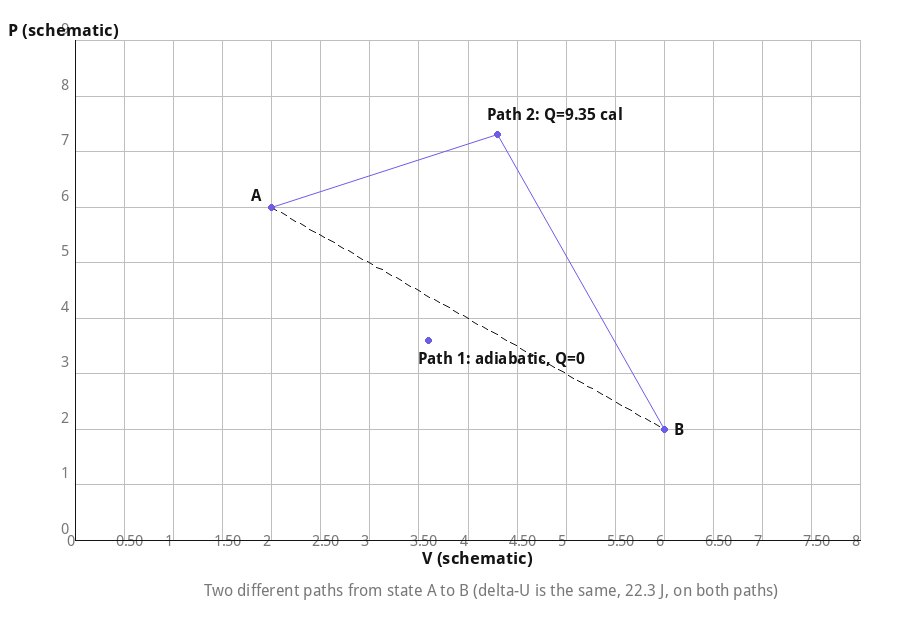
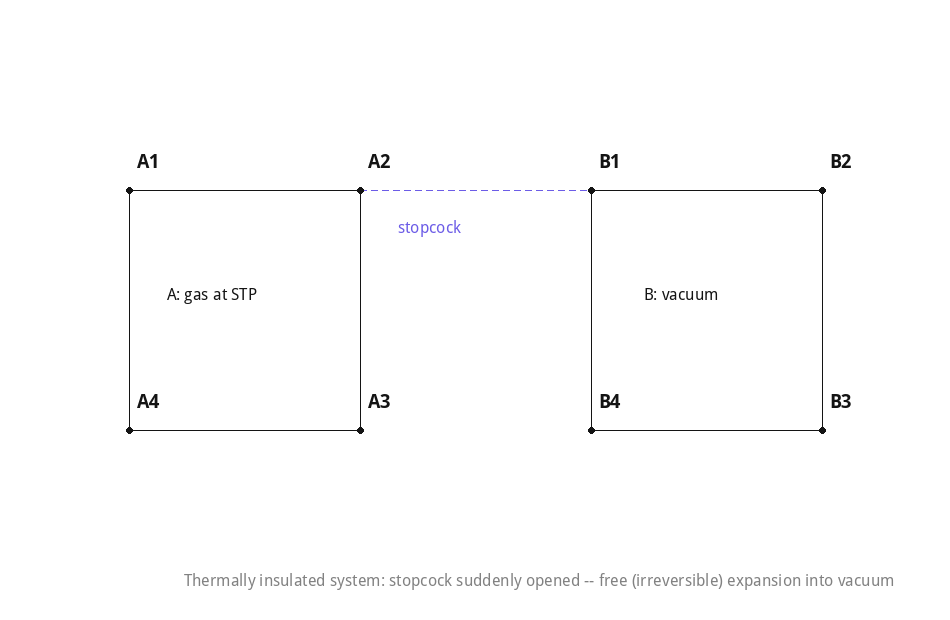
Quick visual: a worked diagram from the full Solutions page, for reference.
- Chapter 1: Units and Measurements - Quick Revision Notes
- Chapter 2: Motion in a Straight Line – Revision Notes
- Chapter 3: Motion in a Plane – Revision Notes
- Chapter 4: Laws of Motion – Revision Notes
- Chapter 5: Work, Energy and Power – Revision Notes
- Chapter 6: System of Particles and Rotational Motion – Revision Notes
- Chapter 7: Gravitation – Revision Notes
- Chapter 8: Mechanical Properties of Solids – Revision Notes
- Chapter 9: Mechanical Properties of Fluids – Revision Notes
- Chapter 10: Thermal Properties of Matter – Revision Notes
- Chapter 12: Kinetic Theory – Revision Notes
- Chapter 13: Oscillations – Revision Notes
- Chapter 14: Waves – Revision Notes
Frequently Asked Questions
What is the difference between an isothermal and an adiabatic process?
In an isothermal process, the temperature remains constant while heat is exchanged with the surroundings, whereas in an adiabatic process, no heat is exchanged at all, and any change in internal energy comes purely from work done.
What does the Second Law of Thermodynamics say about the direction of natural processes?
The Second Law states that heat cannot spontaneously flow from a colder body to a hotter body without external work being done, which explains why natural processes have a preferred direction and why no engine can be perfectly efficient.
Chapter Quiz — Test Your Understanding
Class 11 Physics Chapter 11 – Solutions and Important Questions
Need full answers or more practice? See the Class 11 Physics Chapter 11 Solutions and Class 11 Physics Chapter 11 Extra Questions.
See also: Chapter 1 | Chapter 2 | Chapter 3 | Chapter 4 | Chapter 5 | Chapter 6 | Chapter 7 | Chapter 8 | Chapter 9 | Chapter 10 | Chapter 11
Practice more: Chapter 1 | Chapter 2 | Chapter 3 | Chapter 4 | Chapter 5 | Chapter 6 | Chapter 7 | Chapter 8 | Chapter 9 | Chapter 10 | Chapter 11
Quick revision: Chapter 1 | Chapter 2 | Chapter 3 | Chapter 4 | Chapter 5 | Chapter 6 | Chapter 7 | Chapter 8 | Chapter 9 | Chapter 10
Recommended: Buy the Printed NCERT Class 11 Physics Book Set
Contains Amazon affiliate links.
If you’d like a printed copy alongside the PDF, here’s a verified option:
Rs. 280
Price and availability may change on Amazon. As an Amazon Associate, ncertbooks.org earns from qualifying purchases.


