
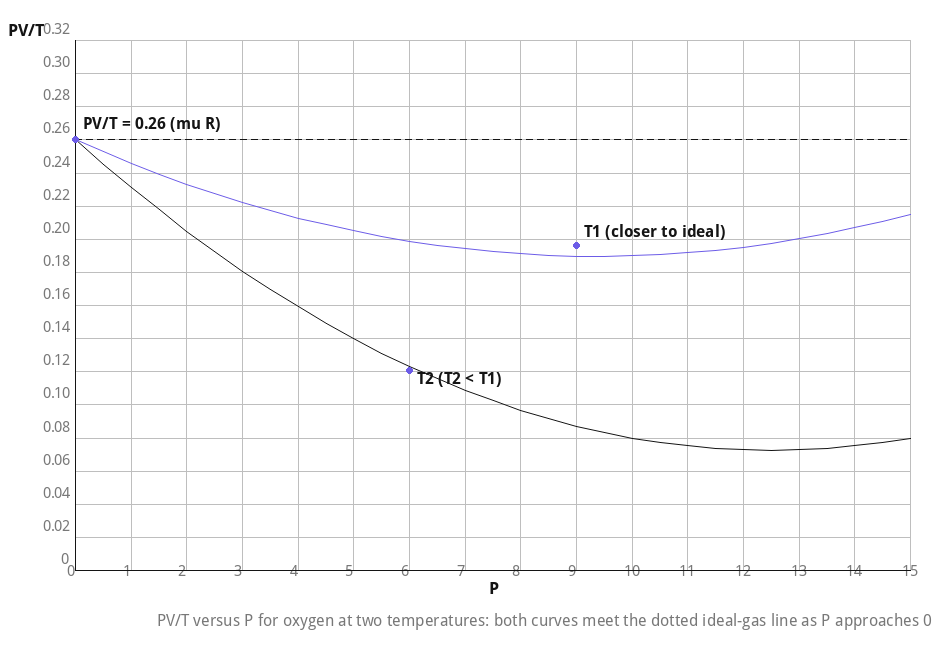
Most questions in this set trace back to the ideal gas equation, PV=nRT, and the value of the universal gas constant R. Others probe degrees of freedom and the equipartition of energy across a molecule’s possible motions.
Last Updated: September 23, 2026
Very Short Answer Questions (1 mark)
Q1. Write the ideal gas equation.
Ans: PV=nRT.
Q2. What is the value of the universal gas constant R?
Ans: 8.314 J/(mol·K).
Q3. How many degrees of freedom does a monatomic gas molecule have?
Ans: 3 (all translational).
Q4. State the law of equipartition of energy.
Ans: Energy is distributed equally among all degrees of freedom, each contributing (1/2)kBT per molecule.
Q5. Write the formula for pressure of an ideal gas from kinetic theory.
Ans: P=(1/3)ρvrms².
Short Answer Questions (2–3 marks)
Q6. Find the number of moles in 44 g of CO₂ (molar mass 44 g/mol).
Ans: n=mass/molar mass=44/44=1 mole.
Q7. Two moles of an ideal gas occupy 0.05 m³ at 300 K. Find the pressure (R=8.314 J/mol·K).
Ans: P=nRT/V=2(8.314)(300)/0.05=99768 Pa ≈ 9.98×10⁴ Pa.
Q8. Calculate the average kinetic energy per molecule of a gas at 300 K (kB=1.38×10⁻²³ J/K).
Ans: KE=(3/2)kBT=(3/2)(1.38×10−23)(300)=6.21×10−21 J.
Higher-Order Thinking / Application Questions
Q9. Explain, using the kinetic theory of gases, why the pressure of a gas increases when it is heated at constant volume, connecting this to molecular motion.
Ans: According to kinetic theory, temperature is a measure of the average kinetic energy of gas molecules: average KE=(3/2)kBT. When a gas is heated, its temperature rises, so the average kinetic energy (and hence average speed) of the molecules increases. At constant volume, the molecules now collide with the container walls more frequently and with greater momentum change per collision (since they move faster). Since pressure is a result of the cumulative force from molecular collisions on the walls per unit area, this increase in collision frequency and force leads to a corresponding increase in pressure, consistent with P=(1/3)ρvrms² (vrms increasing with T).
Q10. Compare the number of degrees of freedom, and hence specific heat capacities, of a monatomic gas (like helium) and a diatomic gas (like oxygen) at moderate temperatures, explaining why diatomic gases have higher molar specific heats.
Ans: A monatomic gas has only 3 translational degrees of freedom, so by the law of equipartition of energy, its internal energy per mole is (3/2)RT, giving molar specific heat at constant volume Cv=(3/2)R. A diatomic gas, at moderate temperatures, has 5 degrees of freedom (3 translational + 2 rotational, since a diatomic molecule can rotate about two axes perpendicular to the bond axis), giving internal energy per mole = (5/2)RT and Cv=(5/2)R. Because diatomic gas molecules have more ways (degrees of freedom) to store thermal energy for the same rise in temperature, more heat is needed to raise their temperature by the same amount, giving them a higher molar specific heat than monatomic gases.
Quick visual: a worked diagram from the full Solutions page, for reference.
- Chapter 1: Units and Measurements - HOTS & Extra Questions with Answers
- Chapter 2: Motion in a Straight Line – Extra Questions with Answers
- Chapter 3: Motion in a Plane – Extra Questions with Answers
- Chapter 4: Laws of Motion – Extra Questions with Answers
- Chapter 5: Work, Energy and Power – Extra Questions with Answers
- Chapter 6: System of Particles and Rotational Motion – Extra Questions with Answers
- Chapter 7: Gravitation – Extra Questions with Answers
- Chapter 8: Mechanical Properties of Solids – Extra Questions with Answers
- Chapter 9: Mechanical Properties of Fluids – Extra Questions with Answers
- Chapter 10: Thermal Properties of Matter – Extra Questions with Answers
- Chapter 11: Thermodynamics – Extra Questions with Answers
- Chapter 13: Oscillations – Extra Questions with Answers
- Chapter 14: Waves – Extra Questions with Answers
Frequently Asked Questions
How would you find the root mean square speed of gas molecules if the gas is heated to a higher temperature?
Since rms speed is proportional to the square root of absolute temperature, raising the temperature increases the rms speed by the square root of the temperature ratio.
If the pressure of an ideal gas doubles at constant volume, what happens to its temperature?
Since pressure is directly proportional to temperature at constant volume, the temperature also doubles.
Chapter Quiz — Test Your Understanding
Class 11 Physics Chapter 12 – Solutions and Notes
For complete step-by-step answers and a quick summary, check the Class 11 Physics Chapter 12 Solutions and Class 11 Physics Chapter 12 Revision Notes.
See also: Chapter 1 | Chapter 2 | Chapter 3 | Chapter 4 | Chapter 5 | Chapter 6 | Chapter 7 | Chapter 8 | Chapter 9 | Chapter 10 | Chapter 11 | Chapter 12
Practice more: Chapter 1 | Chapter 2 | Chapter 3 | Chapter 4 | Chapter 5 | Chapter 6 | Chapter 7 | Chapter 8 | Chapter 9 | Chapter 10 | Chapter 11
Quick revision: Chapter 1 | Chapter 2 | Chapter 3 | Chapter 4 | Chapter 5 | Chapter 6 | Chapter 7 | Chapter 8 | Chapter 9 | Chapter 10 | Chapter 11
Recommended: Buy the Printed NCERT Class 11 Physics Book Set
Contains Amazon affiliate links.
If you’d like a printed copy alongside the PDF, here’s a verified option:
Rs. 280
Price and availability may change on Amazon. As an Amazon Associate, ncertbooks.org earns from qualifying purchases.



Pingback: Class 11 Physics Chapter 14 Waves Revision Notes (2026-27)