
Oscillatory motion in this chapter starts from the defining SHM condition a=−ω²x and the standard displacement, velocity, and acceleration equations that follow from it. It then covers how kinetic and potential energy interconvert while total mechanical energy stays constant, and how pendulum and spring-mass periods are calculated.
Last Updated: September 23, 2026
SHM Basics
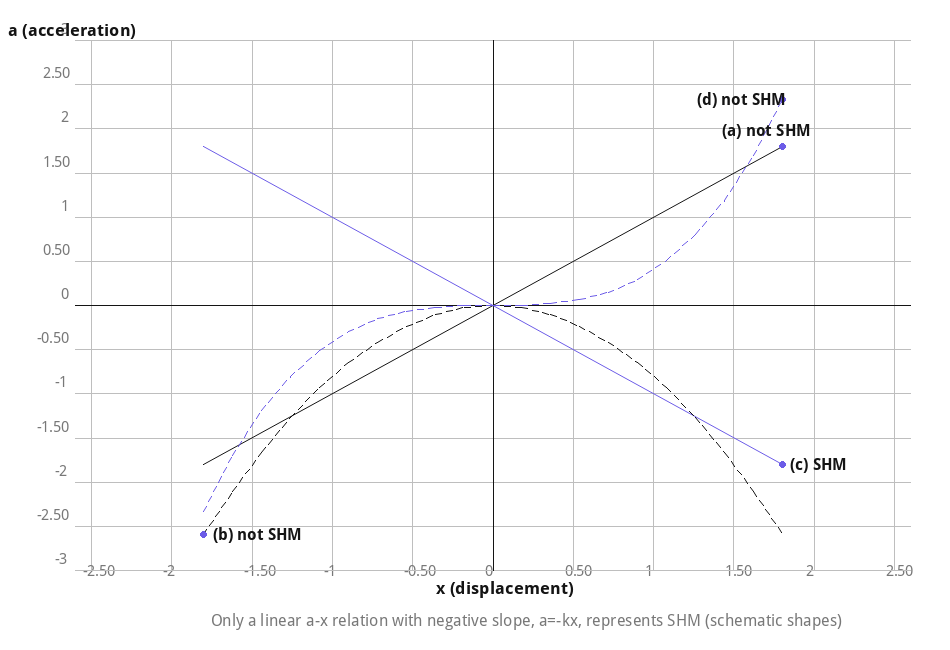
- Condition: a=−ω²x.
- x=A sin(ωt+φ); v=Aωcos(ωt+φ); a=−Aω²sin(ωt+φ).
Energy
- E=½mω²A² (constant); KE and PE interconvert.
Time Periods
- Simple pendulum: T=2π√(l/g).
- Spring-mass: T=2π√(m/k).
One-Line Summary
Oscillations describe periodic to-and-fro motion, with simple harmonic motion being the special case where restoring force is proportional to displacement, conserving total mechanical energy throughout.
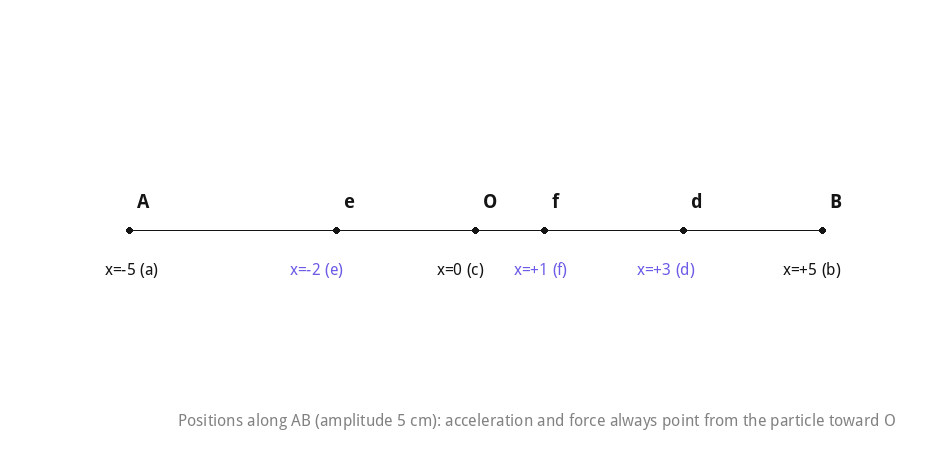
Quick visual: a worked diagram from the full Solutions page, for reference.
- Chapter 1: Units and Measurements - Quick Revision Notes
- Chapter 2: Motion in a Straight Line – Revision Notes
- Chapter 3: Motion in a Plane – Revision Notes
- Chapter 4: Laws of Motion – Revision Notes
- Chapter 5: Work, Energy and Power – Revision Notes
- Chapter 6: System of Particles and Rotational Motion – Revision Notes
- Chapter 7: Gravitation – Revision Notes
- Chapter 8: Mechanical Properties of Solids – Revision Notes
- Chapter 9: Mechanical Properties of Fluids – Revision Notes
- Chapter 10: Thermal Properties of Matter – Revision Notes
- Chapter 11: Thermodynamics – Revision Notes
- Chapter 12: Kinetic Theory – Revision Notes
- Chapter 14: Waves – Revision Notes
Frequently Asked Questions
What makes a motion simple harmonic rather than just periodic?
A periodic motion is simple harmonic only if the restoring force is directly proportional to the displacement from the mean position and always directed toward that mean position, producing the characteristic sinusoidal variation with time.
How is the time period of a simple pendulum related to its length?
The time period of a simple pendulum is directly proportional to the square root of its length, meaning a longer pendulum takes more time to complete one oscillation, while the period is independent of the mass of the bob.
Chapter Quiz — Test Your Understanding
Class 11 Physics Chapter 13 – Solutions and Important Questions
Need full answers or more practice? See the Class 11 Physics Chapter 13 Solutions and Class 11 Physics Chapter 13 Extra Questions.
See also: Chapter 1 | Chapter 2 | Chapter 3 | Chapter 4 | Chapter 5 | Chapter 6 | Chapter 7 | Chapter 8 | Chapter 9 | Chapter 10 | Chapter 11 | Chapter 12 | Chapter 13
Practice more: Chapter 1 | Chapter 2 | Chapter 3 | Chapter 4 | Chapter 5 | Chapter 6 | Chapter 7 | Chapter 8 | Chapter 9 | Chapter 10 | Chapter 11 | Chapter 12 | Chapter 13
Quick revision: Chapter 1 | Chapter 2 | Chapter 3 | Chapter 4 | Chapter 5 | Chapter 6 | Chapter 7 | Chapter 8 | Chapter 9 | Chapter 10 | Chapter 11 | Chapter 12
Recommended: Buy the Printed NCERT Class 11 Physics Book Set
Contains Amazon affiliate links.
If you’d like a printed copy alongside the PDF, here’s a verified option:
Rs. 280
Price and availability may change on Amazon. As an Amazon Associate, ncertbooks.org earns from qualifying purchases.


