
Sound is the go-to example of a longitudinal wave, and the relation v=fλ connecting speed, frequency, and wavelength runs through much of this question set. Later questions cover standing waves, nodes and antinodes, and the beat frequency formed when two close frequencies overlap.
Last Updated: September 23, 2026
Very Short Answer Questions (1 mark)
Q1. Give an example of a longitudinal wave.
Ans: Sound wave.
Q2. Write the relation between wave speed, frequency, and wavelength.
Ans: v=fλ.
Q3. What are nodes and antinodes?
Ans: Nodes are points of zero displacement; antinodes are points of maximum displacement in a standing wave.
Q4. Write the formula for beat frequency.
Ans: fbeat=|f1−f2|.
Q5. What is the formula for speed of a transverse wave on a stretched string?
Ans: v=√(T/μ).
Short Answer Questions (2–3 marks)
Q6. A wave has frequency 50 Hz and wavelength 4 m. Find its speed.
Ans: v=fλ=50(4)=200 m/s.
Q7. A string of mass per unit length 0.02 kg/m is under tension 80 N. Find the wave speed.
Ans: v=√(T/μ)=√(80/0.02)=√4000≈63.2 m/s.
Q8. Two tuning forks of frequency 256 Hz and 260 Hz are sounded together. Find the beat frequency.
Ans: fbeat=|260−256|=4 Hz.
Higher-Order Thinking / Application Questions
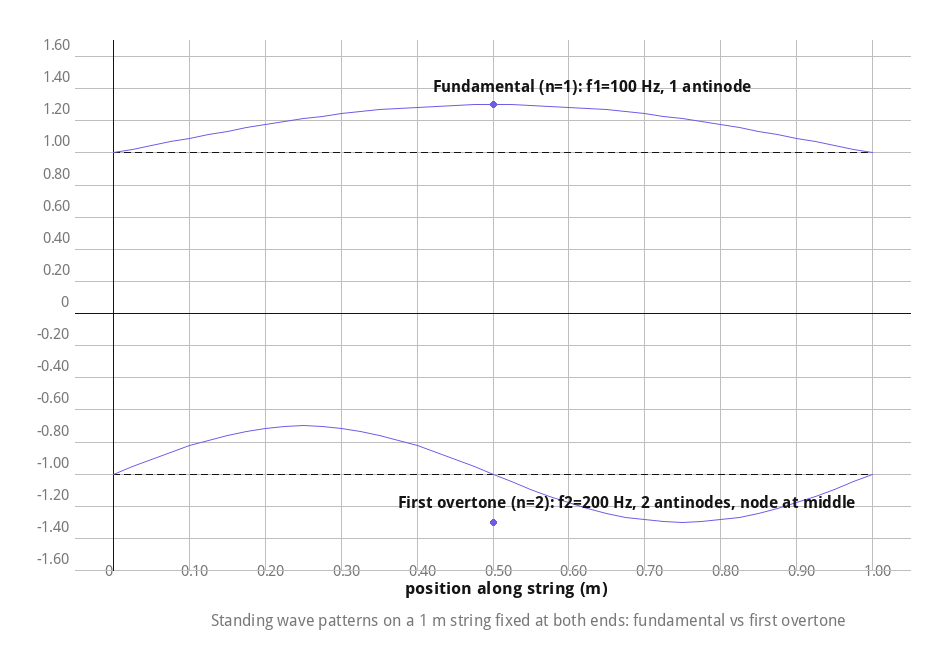
Q9. A string fixed at both ends has length 1 m and the wave speed on it is 200 m/s. Calculate the fundamental frequency and the frequency of the first overtone, explaining the standing wave pattern in each case.
Ans: Fundamental frequency (n=1): f1=v/2L=200/(2×1)=100 Hz. This has one antinode at the centre and nodes only at the two fixed ends. First overtone (n=2): f2=2v/2L=2(100)=200 Hz. This standing wave pattern has an additional node at the midpoint, dividing the string into two equal segments, each vibrating like a smaller fundamental mode, with a total of 3 nodes (two ends + middle) and 2 antinodes.
Q10. Explain, using the principle of superposition, why beats are heard as a periodic rising and falling of loudness when two sound waves of close but different frequencies are played together, rather than as two separate constant tones.
Ans: When two sound waves of close but slightly different frequencies (f1 and f2) overlap at a point in space, the principle of superposition states that the resultant displacement is the sum of the two individual wave displacements at every instant. Because the two frequencies are close but not identical, the two waves periodically go in and out of phase with each other: at times they add constructively (in phase, producing a louder resultant amplitude) and at other times they add destructively (out of phase, producing a much smaller resultant amplitude). This periodic constructive-destructive alternation happens at a rate equal to the difference in the two frequencies, |f1−f2|, which is perceived by the human ear as a periodic rising and falling of loudness (beats), rather than as two separate distinguishable constant tones, because the beat frequency is typically too slow to be perceived as a separate pitch but fast enough to be heard as throbbing loudness variations.
- Chapter 1: Units and Measurements - HOTS & Extra Questions with Answers
- Chapter 2: Motion in a Straight Line – Extra Questions with Answers
- Chapter 3: Motion in a Plane – Extra Questions with Answers
- Chapter 4: Laws of Motion – Extra Questions with Answers
- Chapter 5: Work, Energy and Power – Extra Questions with Answers
- Chapter 6: System of Particles and Rotational Motion – Extra Questions with Answers
- Chapter 7: Gravitation – Extra Questions with Answers
- Chapter 8: Mechanical Properties of Solids – Extra Questions with Answers
- Chapter 9: Mechanical Properties of Fluids – Extra Questions with Answers
- Chapter 10: Thermal Properties of Matter – Extra Questions with Answers
- Chapter 11: Thermodynamics – Extra Questions with Answers
- Chapter 12: Kinetic Theory – Extra Questions with Answers
- Chapter 13: Oscillations – Extra Questions with Answers
Frequently Asked Questions
A wave has a frequency of 500 Hz and travels at 340 m per second, how would you find its wavelength?
Wavelength = speed over frequency = 340 over 500 = 0.68 m.
Two speakers producing sound waves of the same frequency create a loud point, how would you explain this using interference?
This point shows constructive interference, where the waves arrive in phase and their amplitudes add to produce a louder sound.
Chapter Quiz — Test Your Understanding
Class 11 Physics Chapter 14 – Solutions and Notes
For complete step-by-step answers and a quick summary, check the Class 11 Physics Chapter 14 Solutions and Class 11 Physics Chapter 14 Revision Notes.
See also: Chapter 1 | Chapter 2 | Chapter 3 | Chapter 4 | Chapter 5 | Chapter 6 | Chapter 7 | Chapter 8 | Chapter 9 | Chapter 10 | Chapter 11 | Chapter 12 | Chapter 13 | Chapter 14
Practice more: Chapter 1 | Chapter 2 | Chapter 3 | Chapter 4 | Chapter 5 | Chapter 6 | Chapter 7 | Chapter 8 | Chapter 9 | Chapter 10 | Chapter 11 | Chapter 12 | Chapter 13
Quick revision: Chapter 1 | Chapter 2 | Chapter 3 | Chapter 4 | Chapter 5 | Chapter 6 | Chapter 7 | Chapter 8 | Chapter 9 | Chapter 10 | Chapter 11 | Chapter 12 | Chapter 13
Recommended: Buy the Printed NCERT Class 11 Physics Book Set
Contains Amazon affiliate links.
If you’d like a printed copy alongside the PDF, here’s a verified option:
Rs. 280
Price and availability may change on Amazon. As an Amazon Associate, ncertbooks.org earns from qualifying purchases.


